Showing posts with label Flanders. Show all posts

Monday, March 3, 2014

American Cemetery and Memorial


Our last stop today was at Flanders Field American Cemetery and Memorial. Hilbren wanted us to see the pristine care the US government provides for its fallen soldiers compared to the other cemeteries. (Those of us who have visited our military cemeteries around the world are already aware--and proud.) This is the only American WWI cemetery in Belgium and 411 American servicemen are buried or commemorated here. Many of them fell during the Ypres-Lys Campaign by the 91st Infantry Division in the closing days of the war.


Administered by the American Battle Monuments Commission, the cemetery occupies a six-acre site. And as with all Allied war cemeteries, the land was provided in perpetuity by the Belgium government. Masses of graceful trees and shrubbery frame the burial area and screen it from passing traffic. At the end of paths leading to three of the cemetery corners are circular retreats with benches and urns.


Chris, the superintendent of the property for the past four years, led us into the visitors' center and explained that this is the smallest of 24 American cemeteries outside the US. It includes 368 buried and 43 listed as missing soldiers, most of whom gave their lives in liberating the soil of Belgium. Families, he told us, could decide to ship their loved ones home or leave them here.


Before leading the visitor center, he also proudly pointed out the photo of Charles Lindbergh's plane flying over the cemetery on May 30, 1927. Not my best photo...
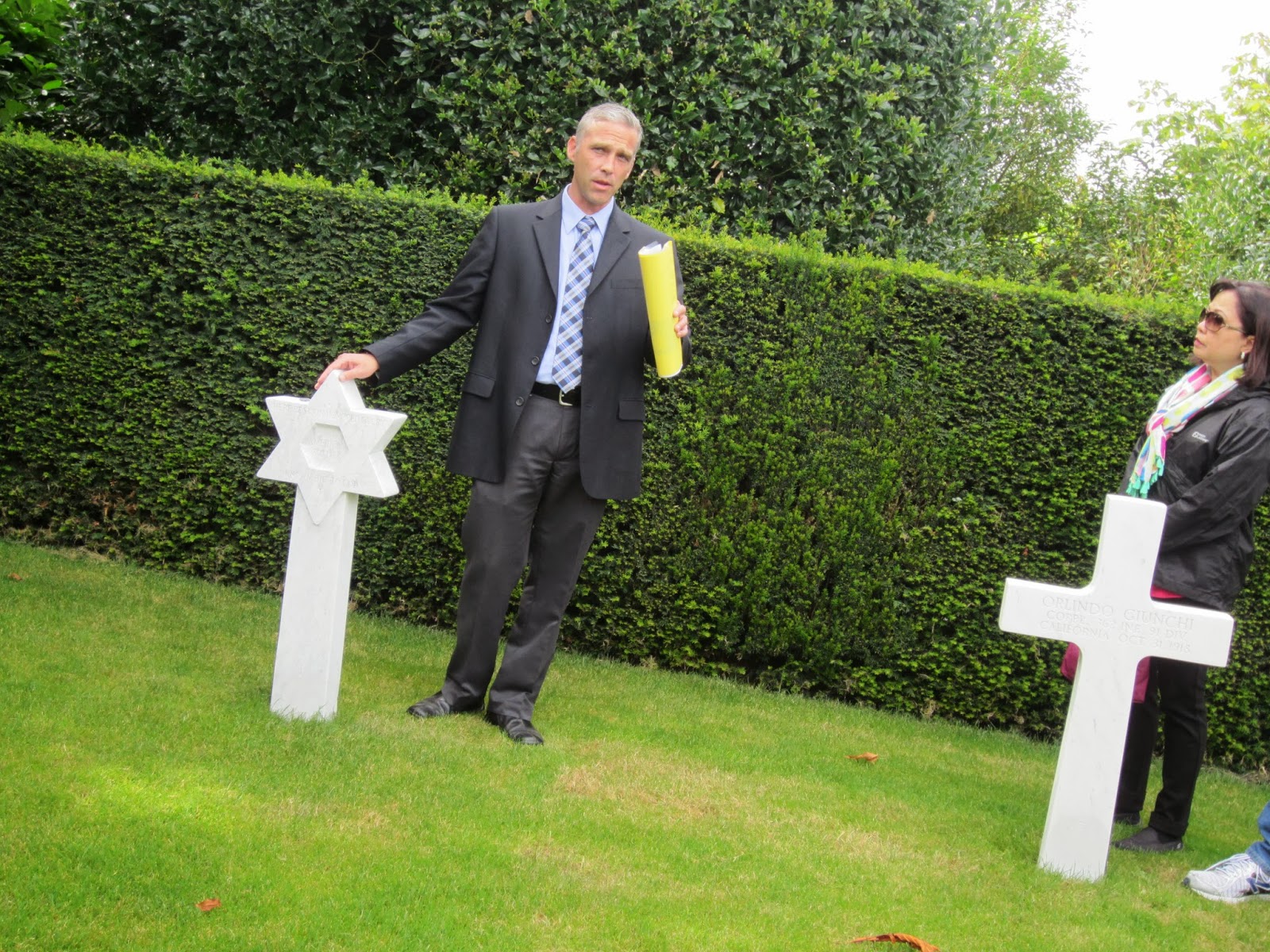

Chris then led us outside to stand among the graves. Showing us two graves next to one another--one with a cross and the other, a Star of David, Chris explained that the two were best friends and the families asked they be buried next to each other. He also told us each gravestone is washed and cleaned every week day.


Headstones throughout the cemetery are aligned in four symmetrical areas around a white stone chapel standing in the center of the cemetery.


The altar inside the chapel is made of black and white Grand Antique marble with draped flags on each side; above it is a crusader's sword outlined in gold. The chapel furniture is made of carved oak, stained black with white veining to harmonize with the altar. The forty-three names of the missing American servicemen are inscribed on the Walls of the Missing; and rosettes mark the names of those since recovered and identified.


It really is a beautiful and peaceful place; and you could tell how proud Chris is to serve his country at this location. After a very busy day, we got back on the bus for the trip back to Bruges.

Hill 62 Near Ypres, Belgium


Our next stop on this busy day was Hill 62 Sanctuary Wood Museum, which houses a collection of objects from the Great War. 


Hill 62 is where the Canadian Corps defended the southern stretches of the Ypres Salient between April and August 1916--the first occasion in which Canadian divisions engaged in offensive operations, denying the Germans a commanding view of the town of Ypres itself. I can't remember if the name "Hill 62" designated the meters the land stood above sea level or possibly the map location (latitude-longitude?). And I can't seem to confirm this.


After the war, a farmer returned to reclaim his land in and around what was left of the woods (called Sanctuary Woods) which he had left in 1914. A section of the original woods was cleared of debris and casualties but the farmer allowed part of a British trench system to remain as he found it.


The property is still in the hands of this family all these years later and now Jacques Schier, the grandson of that farmer, is the owner. The museum has a unique collection of battlefield relics, weapons, uniforms, bombs, and rare three-dimensional photographs, called stereoscopes, many uncensored and untouched inside special viewing boxes.


Walking out of the museum, some German grave markers reclaimed from the battlefields lay along the path. These were removed from their original burial locations after all burials were presumably moved into the formal German cemetery during the battlefield clearance after 1918. Notice the small wooden crosses nailed to the tree in the background, some with the famous red poppies attached.


Walking along the trails, you begin to notice the explosive impressions across the landscape and the preserved section of some British trench lines. When the war was over, the neighbors of Schier's grandfather filled in the trenches on their land, ploughed over the damage, and replanted their former farms. Many wanted to do everything to forget what had happened during the war. But the decision to leave it "as is" has made this family a lot of money.


Hilbren mentioned, with a knowing smile, that one neighbor's descendants have a few cows and another, some crops. And maybe Jacques isn't a happy man but he is a wealthy one (seen in the photo above, leaning over his cash box in his "cage").

Tyne Cot


After a short drive following lunch, we arrived at Tyne Cot, the largest cemetery honoring soldiers of the British Commonwealth. Named for a blockhouse taken by British forces on this site--nicknamed "Tyne Cottage" after the river in North England--it is the final resting place of 11,956 British, Canadian, Australian, New Zealander, South African, and other British Commonwealth soldiers.


The grounds also hold three German pillbox bunkers. And between those are seemingly endless rows of white headstones, marked with the deceased soldier's name and the emblem of his unit (such as the maple leaf of Canada). Many graves are marked simply, "A soldier of the Great War, known unto God." So sad.


In the center of the cemetery, near the tallest cross (marking the location of Tyne Cottage), you see a higgledy-piggledy arrangement of graves. In the beginning, we know the soldiers were buried where they fell.


When this cottage was a makeshift medic station during the war, the area around it became an impromptu burial ground. (In contrast, any cemetery that's neat and symmetrical--like the surrounding headstones--dates from after the war.)


Running along the top of the cemetery is a wall inscribed with the names of 34,857 "officers and men to whom the fortune of war denied the known and honoured burial given to their comrades in death."


The Belgium people still uncover burials from the war--during building construction or when fields are plowed every year. Authorities can usually determine their nationality and therefore, to which cemetery to move them, by the remains of their uniforms and/or their dog tags.

Lunch at the Passchendaele Cheese Factory

After the sober German cemetery and stories of death and war, it was time to eat. We headed to the village of Passchendaele, which was destroyed in early 1917. British soldiers took it because of its location--perched on a modest ridge with a strategic view over the flat lands below. The name literally means "passing the valley;" but the Brits dubbed it "Passiondale"...the valley of suffering. Menin Road connects Ypres to Passchendaele and it was the focus of much warfare.
 

We were not aware of this sad information when we stopped at this old cheese factory for lunch, now a museum in Passchendaele. As we walked from the bus into the museum, we passed a Churn Organ. Huh? The sign explained that those who collect milk can be heard far away because of the rattling and tinkling of the milk churns. So the sign invited anyone who felt like it to pick up a stick and make the churns ring. I don't think anyone did...but Sam was tempted.

 
As we entered, we were faced with a world globe made up of cheese cubes. Very clever.


The tables in the little cafĂ© were pre-set for us--excellent idea for keeping a schedule. Wood cutting boards at each place displayed bread, meat, Passiondale cheese (of course!), sliced tomatoes, cucumbers, shredded carrots, and lettuce. Very efficient and we also got a sweet apple.


Everything was delicious and the open and bright windows made it warm, friendly, and even more enjoyable. There was no time for us to tour the museum because now we were on our way to the Tyne Cot Cemetery.

German Military Cemetery

 
After leaving Essex Farm, the next stop on the Flanders Fields' tour was the German cemetery outside the village of Langemark (originally spelled Langemarck). Very gloomy compared to the others we were to visit this day, we entered through a black structure the size and look of a car wash. Inside, monitors displayed scenes of WWI and German gas attacks, all while playing solemn sounds. 


The stones--lying flat on the ground--were gray and gloomy because the Treaty of Versailles (which ended WWI) forbade the Germans from using white stones. Instead, they are made of basalt and even oak.


A relatively rare site dedicated to the invaders of this region, this is one of only four WWI German cemeteries in the Flanders region. As we learned from Filip, it is expensive to maintain so many Flanders Field cemeteries; and it was the same for the Germans. The origins of this one began with a small group of German graves in 1915. But between 1916 and 1918, the burials at Langemark were increased by order of the German military directorate in Ghent.


In the 1950s, over 9,000 soldiers' remains exhumed from 18 German burial sites around the area were brought here. Eight soldiers, identified and unidentified, were generally buried in each grave plot and their identities marked with a grave number. In 1971 all grave markers which had previously displayed only the number were changed to include personal details for each soldier where possible: a forename, family name, rank, and the date of death.
 

This now is the final resting place of 44,324 (total) Central Power soldiers (along with two Brits who were originally misidentified). In the center is a mass grave--called the Comrades Grave (Kameraden Grabe)--holding the remains of 25,000 soldiers who are unidentified. The names of hundreds of those known to be buried in the mass grave were at that time carved on oak panels in a room on one side of the entrance building. In recent years, research has identified 16,940 of the 25,000 previously "unknown" soldiers. And since 1984, their names have been inscribed on bronze tablets surrounding the common grave.


Filip showed us a photo of Adolf Hitler standing on one of the old bunkers in this cemetery at the beginning of WWII. In the first World War, Hitler had served with the Bavarian Reserve-Infantry and had seen action south of Ypres. He spent two days in 1940 visiting the Ypres Salient battlefields, the town of Ypres, and this cemetery.


This bronze statue of four figures, a particular feature of this cemetery, was created by the Munich sculptor Professor Emil Krieger. Slightly larger than life, they immediately capture the eye, standing solemnly watching over so many thousands of German casualties of war. Krieger's inspiration was a 1918 photograph of soldiers from the Reserve-Infantry-Regiment 238 as they mourned at the grave of a comrade. It became a well-known photograph in the German press that year, made more solemn because one of the soldiers in the photo was killed two days after it was taken.
 
During renovation in the late 1950s, several groups of three basalt-lava crosses were placed in the grounds as an architectural feature only. One was also erected on one of the three original battlefield bunkers left on the site.


Oak trees, the national tree of Germany, were planted during renovation in the mid-1920s and have grown very tall over the past 90+ years. The ground, in fact, was covered in acorns this day. Although this cemetery is the same land size as Essex Farm, there are so many more buried here (44,000) compared to those at Essex (1,200). Officially inaugurated on July 10, 1932, the German War Commission maintains the cemetery by hiring local gardeners. Filip shared, when asked, that he gets very few German citizens on his tours of Flanders Fields.

Essex Farm and John McCrae's Poem, "In Flanders Fields"


Our first stop on the Flanders Fields' tour was a British cemetery called Essex Farm, where I noticed from the bus a sign planted at the outside boundary. Who is John McCrae? I wondered, even though I soon discovered that I had already heard about his famous poem.


Essex Farm received its name from a small cottage which stood nearby. We stepped into the bunkers which comprised dressing stations used from April 1915 to August 1917. Soldiers were brought here for treatment and if they died, Essex Farm was their final resting place. Burials and commemorations of the over 1,200 servicemen honored here--103 are unidentified--were made without a definite plan.


Physician and Army Medical Corps Lieutenant Colonel John McCrae volunteered, at age 41, for his second tour of duty in the Canadian military to join a fighting unit as a gunner and medical officer. Son of a military leader, he was raised to believe in duty to his country and fought in the second battle of Ypres where the Germans launched one of the first chemical attacks (chlorine gas) in the history of war.

Fortunately, the Germans were unable to break though the Canadian line, which held for over two weeks. McCrae described the battle in a letter to his mother as a "nightmare." Alexis Helmer, a close friend, was killed during it and McCrae performed the burial service in 1915, which inspired him to write his poem.
 

McCrae noticed at the burial how poppies quickly grew around the graves of those who died. The next day, he composed the poem while sitting in the back of an ambulance at this site. As with his earlier poems, "In Flanders Fields" continued his preoccupation with death, the struggle of life, and the peace that follows. It was written from the point of view of the deceased, speaking of their sacrifice and commanding the living to press on.

Legend has it that fellow soldiers retrieved the poem after McCrae, initially unsatisfied with his work, discarded it. He was finally convinced to submit it for publication, which happened on December 8, 1915 in a London-based magazine called "Punch."


As one of the most popular and quoted poems from the war, parts were used in propaganda efforts and appeals to recruit soldiers and to raise money selling war bonds. The poem was written early in the conflict, before the romanticism of war turned to bitterness and disillusion for soldiers and civilians alike.


Its references to red poppies resulted in one of the world's most recognized memorial symbols for all soldiers who have died in combat. Interestingly, poppies have been associated with war since the Napoleonic Wars when a writer then also noted how poppies grew over the graves of soldiers. The damage done to the Flanders' landscape during the fighting in Belgium greatly increased the lime content in the soil, leaving the poppy as one of the few plants able to grow in the region.


It was an American professor, Moina Michael, who resolved at the war's conclusion in 1918 to wear a red poppy year-round to honor the soldiers lost in war. Her poem, "We Shall Keep the Faith," was a response to McCrae's and she distributed silk poppies to her peers in a campaign to have it adopted as the American Legion's official symbol of remembrance. This tribute was soon adopted by the French, the British Empire, Canada, South Africa, Austria, and New Zealand.

Written as a rondeau, a form of French poetry, it is one of the verse forms in France most commonly set to music between the late 13th and 15th centuries. Here is the first chapter:

In Flanders fields the poppies blow
     Between the crosses, row on row.
   That mark our place; and in the sky
   The larks, still bravely singing, fly
Scarce heard amid the guns below.
          
We are the Dead. Short days ago
We lived, felt dawn, saw sunset glow.
   Loved and were loved, and now we lie
     In Flanders fields.

Take up our quarrel with the foe:
To you from failing hands we throw
   The torch; be yours to hold it high.
   If ye break faith with us who die
We shall not sleep, though poppies grow
     In Flanders fields.

          By John McCrae

After the war, McCrae was stationed in Boulogne, France, where he was promoted and placed in charge of medicine at the Canadian General Hospital. Promoted to Colonel in 1918 and named Consulting Physician to the British Armies in France, he contacted pneumonia which led to cerebral meningitis. He died in December 1918 at the military hospital in Wimereux, France and was buried there with full military honors.

NOTE: The grave of McCrae's friend, Lt. Alexis Helmer, was lost in subsequent fighting and is today marked among the names of the missing on the Menin Gate in Ypres.

Flanders Field Cemeteries and the Ypres Salient


We visited Flanders Field on a Sunday (I had forgotten what day it was) when we rode pass cemetery after cemetery. Over the years, our Rick Steves' tours have forced us into learning about Europe's involvement in the world wars. "Force" is too strong a word but frankly, I would not have studied this topic if it hadn't been for my travels on his tours.

Today was another chance for me to expand my horizons; I was a World War I virgin before this side trip. Because American forces played a relatively minor role in the fighting here, its history is obscure to many US visitors. So I don't think I was the only one. And it finally dawned on me--at age 63 (I'm not too old to learn)--that WWI was called the "Great War" because they didn't think, after the horror that it was, there would be another war of this magnitude! Duh.


We met the bus in front of the hotel at 8:30 AM and we wouldn't return to Bruges until late in the afternoon. We drove to Ypres, where we met out local guide, Filip, at the Menin Gate, an archway in the Roman tradition begun in 1921. The monument to the Allied effort marks the Menin Road, where many Brits, Canadians, Aussies, and Kiwis left this town for the grueling battlefields and trenches, never to return.

The gate was designed by Sir Reginald Blomfield and is made of French limestone. It is 135 feet in length, 140 feet wide, and 80 feet high, dominating Ypres along with the rebuilt Cloth Hall.


The gate was officially unveiled on July 24, 1927 in the presence of the King and several thousand relatives whose names of their loved ones--nearly 54,900 of the missing--were inscribed around the memorial. Like at Paris's Arc de Triomphe, local police stop traffic every evening while the Last Post is played by buglers from the local fire station. It is often attended by large crowds. This has been happening nightly since the 1920s except for the duration of German occupation during World War II. Amazing.


Ypres was so devastated by the end of the war that Winston Churchill advocated keeping it in ruins as a monument to the travesty of warfare. But locals did rebuild, resurrecting its charming main market (Grote Markt), watched over by the grand and impressive Cloth Hall. So although the buildings look ancient, they are only about 90 years old. "They rebuilt everything as it was before the war, even the buildings they didn't like," according to Hilbren.

After a short break to walk around the Markt, Filip began explaining the WWI battlefields known as Flanders Fields. It was here, in the second decade of the 20th century, that the world saw the invention of modern warfare: machine guns, trenches, and poisonous gas. The most intense fighting occurred in the area called the Ypres Salient, a nondescript but hilly--and therefore terrifically strategic--bulge of land east of the medieval trading town of Ypres (which the Flemish call "Ieper").


Of the estimated nine million people claimed by WWI, about a million of them were killed, wounded, or declared missing in action here in the Ypres Salient. Because there were five "Battles of Ypres" and soldiers were buried where they fell, there were nearly 1,000 cemeteries by the end of the war. Because this amount was unmanageable after the war, graves were relocated and centralized so that today, the number is down to approximately 150 war cemeteries in Ypres. And Filip says it would take over a week to visit them all. We would only visit four today.