Showing posts with label Museum. Show all posts
Friday, March 7, 2014
The Outdoor Gardens of the Rijksmuseum
As we left the museum, our paths took us through the relaxing Rijksmuseum garden, also restored with an eye to Cuypers' original vision. It features statues, fountains, ponds, and five centuries of Dutch architectural artifacts.
Sam hopped into the middle of this fountain--and escaped without a drop.
Sculptures by Henry Moore (1898-1986), one of the most influential artists of the 20th century, are featured in the gardens. His monumental figures seem abstract, yet are clearly inspired by natural forms. On Moore's walks across the rolling English countryside, he would often collect animal bones which he sometimes literally transformed into sculptures.
A key theme in Moore's oeuvre is the reclining figure, in which the human body acquires a landscape-like quality. He tried to express--in stone or bronze--the energy he felt in nature: "I would like to think my sculpture has a vitality from inside it."
For example, his "Reclining Woman: Elbow" (above) was placed at the main entrance of the Leeds (England) City Art Gallery in 1982. Detractors complained: "Puzzling, suggestive, ridiculous, and diabolical," the Yorkshire Post commented. But that changed. When the sculpture was removed to be shown at the Rijksmuseum, the newspaper wrote, "You'll miss her when she's gone."
The sensual curves of the "Two Piece Reclining Figure: Cut" are interrupted by the incision in the center. Yet this also creates space, like the eye at the top (not visible in this photo), through which the sky appears. These hollows are typical of Moore's exploration of the sculpture's connection with its environment.
Henry Moore isn't the only sculptor featured in these gardens. "Mercury and Psyche" is a copy of a famous work by Adriaen de Vries now in the Louvre. De Vries worked at Giambologna's studio in Italy and for Emperor Rudolf II in Prague. As a result, he enjoyed considerable fame abroad, while remaining relatively obscure in the Netherlands. This copy was commissioned in 1890 for the Rijksmuseum garden.
I was also fascinated with this beautiful "street art" displayed in a shallow pond stretching out in front of the museum. We wandered around the neighborhood after leaving the museum, looking for a pastry shop my friend asked me to locate. We gave up after about 30 minutes and ended up at a souvenir shop where we bought some t-shirts. Then it was time for some lunch.
Labels:
Amsterdam,
Art,
Artist,
Museum,
Sightseeing,
Street Scenes
Rembrandt's "Night Watch "
This is one of the most famous and well-known paintings hanging in the Rijksmuseum and deserves a separate post. As usual, the more you learn about a painting, the more interesting it becomes. Rembrandt's masterpiece, the "Night Watch," his most famous--though not necessarily greatest--is a group portrait of a company of Amsterdam's militiamen, the city's civic guard. Rembrandt made the painting in 1642 at the age of 36 for their guild headquarters, the Kloveniersdoelen. It hung in the large assembly room, together with six other group portraits.
Standing in the foreground are Captain Frans Banninck Cocq (in black with a red sash) giving an order and Lieutenant Willem van Ruytenburch, focusing on the captain's every word. That Rembrandt depicted the militiamen in action is quite exceptional; until then, "sitters" in such group portraits were either standing or sitting stiffly next to one another.
The painting is full of action: flags waving, drums beating, the guardsmen (who, by the 1640s, were really only an honorary militia of rich bigwigs) spilling onto the street from under an arch in the back. It's "all for one and one for all" as the soldiers grab lances, load their muskets, and rush to Amsterdam's rescue.
The painting was a smashing success in its day. However, there are elements in it that show why Rembrandt soon fell out of favor as a portrait painter. He seemed to spend as much time painting the dwarf and the mysterious glowing girl with a chicken as he did the faces of his employers.
But Rembrandt caught the optimistic spirit of Holland in the 1600s. Its war of independence from Spain was heading to victory and the economy was booming. These guardsmen on the move epitomize the proud, independent, upwardly mobile Dutch. Compared with other, less famous group portraits, where every face is visible, well-lit, flat, and flashbulb-perfect, these people paid good money to have their faces preserved for posterity, and they wanted to be right up front. Other group portraits may be colorful, dignified works by a master...but not quite masterpieces. Rembrandt rousted the Civic Guards off their fat duffs. And by adding movement and depth to an otherwise static scene, he took posers and turned them into warriors--a simple portrait became great art.
Some other "Night Watch" scuttlebutt. First, "Night Watch" is a misnomer since it's a daytime scene. But over the years, as the preserving varnish darkened and layers of dirt built up, the sun set on this painting and it got its popular title. When the painting was moved in 1715 from the large hall of the Kloveniersdoelen to a smaller room in Amsterdam's town hall, three sides were lopped off so it would fit in between two doors in its new location! This resulted in putting the two main characters in the center and causing the work to become more static than intended. (Unfortunately, the pieces were lost.)
During WWII, when the Nazis where "shopping" for art throughout Europe, the painting was rolled up and hidden for five years. In 1975, a madman attacked it, slicing the captain's legs; and in 1990, it was sprayed with acid (skillfully restored after both incidents). Such a dramatic history.
Rembrandt's life darkened long before his "Night Watch" did. This work marked the peak of his popularity...and the beginning of his fall from grace. Free from the dictates of employers, he painted what he wanted and how he wanted. Rembrandt went beyond mere craftsmanship to probe into, and draw life from, the deepest wells of the human soul.
On our way out of the museum, a person is usually forced into the gift shop. This was a fun construction game for children based on the famous painting. But we didn't indulge in any retail therapy here today.
By the way, "Night Watch" is now back in its original position in this beautiful gallery at the center of the museum, exactly where architect Cuypers had originally placed it in 1885. And it is always surrounded by mobs of people.
Labels:
Amsterdam,
Artist,
Museum,
Sightseeing,
Tour Group
Visiting the Rijksmuseum
The 17th century saw the Netherlands at the pinnacle of its power when they won their independence from Spain. Trade and shipping boomed; wealth poured in; the Dutch people were understandably proud; and the arts flourished. This became their Golden Age. And after so much sober religious art from the Middle Ages, artists discovered upper-middle-class businessmen in the Protestant republic who fueled Holland's capitalist economy and thus, commissioned big canvases to flaunt their prosperity. In the 17th century alone, five million paintings were hanging in those peoples' homes. Eventually, the best of these needed a place to be displayed.
This morning found our group marching to a guided tour of the Rijksmuseum (which means, the "State Museum"). Thanks to a ten-year, 374 million euros renovation, it once again matches the vision of its 19th century architect, Pierre Cuypers. Built in 1885 to house the Netherland's greatest art, a series of brutal 20th century renovations chopped up and painted over a great amount of the massive complex. But today, much of Cuypers' original Gothic-revival design is back: natural light floods large rooms with high ceilings and long viewing galleries surround two massive courtyards, walled up for half a century.
The Rijksmuseum has up to 8,000 works on display (from the 13th through the 20th centuries), including several thousand paintings. The incomparable collection of 17th century Dutch Masters includes those by Rembrandt, Vermeer, Hals, and Steen. Now, around the museum, many pieces are displayed together in their cultural context, making the exhibits a lively mix of Delftware, photographs, decorative objects, paintings, etc. The renovation has restored this great building to its original 1885 glory. And it's beautiful inside.
After an informative tour by a docent (we were divided into two groups), we were released to continue exploring on our own. It's a huge place and there were lots of things we wanted to see.
Of course, Sam and I were "forced" to try some fancy drinks and sweets in the fancy café before we continued our treasure hunt. It seems like we're now doing "morning cake and coffee!" Delicious!
Climbing up to the second floor on a staircase which hasn't been replaced since 1885, we entered the Great Hall. With its stained-glass windows, vaulted ceiling, and gilt moldings, this looks like the inside of many cathedrals we've seen on our travels. And it is--a cathedral to Dutch art and history. For more than 50 years, this space was painted over and used as a lobby and gift shop. For the recent restoration, it was returned back to Cuypers' design. The late-Victorian murals on the walls are original, restored after a long absence--the murals were deemed chauvinistic and taken down in the 1920s. They celebrate great moments in Dutch history--lots of explorers and warrior kings.
Who doesn't recognize Frans Hals' (1581-1666) the "Merry Drinker," which he painted in 1627? This jovial man in a black hat captures the earthy, exuberant spirit of the Dutch Golden Age. The militiaman merrily raises his glass of Berkemeyer to toast us. Hals' bravura painting style--the spontaneously applied brushstrokes enhancing the portrait's sense of liveliness and animation--ensured the continued success of the artist. We were now headed, along with many other museum visitors, to see the famous Vermeer section.
The master of tranquility and stillness, most of Vermeer's canvases show interiors of Dutch homes where women are engaged in everyday activities, lit by a side window. The Rijksmuseum has the best collection of Vermeers in the world--four of them. (There are only 34 in captivity, including "The Music Lesson" owned by Her Majesty Queen Elizabeth II.)
In one of my favorites, "The Milkmaid" (1658), a maidservant, entirely absorbed in her work, pours milk into a bowl. Except for the stream of milk, which you can almost hear, everything else is still. The sign next to the painting explains, "Vermeer took this simple everyday activity and made it the subject of an impressive painting--the woman stands like a statue in the brightly lit room. Vermeer also had an eye for how light by means of hundreds of colorful dots play over the surface of objects."
We saw much, much more, like Rembrandt's "Isaac and Rebecca: (a.k.a. "The Jewish Bride", 1667), but our minds were saturated and it was time to move on.
Labels:
Amsterdam,
Eating,
Museum,
Sightseeing,
Tour Group
Thursday, March 6, 2014
Vincent van Gogh, the Man
"I am a man of passions," said Vincent van Gogh (1853-1890).
When I read Van Gogh's letters to his brother Theo, I was surprised to learn they were sons of a pastor and, in fact, Vincent toyed with becoming a minister. Although his first job at age 16 was clerking for an art dealership, his two interests--art and religion--distracted him from his dreary work and he was eventually fired.
The next ten years were a collage of dead ends as Vincent bounced around northern Europe (England, France, Belgium, and the Netherlands), pursuing one path after another. In his letters to Theo and their parents, he writes of launching into each project with incredible energy, then becoming disillusioned and moving on to something else: teacher at a boarding school, assistant preacher, bookstore apprentice, preacher again, theology student, English student, literature student, art student. He fell in love but was rejected; he quarreled with his family and was estranged; he lived with a prostitute and her daughter, offending the few friends he had. Finally, in his late 20s, worn out, flat broke, and in poor health, Vincent returned to his family and made peace. That's when he started to paint.
The self-portrait by the artist (top) was painted in 1888 while he was living in Paris with Theo (March 1886 - February 1888). The budding young artist proudly displayed his new palette full of bright new colors. He was trying his hand at Impressionism techniques--building a scene using dabs of different-colored paint. A whole new world of art--and life--had opened up to him in Paris.
While there, along other Impressionist painters, Vincent learned the shimmering effect which comes from placing dabs of different colors side by side on the canvas. At a distance, the two colors blend in the eye of the viewer to become a third color. In the "Self-Portrait with Straw Hat" above (1887), Vincent used separate strokes of blue, yellow, green, and red to create a brown beard--a beard which seems to throb with excitement.
"You wouldn't recognize Vincent, he has changed so much... The doctor says that he is now perfectly fit again. He is making tremendous strides with his work... He is also far livelier than he used to be and is popular with people." - Theo van Gogh to their mother
Van Gogh's use of color is world-famous. Many of his theories can be traced back to that of complimentary colors. In "Irises," yellow and purple--colors that reinforce each other, according to the theory--thus maximize their effect. The purple (a mixture of red and blue) is now mainly blue, since the red pigment has faded.
Despite his new sociability, as referenced by Theo, Vincent never quite fit in with his Impressionist friends. As he developed into a good painter, he became anxious to strike out on his own. Also, he thought the social life of the big city was distracting him from serious work. Wanting peace and quiet, a place where he could throw himself completely into his work, he headed for the sunny south of France.
"The worse I get along with people, the more I learn to have faith in Nature and concentrate on her."
He saw sunflowers as his signature subject and he painted a half-dozen versions of them, each a study of intense yellow. Even a simple work like the one above, painted in 1889, bursts with life. But during his time in Provence, he swung from flurries of ecstatic activity to bouts of great loneliness. And after his friend, fellow artist Paul Gauguin, arrived, things went sour very fast. This began his spiral into "acute mania with hallucinations," as diagnosed by an Arles' doctor. (By the way, in January 2014, the painting above was displayed at London's National Gallery next to the sunflowers he painted in 1888--the first time in six decades they have been hung side by side.)
Vincent spent some time--productive time, actually--in a St. Remy mental hospital, still painting as his health seemed to improve: pictures of his hospital room, the gardens of the asylum, and landscapes (when he was allowed outside) like "The Garden of Saint Paul's Hospital" painted in 1889 (or, as it's also known, "The fall of the leaves"). The stark brown trees are blown by the wind, and a solitary figure (Vincent?) makes his way along a narrow winding path as the wind rains leaves down on him. The colors are surreal--blue, green, and red tree trunks with heavy black outlines. A road runs away from us, heading nowhere.
How much of these paintings reflect Vincent's spiral into total depression and finally putting a bullet through his chest? Although his life was sad and tragic, the record he left us is one of beauty. And I'm beginning to appreciate that beauty more and more.
Believe it or not, Vincent sold only one of his canvases during his lifetime--to a woman in Brussels. In 1987, one of his "Sunflowers" sold for $40 million and three years later, a portrait of his doctor for more than $80 million. Sadly, this "famous after the fact" was not uncommon for some of Europe's most renown artists.
The Van Gogh Museum
In 2000, on Sam's first trip to Amsterdam, neither one of us had any interest in Vincent van Gogh. Not only that, we only had about 45 minutes to visit the museum that day and chose, instead, to enjoy the sunshine and vast green space between the Rijksmuseum and Van Gogh's.
But tastes change--or mature. We are now more interested in Vincent--I've been studying and reading about him for the past several years--and we were both looking forward to discovering and exploring the place. So we used our free Thursday afternoon to visit his remarkable museum, which features works by the troubled Dutch artist--works of art which seem to mirror his life.
Vincent, who killed himself in 1890 at age 37, is best known for sunny, Impressionist canvases that vibrate and pulse with vitality. The museum's 200 paintings--which offer a virtual stroll through his work and life--were owned by Theo, Vincent's younger, art-dealer brother. Paintings were divided into five periods of his life--the Netherlands, Paris, Arles, St. Remy, and Auvers-sur-Oise.
The mix of his creative genius and his tumultuous life makes the museum as much a walk with Vincent as with his art. In fact, the paintings, arranged chronologically, leave a series of suicide notes and begin with some dark, gray canvases showing the hard, plain existence of the Dutch people--simple buildings, barren trees, and overcast skies--a world where it seems spring will never arrive.
"The Potato Eaters," painted in 1885, reflects a dark, cramped room lit only by a dim light and poor workers helping themselves to a steaming plate of potatoes. Van Gogh gave their heads "something like the color of a really dusty potato, unpeeled, of course." In line with the theory he was studying at the time, he obtained all his colors by mixing the primary colors red, yellow, and blue. The artist produced a large number of preparatory studies in the cottage of the peasant family that we see eating their meal here, but he made the final painting in his studio.
We really liked the displays and the very interactive audioguide. In fact, it was a SmartPhone-like device and while standing in front of a painting, we'd sometimes receive an email from Vincent. And if I could figure out how to open it....it was intriguing to read the information he provided about a painting or technique. Like the email about the "Courtesan" he painted in 1887.
In Van Gogh's day, many artists were keen collectors of Japanese prints, which presented them with a fresh way of looking at composition, the use of color, and perspective. In fact, Vincent and Theo built up a collection of their own Japanese prints. The "Courtesan" painting was based on a cover illustration for a magazine on Japanese art, using other models for the surrounding landscape which also displayed water plants, a frog, and a crane.
"The Bedroom" was painted in 1888--his actual bedroom in his "yellow house" in Arles--and this was the first version. The second version is in Chicago's Art Institute and the third, in Paris's Musee d'Orsay.
I really liked the openness of the museum, the bright wall colors--the same colors Vincent used--how the paintings were displayed, the general feel of the museum. I think Sam enjoyed it, as well.
Labels:
Amsterdam,
Art,
Artist,
Museum,
Sightseeing
Wednesday, March 5, 2014
Prophetic Entry in Anne Frank's Diary
Anne received her first diary--the one with the red-plaid binding--as a birthday present when she turned 13, shortly before the family went into hiding. Her diary entries were written in the form of a letter to an imaginary friend named Kitty. When she ran out of pages in the original diary, she continued journaling her thoughts in two school exercise books.
Anne had expressed an interest in becoming a writer before entering the annex. And while in hiding, sadly, she had recognized the uniqueness of her situation. So prior to her arrest, she had been in the process of revising her diaries and preparing them to be published.
One of Otto Frank's workers, Miep Gies (who passed away in 2010 at the age of 100), found Anne's diaries in the Secret Annex following the arrest. She scooped them up, along with Anne's short stories, her favorite quotes, and some loose-leaf pages on which Anne had rewritten and revised parts of her dairy. When Mr. Frank returned to Amsterdam following the war, Miep gave the diaries to him, which he arranged to be published in 1947. This was followed by many translations, a play, and a movie.
I really paused when I read the following passage in her diary (the 70th Anniversary Edition). It was haunting.
Wednesday, 5, April 1944 ("Anne Frank, The Diary of a Young Girl," page 250)
"...I'm overjoyed that at least I can write. And if I don't have the talent to write books or newspaper articles, I can always write for myself. But I want to achieve more than that. I need to have something besides a husband and children to devote myself to! I don't want to have lived in vain like most people. I want to be useful or bring enjoyment to all people, even those I've never met. I want to go on living even after my death! And that's why I'm so grateful to God for having given me this gift, which I can use to develop myself and to express all that's inside me!" Yours, Anne M. Frank
Sunday, March 2, 2014
More Art in Saint John's Hospital and the Memling Museum
The Memling Museum is located in the former wards and church of Saint John's Hospital. And a few more pieces of religious art displayed here are worth mentioning, especially because our local tour guide, Daniella, was so impassioned and eager to share details about them.
One was the gilded oak shrine built especially for the mortal remains of Saint Ursula and decorated with paintings by Memling. It was brought to the church in 1489. Ursula, yet another Christian martyred by the ancient Romans, became a sensation in the Middle Ages when builders in Cologne, Germany unearthed a huge pile of bones believed to belong to her and her 11,000 slaughtered cohorts.
The shrine, carved of wood and covered with gold, looks like a miniature Gothic church (similar to the hospital's church). Memling was asked to fill in the little reproduction's stained-glass windows with six arch-shaped paintings describing Ursula's well-known legend. Daniella circled us around the shrine while explaining the story. Most people couldn't read in the Middle Ages, of course, so they received their lessons from paintings and drawings.
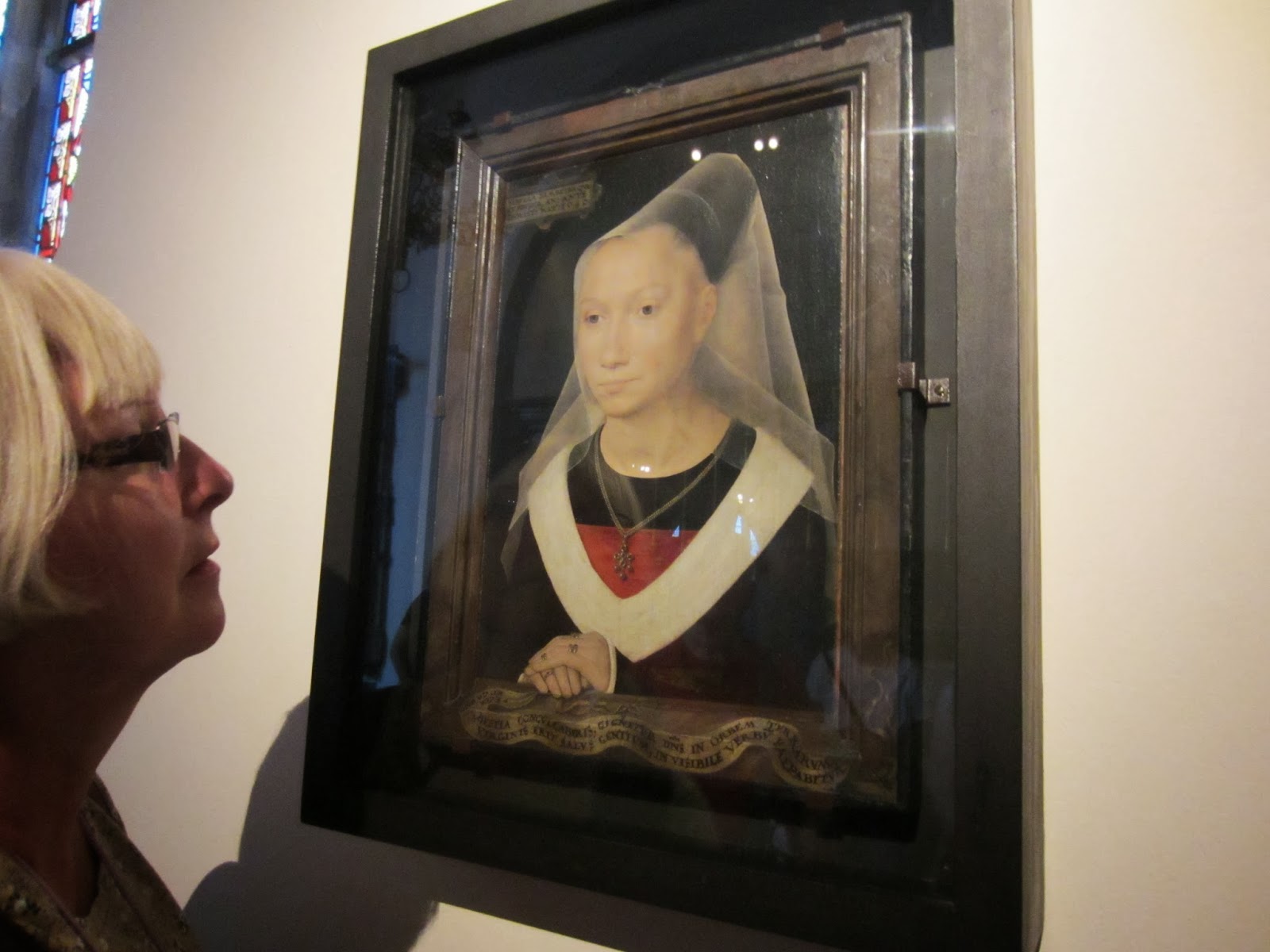
The other piece of art that Daniella was passionate about was Memling's "Portrait of a Young Woman" painted in 1480. Memling's bread-and-butter at the time were portraits created for families of wealthy merchants, especially those visiting from Italy and Portugal, and this is the only portrait of an individual woman by the artist to have survived. The young woman looks out of the frame as if she were looking out a window, with her hands resting on the sill and fingertips sticking over--in a trompe-l'oeil technique, a process frequently applied by Memling.
Her simple-looking clothes were actually high-class in their day and the dark damask dress is brightened by a red sash and detachable white collar. The transparent veil does not hide her hairline, which is shaved, nor her plucked brows which were done to get that clean, high-forehead look--very popular at the time and signifying her family's wealth. This is also apparent from the jewelry she wears--a gem-encrusted pendant cross and no fewer than seven gold rings.
So, who is she? The sign next to the painting identifies her as Sibylla (or Sibyl) of Sambetha on account of a scrolled inscription on the frame; but the sitter is unknown. She remains a mystery, her face unreadable and vacant. Rick Steves believes she's thinking, "It's time for a waffle." And Sam and I, in fact, did get a fancy waffle later that day at our favorite café in Jan Van Eyck Plein.
Labels:
Artist,
Bruges,
Museum,
Sightseeing,
Tour Group
Saint John's Hospital and the Memling Museum
Saint John's Hospital, which has existed since 1188, remains one of Europe's oldest surviving hospital buildings. Some 500 years ago, Bruges was a major destination for pilgrims, both healthy and frail, who trekked here to see the relic of Christ's blood at the Church of the Holy Blood. Saint John's was built to take care of any pilgrims who required it, except those with the plague or leprosy or who were mentally ill. Sadly, the average age of death in those days was only 40.
As one of the scenes shown in this painting, "De Oude Ziekenzalen" (1778) by Jan Beerblock, Daniella pointed out how the hall was lined with beds filled with the sick and dying. Nuns served as nurses; women cooked vegetables because meat was too expensive; a sedan chair (hand-held ambulance taxi) in the painting awaits a patient; dogs were welcomed; floors needed mopping; and clergymen dropped in to visit patients.
The building is now owned by the city and displays furniture from the original hospital, old medical instruments, and medical writings as well as religious art. A chapel was situated so those in the hospital beds could see the famous Saint John Altarpiece by Memling ("The Mystical Marriage of St. Catherine," 1474). Patients could pray for recovery or a speedy death. In many ways, Saint John's was less a hospital than a hospice, helping the dying make the transition from this world to the next.
The hospital still houses the altarpiece and Daniella very excitedly explained its many details. The colorful three-part work was dedicated to the hospital's patron saints, John the Baptist and John the Evangelist, but Memling broadened the focus to take in a vision of Heaven and the end of the world. St. Catherine of Alexandria, born rich, smart, and pagan to Roman parents, joined the outlawed Christian faith and is shown in the central panel receiving a ring from Jesus to seal the "mystical marriage" between them. Unfortunately, Catherine still came to a brutal death because she refused to marry her emperor, Maxentius.
Labels:
Artist,
Bruges,
Museum,
Sightseeing,
Tour Group
Saturday, March 1, 2014
First Lunch in Brussels and the City Museum
After checking into our hotel around noon, we walked back to the Grand Place to find a café in Agora Place for a hearty meal. We were obviously hungry--because the bill was 41 euros. But neither of us took a photo or remember what we ate! It was fun to sit outside though, relax, and enjoy interesting street scenes and people-watching.
After lunch, we returned to the Grand Place to visit the City Museum. I especially wanted to see the room full of costumes sent to and worn by the world-famous statue, Manneken-Pis (separate post).
Other floors in the museum contained tapestries and paintings; stained glass; maps and models of 13th through 17th century Brussels; sculptures, finely-carved altarpieces, and porcelain.
This small altarpiece from the 15th century--labeled as "Life of the Virgin Mary and Baby Jesus"--was used in a private home for family devotions. Amazing detail and coloring in this intricately sculpted and painted wooden three-dimensional work.
The bombardment of Brussels by the French, as depicted in this massive and realistic painting, occurred in 1695. The fires that followed were fanned by the wind and subsequently destroyed nearly 4,000 buildings in the city.
Since it was so beautiful outside and temperatures were mild, we didn't want to spend too much time inside. So we pulled out the Rick Steves' book and made our way to the Upper Town. We would see much of this on the following day with our group but we wanted to keep moving. Even though we were wearing down from jet lag, it was only mid-afternoon and too early to throw in the towel!
Labels:
Art,
Brussels,
Eating,
Museum,
Sightseeing,
Street Scenes
Subscribe to:
Posts (Atom)