Showing posts with label Street Scenes. Show all posts

Friday, March 7, 2014

Max Euweplein and Tiny Souvenirs


Rick Steves' tours always end with a group dinner, our final gathering. And I think this was the first time on this trip where we had to walk in a little downpour on our way to the restaurant. We've been lucky with the weather; in fact, I know I was dressed too warmly on some days.


This scene caught our attention as we scurried by. In a pleasant interior courtyard surrounded by cafés and the ever-popular Hard Rock, this large chessboard with knee-high kings gets a lot of attention. The square is named after Max Euwe, a Dutch world chess champion. He is known for beating 14-year-old Bobby Fischer in 1957 with 20 moves.


We quickly took shelter under a row of tall, grey, Greek-style columns next to the square. Had we not had our heads tucked into our collars to avoid rain in our faces, we might've seen the Latin inscription above the colonnade--"Homo Sapiens non urinat in ventum." It supposedly translates to "People, don't pee into the wind." Good advice.


This is where we paused for Hilbren to give a little speech and hand out a little souvenir. I will add these tiny porcelain blue and white Dutch shoes to my miniature reminders of past Rick Steves' tours.

Our Traditional Old Friend, Plus Dam Square


Sam and I have a tradition of eating at McDonald's in all the European cities we visit. I mentioned to her when we arrived in Amsterdam (our last stop) that we hadn't done it yet on this trip... And yesterday, while walking with the group down the pedestrian street, Kalverstraat, guess what we spied?


So this afternoon, we found our way back to maintain our tradition. Some travelers consider it sacrilege to stop at a Burger King, a Starbucks, a McDonalds when out of the country. But we've stopped hiding from this; sometimes, you just need a "taste of home." (Yes, sir, we've seen a lot of museums in eleven days! I love this shirt!)

On the way back to the hotel, we walked again through Dam Square, which is the historic heart of the city. Amsterdam got its start here around 1250, when fishermen in this marshy delta settled along the built-up banks of the Amstel River. They built a "damme" to bloc the Amstel River and created a small village called "Amstel-damme." Get it?


My memories of Dam Square are from my very first trip to Europe in 1989. The square seemed bigger then (isn't that always the way?) and was busy, busy, busy with drunks, bums, and street entertainers, like this accordion player entering his "venue" today to join the mimes, jugglers, and human statues who still mingle with locals and tourists. I even remember from my first trip a person swinging on a trapeze which reached into the air! And all this was happening during the day--you can imagine what "events" were held in the evenings. But Amsterdam has been cleaned up over the decades and is not as seedy as my first impressions attest. And yet I have very fond memories of that trip.


The Bulldog Café Coffeeshop, towards where the accordion player is headed, is not the most famous or original Bulldog, which is in the Red Light District facing a canal. The chain claims to be the city's very first marijuana coffeeshop established here in 1975. It is a famous and well-known destination for all young American visitors--touristy like a Hard Rock Café. True connoisseurs (and Rick Steves' tour members), however, seek out smaller, neighborhood places with better-quality pot and those playing Donovan music for their older and mellower clientele.

The Outdoor Gardens of the Rijksmuseum


As we left the museum, our paths took us through the relaxing Rijksmuseum garden, also restored with an eye to Cuypers' original vision. It features statues, fountains, ponds, and five centuries of Dutch architectural artifacts.


Sam hopped into the middle of this fountain--and escaped without a drop.

Sculptures by Henry Moore (1898-1986), one of the most influential artists of the 20th century, are featured in the gardens. His monumental figures seem abstract, yet are clearly inspired by natural forms. On Moore's walks across the rolling English countryside, he would often collect animal bones which he sometimes literally transformed into sculptures.

A key theme in Moore's oeuvre is the reclining figure, in which the human body acquires a landscape-like quality. He tried to express--in stone or bronze--the energy he felt in nature: "I would like to think my sculpture has a vitality from inside it."


For example, his "Reclining Woman: Elbow" (above) was placed at the main entrance of the Leeds (England) City Art Gallery in 1982. Detractors complained: "Puzzling, suggestive, ridiculous, and diabolical," the Yorkshire Post commented. But that changed. When the sculpture was removed to be shown at the Rijksmuseum, the newspaper wrote, "You'll miss her when she's gone."


The sensual curves of the "Two Piece Reclining Figure: Cut" are interrupted by the incision in the center. Yet this also creates space, like the eye at the top (not visible in this photo), through which the sky appears. These hollows are typical of Moore's exploration of the sculpture's connection with its environment.


Henry Moore isn't the only sculptor featured in these gardens. "Mercury and Psyche" is a copy of a famous work by Adriaen de Vries now in the Louvre. De Vries worked at Giambologna's studio in Italy and for Emperor Rudolf II in Prague. As a result, he enjoyed considerable fame abroad, while remaining relatively obscure in the Netherlands. This copy was commissioned in 1890 for the Rijksmuseum garden.


I was also fascinated with this beautiful "street art" displayed in a shallow pond stretching out in front of the museum. We wandered around the neighborhood after leaving the museum, looking for a pastry shop my friend asked me to locate. We gave up after about 30 minutes and ended up at a souvenir shop where we bought some t-shirts. Then it was time for some lunch.

Thursday, March 6, 2014

Do You Feel Anything Yet?

 
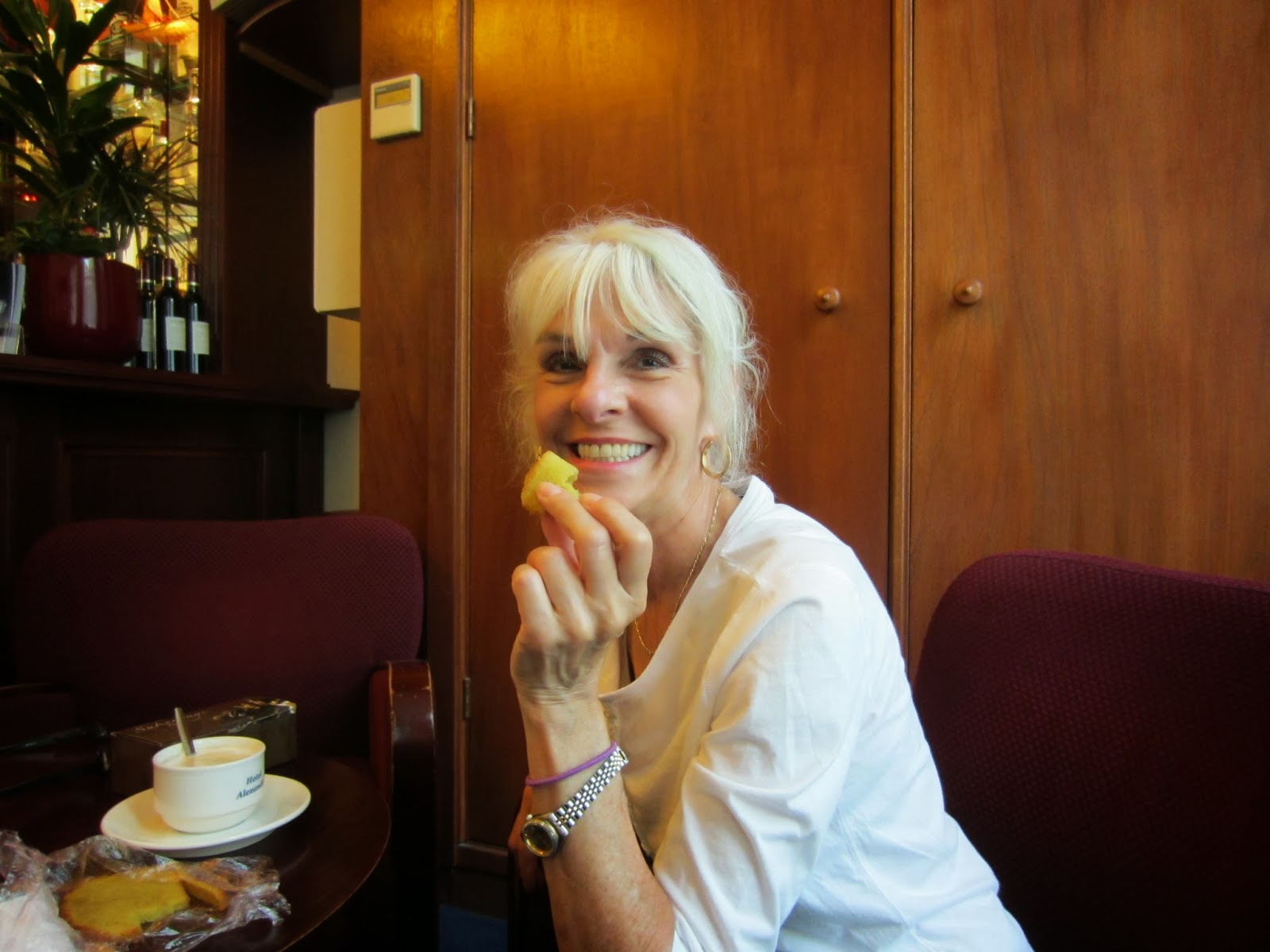
After touring the Van Gogh museum and returning to the hotel, Sam took a rest while I headed to the lobby for an espresso, some Bruges chocolates, and to test my "cake." I was a little hesitant because I have never indulged in marijuana and didn't want to make a fool of myself--who knew how I was going to react to this soft drug. I had an interesting conversation with the young hotel clerk (very hip and nice--probably the son of the owners) and he was very intrigued (or incredulous?) by my experiment.


I decided to only eat a small piece--not even a quarter slice, as listed on the package instructions. And every 15 minutes, the young man looked over at me and said, "Do you feel anything yet?" I didn't--and just continued reading and relaxing. Eventually, Sam came downstairs and our tour buddies began drifting into the lobby, returning from their afternoon adventures.


It was obvious that I wasn't the only one who had been eating "cake." Bud, the guy from Cape Cod, had already been snacking and looked a little bleary-eyed. And the big, burly retired Brooklyn cop came downstairs wearing an earring! Sam and I hadn't really mixed with any of the group outside of group events so we joined several couples and Bud for a nice dinner that evening. "Do you feel anything yet?"

 
We walked to a lovely restaurant, Bicken, and sat outside; it was a very nice evening and we had a lot of laughs. Closest to the camera are Mike and Peggy from Sonoma, CA; then Pam and Larry from Brooklyn; Bud (waving) from Cape Code; and Herman and Kay from Youngstown, OH.


As you can tell, this was a fairly fancy place (expensive)--small portions of food but displayed beautifully.

 
And by this time, I was feeling something--very, very giggly--more so than usual. And at one time, Sam leaned over and said I was pretty quiet (which is VERY unusual). Besides the intermittent giggling, I remember thinking (again) that I did not want to make a fool of myself. And I was having trouble following the conversations going on around me. By the time someone made it to the end of a sentence, I had lost track of the beginning of it! Very strange.
 
I tried to explain this to the lobby clerk when I returned--because he caught my eye right away and asked, "Do you feel anything yet?" I said that I was really giggly but that could've been because I was drinking wine. His eyes widened and he blurted out, "You were drinking wine, too!?!" "Was I not supposed to?" I asked...


I had complained that my sleep the previous night was like being in a Dali painting--I believed I never slept because objects were constantly flying around in my brain. This night--after eating some "cake"--I again believed that morning arrived without any sleep. But as I lay in a comatose state, the objects (or thoughts) were lazily floating around in my brain and I was entirely calm. The next day, I handed the rest of my "cake" to Bud. I knew it was in good hands...

Rembrandtplein and Other Street Art

The site of this leafy square was another city gate in the defensive walls constructed to protect the city in the Middle Ages. It was renamed Rembrandtplein when this cast iron statue by Louis Royer (1793-1868) was moved here in 1876. Cast in one piece, it is Amsterdam's oldest surviving statue in a public space and stands on a grey granite base bearing a replica of Rembrandt's signature. Coincidently, the square is near where the famous painter owned a house from 1639 to 1656.
 
 
As part of the artist's 400th birthday celebration in 2006, Russian artists Mikhail Dronov and Alexander Taratynov made bronze-cast representatives of a jaunty group of statues from his most famous painting and displayed them around Royer's work. We'll be seeing the "Night Watch" tomorrow at the Rijksmuseum.
 
Evidently, this is quite a lively area, especially with late-night dance groups who party here into the wee hours. Sam and I just wandered upon it while we were looking for a pharmacy on our way home from the Van Gogh Museum. She hoped to find some heat packs for her black eyes.
 
 
We also came across this rough clay statue reclining on a half roof outside a restaurant. As I snapped the photo, some guy sitting in a courtyard said something about sharing in the profits from my photograph. Huh? And because he wasn't smiling, I pretended I didn't speak English (again) and kept walking.


Which way do we go? Actually, we knew where we were when we got back to the museums. Circular route, anyone? And after stepping into a hotel along the way to ask about the nearest pharmacy (which was just around the corner), Sam discovered that any heat pads they had for sale were w-a-y too big for her face.

A Begijnhof, the English Reformed Church, and Lunch at Blue


We have been introduced to Begijnhofs in other cities, a spot that's not only a tourist attraction but a place where people live. This quiet and peaceful courtyard, lined with houses around a church, has sheltered women since 1346 (and is quite a contrast from noisy Kalverstraat, along which we had walked after leaving the "hidden" church).

The Begijnhof was for centuries the home of a community of Beguines--pious and simple women who removed themselves from the world at large to dedicate their lives to God. When first established, it was literally a "woman's island"--a circle of houses facing the courtyard and surrounded by water.


This statue of one of the charitable sisters sits just beyond the courtyard's entrance near the church. The Beguines' ranks swelled during the Crusades when so many men took off--never to return--leaving society with an abundance of single women. Poor and rich alike--as well as those widowed by the hazards of overseas trade--turned their backs on materialism and marriage to live out their days as Beguines in Christian poverty and to serve others.
Very popular for their simple, unpretentious Christ-like dedication, they spent their days deep in prayer and busy with daily tasks--spinning wool, making lace, teaching, and caring for the sick. Though obedient to a mother superior, the members of the lay order were not nuns. In quiet seclusion, they provided a striking contrast to the more decadent and corrupt Roman Church, inspiring one another as well as their neighbors.


We then walked into the brick-faced English Reformed church, which was built in 1420 to serve the Beguine community. In 1578 when Catholicism was outlawed, the Dutch Reformed Church took over many of these Catholic monasteries. Still, the Begijnhof survived; and in 1607, this church became Anglican.


The church served as a refuge for English traders and religious refugees fleeing persecution in England. Strict Protestants such as the Pilgrims stopped in tolerant Amsterdam, praying in this church before sailing to religious freedom in America. In fact, the stained glass at the far end shows Pilgrims praying before boarding the Mayflower. And on the altar sits a Bible from 1763. Amazing history.

We were finally "dismissed" for lunch so Sam and I headed to the third floor of an American-like shopping center. Their "Blue" café, which Hilbren recommended, was modern, intimate, and comfortable with a beautiful view (also "blue" today).


And the food was great, too! We both had sandwiches but mine was an open-faced one with cheese, honey, and pecans. Ahhh, we needed the break and did I mention the view?


We were now fueled up for our next stop, the Van Gogh Museum.

The Singel Canal and Others


The Singel Canal, viewed from the Torensluis Bridge with the Mint Tower in the background, was the original moat running around the old walled city. This bridge is so wide because it was the road that led to one of the original city gates where the Mint Tower stood. The area still looks much as it might have during the Dutch Golden Age of the 1600s. This was when Amsterdam's sea-going merchants ruled the waves, establishing trading colonies as far away as modern Indonesia.


Fueled with this wealth, the city quickly became a major urban center, lined with impressive homes. Each proud merchant tried to outdo his neighbor and the buildings are varied. Crowded together, shoulder-to-shoulder, the houses are built on top of thousands of logs hammered vertically into the marshy soil to provide a foundation. Over the years, they've shifted with the tides, leaving some leaning this way and that.


The Singel canal is just one of Amsterdam's many canals. There are nearly 100, most about ten feet deep and covering roughly 50 miles. Why so many? In this marshy river delta, its citizens needed to keep the water at bay. So they built a dike, near where Central Station stands today, to keep out the sea tide surge and then they dammed the Amstel River. The excess water was channeled safely away into canals, creating pockets of dry land on which to build. Windmills, of course, were used to harness wind power and pump excess water into the canals. Locks near Central Station are opened periodically to flush out the system and control the flow.


Today, the city has about 100 canals, most of which are about ten feet deep. They're crossed by some 1,200 bridges, fringed with 100,000 Dutch elm and lime trees, and bedecked with 2,500 houseboats.


Some of the boats in the canals look pretty funky. That's because Amsterdam is an unpretentious, anti-status city. When the sun goes down and the lights come on, people cruise the sparkling canals with an on-board hibachi and a bottle of wine, and even scows can become chick-magnets.

De Papegaai Hidden Church


Continuing along our walk, Hilbren introduced us to some more sites where he thought we might want to explore during our free afternoon. Tucked amongst chain stores on the pedestrian-only Kalverstraat, he invited us into a "hidden church," not uncommon in some cities and countries around the world.

 
In the 1500s, Protestants were fighting Catholics all over Europe. Amsterdam had long made an effort to put business above ideological differences; but by 1578, Protestant extremists took political control of the city. They expelled Catholic leaders and bishops and outlawed the religion, stripping their churches of lavish decorations and converting them into Dutch Reformed churches. Simultaneously, the Dutch rose up against their (Catholic) Spanish overlords, and eventually threw them out.
 

For the next two centuries, Amsterdam's Catholics were driven underground. While technically illegal here, Catholicism was tolerated (kind of like marijuana is these days). Catholics could worship so long as they practiced in humble, unadvertised places, like this church.


It gets its name (De Papegaai) from a parrot carved over the entrance of the house that formerly stood on this site. I read that a stuffed parrot hangs in the nave as a nod to that original papegaai. But I didn't notice that. I know I was zoning out--we passed by and saw lots of stuff on this particular walk.


Today, the church asks visitors for a mere "15 minutes for God" (as the sign says: Kwartier voor God)--an indication of how religion has long been a marginal part of highly commercial and secular Amsterdam. I, of course, noticed the vertical French message along the wooden edge of the board: Un quart d'heure pour Dieu.

Walking the Streets - Westerkerk, the Royal Palace, and Multatuli

After leaving Ludo's coffeeshop (I was surprised how many of us bought a little treat), Hilbren walked us back through the city. I had no idea where we were or where we were going but he pointed out important buildings and continued to teach us some more history along the way. The Rick Steves' guides never stop teaching!

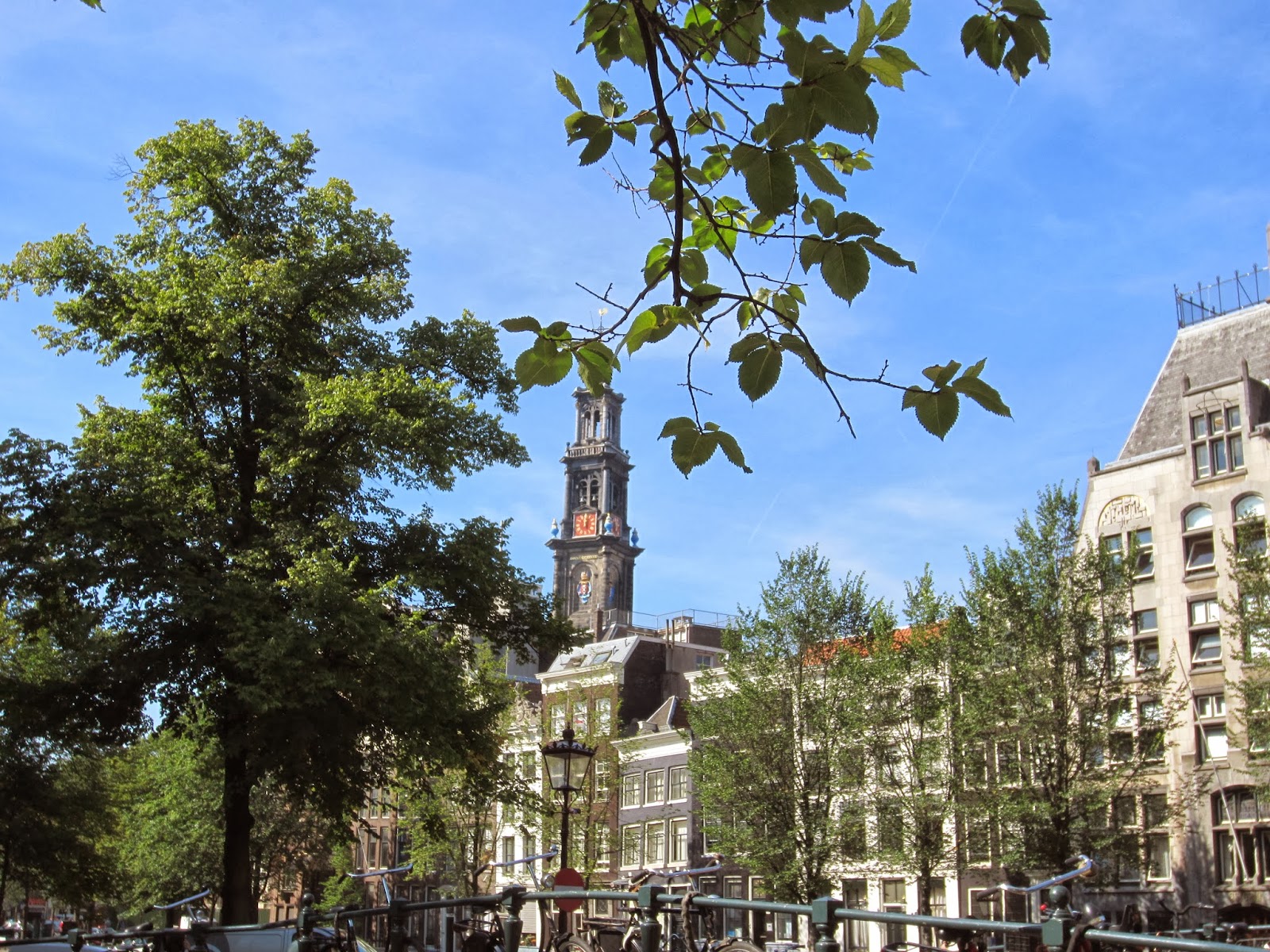
Amsterdam's tallest steeple belongs to the landmark church, Westerkerk (built in 1631), and has a crown at the top (not visible in this photo). It was a gift of the Habsburg emperor, Maximilian I, and as thanks for a big loan, the city got permission to use the Habsburg royal symbol. The tower also displays the symbol of Amsterdam, its three Xs.


Hilbren tells us that Rembrandt's body is buried somewhere under the pews in this church but no one knows exactly where. The church tower's carillon chimes every 15 minutes--although I don't remember noticing this--and play full songs at other times. Invented by Dutch bell makers in the 1400s, a live musician plays the keyboard inside the tower to make the bells of different sizes and pitches "sing." During WWII, the Westerkerk's carillon reminded Anne Frank every day that there was, indeed, a world outside her window.


Amsterdam is one of the cradles of modern democracy. And despite its name, the Royal Palace used to be the City Hall. In medieval times, self-governing Amsterdam prided itself on its independence--thumbing its nose at royalty--and this was where the city council and mayor met. Around 1650, the old medieval town hall was replaced with an classical-styled building, recalling the democratic Greeks. The triangular pediment features denizens of the sea cavorting with Neptune and his gilded copper trident--all appropriate imagery for sea-trading Amsterdam.


The building became known as the Royal Palace in 1806, when Napoleon invaded and installed his brother Louis as king. Even after Napoleon was defeated, the victorious powers dictated that the Netherlands remain a monarchy under a noble Dutch family called the House of Orange. Today, the palace remains one of the four official residences of King Willem-Alexander. (Though Amsterdam is the nominal capital of the Netherlands, all government activity--and the King's actual permanent home--takes place in The Hague, 30 miles away.) Hilbren pointed out that the palace needs to be cleaned. However, city officials, he said, are reluctant to construct the scaffolding to accomplish this because the palace must be presentable at all times in case there is a royal funeral.


At one point, we walked by this "big head" statue honoring a writer known by his pen name, Multatuli. Born in Amsterdam in 1820, Multatuli (aka, Eduard Douwes Dekker) sought his fortune in Indonesia, a Netherlands' colony at the time. His semi-autobiographical novel written in 1860, "Max Havelaar," follows a progressive civil servant fighting to reform colonial abuses, which Dekker witnessed while working as a bureaucrat. He was the first author to criticize Dutch colonial practices--a very bold position back then--and for his talent and subject matter, Multatuli has been dubbed "the Dutch Rudyard Kipling."

Wednesday, March 5, 2014

The Red Light District


With stomachs full of Indonesian food, we headed to the Red Light District, Amsterdam's oldest neighborhood, which has hosted the world's oldest profession since the 1200s. But prostitution has only been legal here since the 1980s; and business still thrives today. This creates a spectacle unique in all of Europe. But as shocking as legalized prostitution may seem to some, it is a good example of a pragmatic Dutch solution to a persistent problem.


I have been here two other times. The first time (the second was on another Rick Steves' tour), I mistakenly wandered alone down these streets during the day even though my girlfriend, who I was visiting, circled the neighborhood on my map and said "Do NOT go in here!" She suggested I might encounter some folks who would offer some unique propositions. And, in fact, she was correct. I realized my error when a guy leered at me and made some comment. Hmmm, these shops I'm passing by are no longer selling pastries or vegetables or candy! I remember telling myself, "Stop walking straight ahead--turn to your left or right and get out of here." It was my first trip to Europe and, although wide-eyed, I was understandably nervous wandering around alone and/or consulting my map in front of everyone.

Since it was dark when we walked through the district this evening, it was not easy to see the history or the sleaze--drunks in doorways, prostitutes in windows, cruising packs of twentysomethings and bachelor parties, peep shows, cannabis being smoked, sex for sale, and shops selling porn. (Of course, we could've been too early--it wasn't even 9:00 PM!) I kept my camera in my backpack--no need to call attention to myself or our group. Nor did I want to encounter a bouncer to rip it from my hands...

Although not everyone's cup of tea, Amsterdam keeps several thousand prostitutes employed--and it's all legal--prostitutes in bras, thongs, and high heels illuminated by red lights and standing in window displays, offering their bodies for sale. (Blue lights, by the way, illuminate the transvestites.) There's a Prostitution Information Center (PIC) in the neighborhood which exists solely to demystify prostitution and provides visitors information on how the trade works and what it's like to be a sex worker. Besides pamphlets, books, condoms, t-shirts, tours, and a most-commonly-asked-questions booklet, the room-rental office is next door. This is where prostitutes come to rent window space and bedrooms to use for their work--100 euros for a day shift and 150 euros for an evening. The office also sells supplies.

The prostitutes are self-employed--entrepreneurs, you might say--and negotiate directly with their customers. Working a four- to eight-hour shift, they can make about 500 euros a day. They are required to keep their premises hygienic, make sure their clients use condoms, and avoid minors. They complete tax returns and many belong to a loose union called the Red Thread. If diagnosed with HIV or AIDS, they lose their license.

Remember, this is a business so the law (not pimps) protects them. In return for their rental fee, they get security: video surveillance in the PIC, small cameras, and orange alarm lights above the doors. A pressed buzzer swiftly unleashes a burly bouncer or the police.

Although some choose prostitution as a lucrative career, others (likely most) are forced into it by circumstances--poverty, drug addiction, abusive partners, and immigration scams. Since the fall of the Iron Curtain, many Eastern Europeans have flocked here and Russian and East European crime syndicates have muscled in. While the hope in the Netherlands is that sex workers are smartly regulated small-business-people, in reality the line between victim and entrepreneur is not always so clear.

Amsterdam's current city government is trying to rein in the sex trade by limiting it to this neighborhood (De Wallen). It's also hoping to splice other commerce into a district that for centuries has had variations on basically only one product. As many as half of the sex businesses here may close over the next few years--not because of prudishness, but to limit the encroachment of organized crime. A major Red Light District landlord was given the option to either lease many of his booths to the city or be zoned out of business. The city picked up the leases; and windows that once showcased "girls for rent" now showcase mannequins wearing the latest fashions--lit by lights that aren't red.


It was time to make our way home for bed. After finding the correct tram and hopping off at the right stop, we knew we were close to the hotel. This was one of our landmarks--i.e., we knew we were not lost--when we walked by this beautiful fountain.

Orientation, Metro Lesson, Indonesian Food

 
We met in front of the hotel at 6:00 PM and Hibren led us on an orientation walk through the streets on our way to tonight's restaurant. This involved a lesson--one that makes Sam's hair stand on end--in using the trams.
 
 
Although I am now very comfortable riding the Paris Metro and buses, I don't speak or read Dutch and it's always a challenge to learn the particular process--which doors to enter, which to exit, how to validate the tickets, etc. (Frankly, I did screw up when exiting one day! But I wasn't caught and think it was the last time we planned to use the two-day pass anyway; so no harm, no foul.)
 
 
Leidseplein, named after a particularly bustling square, was our nearest stop and I think we were always supposed to look for trams marked with #5. (Probably the reason I snapped this photo, journalist that I am...) And, we weren't the only ones trying to get oriented.


Five hundred years of history with the former Indonesian colony has made their food a favorite with the Dutch. You can experience a rijsttafel (literally, "rice table") at most of these restaurants--food served as we would describe "family-style." 


Our dinner was served with lots of rice and around twelve dishes to share: tofu satay with peanut sauce, tempeh satay, spicy tofu, mango and pineapple salad with peanut dressing, spicy green beans, garlic chips, and more. It was a feast for--especially--vegetarians and we liked many of the dishes. The table at which Sam and I sat left a lot of food at the end; however, the other tables really chowed down!

After leaving the Sampurna Indonesian restaurant, we walked through the Red Light District before going home for sleep!

Hotel Alexander


Ahhh, a nicer hotel than the one we left in Delft this morning. Sam and I checked into room 32, which was 32 steps up. This hotel, I believe, is made up of more than one building, with its meandering hallways and varying stairways. I also found an engraved stone on the front of one which gave its building date as August 31, 1809.
 

The room was smallish, like a Paris hotel, but it was very modern and the bathroom, very nice. That's always one of my most important criteria. And, of course, the window opened!
 

I was also very happy about the espresso machine in the lobby/breakfast room--2 euros a cup and worth it.


The balcony at the back of the lobby overlooked a peaceful and lush courtyard. Supposedly, you can see a flock of parrots flitting in and out of the trees. We did hear them--not sure that I was seeing them because they were very fast. Sam got a photo but...this looks like a pigeon to me...


After unpacking and sitting awhile on the balcony, we met the group for an orientation walk around our neighborhood while headed to tonight's group dinner at a Indonesian restaurant--very popular in Amsterdam.