Showing posts with label Cathedrals. Show all posts

Thursday, March 6, 2014

A Begijnhof, the English Reformed Church, and Lunch at Blue


We have been introduced to Begijnhofs in other cities, a spot that's not only a tourist attraction but a place where people live. This quiet and peaceful courtyard, lined with houses around a church, has sheltered women since 1346 (and is quite a contrast from noisy Kalverstraat, along which we had walked after leaving the "hidden" church).

The Begijnhof was for centuries the home of a community of Beguines--pious and simple women who removed themselves from the world at large to dedicate their lives to God. When first established, it was literally a "woman's island"--a circle of houses facing the courtyard and surrounded by water.


This statue of one of the charitable sisters sits just beyond the courtyard's entrance near the church. The Beguines' ranks swelled during the Crusades when so many men took off--never to return--leaving society with an abundance of single women. Poor and rich alike--as well as those widowed by the hazards of overseas trade--turned their backs on materialism and marriage to live out their days as Beguines in Christian poverty and to serve others.

Very popular for their simple, unpretentious Christ-like dedication, they spent their days deep in prayer and busy with daily tasks--spinning wool, making lace, teaching, and caring for the sick. Though obedient to a mother superior, the members of the lay order were not nuns. In quiet seclusion, they provided a striking contrast to the more decadent and corrupt Roman Church, inspiring one another as well as their neighbors.


We then walked into the brick-faced English Reformed church, which was built in 1420 to serve the Beguine community. In 1578 when Catholicism was outlawed, the Dutch Reformed Church took over many of these Catholic monasteries. Still, the Begijnhof survived; and in 1607, this church became Anglican.


The church served as a refuge for English traders and religious refugees fleeing persecution in England. Strict Protestants such as the Pilgrims stopped in tolerant Amsterdam, praying in this church before sailing to religious freedom in America. In fact, the stained glass at the far end shows Pilgrims praying before boarding the Mayflower. And on the altar sits a Bible from 1763. Amazing history.

We were finally "dismissed" for lunch so Sam and I headed to the third floor of an American-like shopping center. Their "Blue" café, which Hilbren recommended, was modern, intimate, and comfortable with a beautiful view (also "blue" today).


And the food was great, too! We both had sandwiches but mine was an open-faced one with cheese, honey, and pecans. Ahhh, we needed the break and did I mention the view?


We were now fueled up for our next stop, the Van Gogh Museum.

De Papegaai Hidden Church


Continuing along our walk, Hilbren introduced us to some more sites where he thought we might want to explore during our free afternoon. Tucked amongst chain stores on the pedestrian-only Kalverstraat, he invited us into a "hidden church," not uncommon in some cities and countries around the world.

 
In the 1500s, Protestants were fighting Catholics all over Europe. Amsterdam had long made an effort to put business above ideological differences; but by 1578, Protestant extremists took political control of the city. They expelled Catholic leaders and bishops and outlawed the religion, stripping their churches of lavish decorations and converting them into Dutch Reformed churches. Simultaneously, the Dutch rose up against their (Catholic) Spanish overlords, and eventually threw them out.
 

For the next two centuries, Amsterdam's Catholics were driven underground. While technically illegal here, Catholicism was tolerated (kind of like marijuana is these days). Catholics could worship so long as they practiced in humble, unadvertised places, like this church.


It gets its name (De Papegaai) from a parrot carved over the entrance of the house that formerly stood on this site. I read that a stuffed parrot hangs in the nave as a nod to that original papegaai. But I didn't notice that. I know I was zoning out--we passed by and saw lots of stuff on this particular walk.


Today, the church asks visitors for a mere "15 minutes for God" (as the sign says: Kwartier voor God)--an indication of how religion has long been a marginal part of highly commercial and secular Amsterdam. I, of course, noticed the vertical French message along the wooden edge of the board: Un quart d'heure pour Dieu.

Tuesday, March 4, 2014

Delft's New Church


The New Church is the second parish church of Delft, also Dutch Reformed, proudly standing over the town from its prominent position in the Markt. The construction of Nieuwe Kerk began in 1383 and took 100 years to complete. With its Late Gothic lines, today the stone tower (dating from 1875) houses a carillon with chimes played on request by the town bell ringer, especially for brides marrying at the Town Hall. The statue in front is of Hugo Grotius (Hugo the Great), a legal scholar and writer of maritime law.


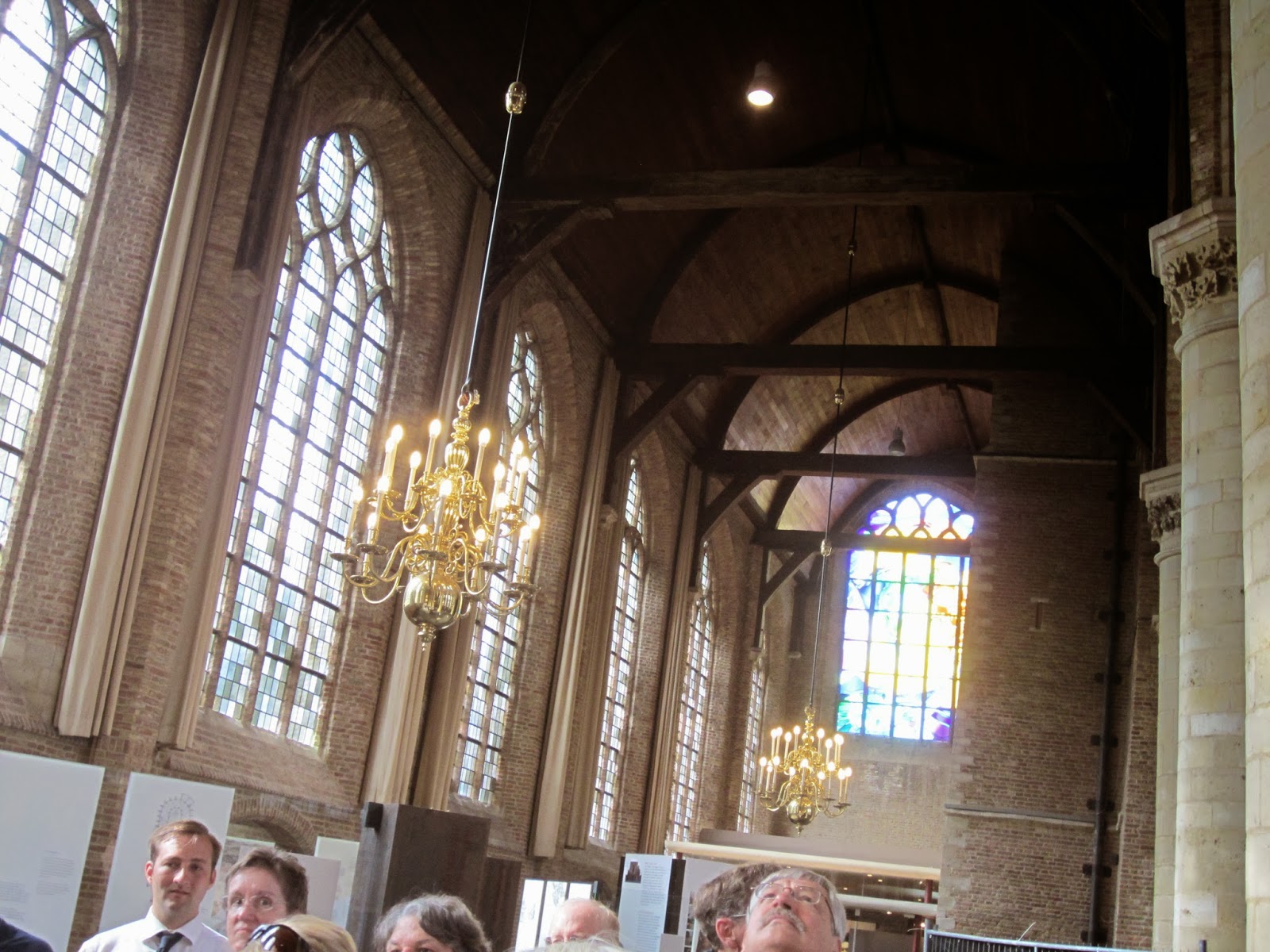
The church was devastated by the 1536 fire and then ransacked, of course, by iconoclasts in the 1560s. After a nearby gun-powder depot exploded and ruined its windows in 1654, the church was rebuilt giving it the look we see today. The chandeliers, produced in 1981 in traditional 17th century style, marked the church's 600th birthday.


Inside are buried the beloved Dutch ruler William I of Orange (1614-1622)--considered the father of the Netherlands--and Dutch royalty who succeeded him. William's ornate tomb--a canopied monument to his greatness--dominates the choir area. There are two representations of William: one of white marble, reclining peacefully; and a strong, armored king in bronze, sitting royally. A dog at his feet symbolizes loyalty and the angel of Fame above the dog blows a trumpet. The female statues at the corners of his monument represent Liberty, Justice, Religion, and Fortitude.


A few paces in front of William's monument is a large stone slab marking the entrance to a sprawling underground labyrinth which holds the tombs of most of William I's descendants--another 45 tombs at this time.


The royal family considers the burial vaults or mausoleum as their private domain. Delft's Lord-Mayor is the official keeper of the keys and administrator of the complex, which is not open to the public. Note the huge rings on the corners of the heavy slab, allowing access to the vault.


Over the years, the vault has been extended a few times--the most recent in 1922 when Queen Wilhelmina made the decision to built a wider entrance with staircases and a vestibule. The former entrance to the extended old vault then became the service entry. This large replica of the underground area sits inside the church and was a popular place for visitors when we were there. Unfortunately, Q was waiting outside for us to conclude our tour with her so I didn't get a chance to study this like I typically would.

The Markt and Some More Delft History


Q led us into the Markt between leaving the Old Church and before entering the Nieuwe Kerk (New Church). We stopped to learn about the square and some more history of the town. Looking toward the Town Hall, Q explained that the look of this market square was defined in 1536 when lightning struck the spire of the New Church. The fire it started destroyed two-thirds of the town. While all the buildings that ring the square have cellars dating from before the fire, the brick buildings we see above ground today were built after 1536.


In the 17th century, considered Delft's Golden Age, this was a thriving market town with an economy stoked by textiles and breweries. Two hundred breweries in the city, in fact, exported 80% of its beer. Then, in the 18th century, the economy collapsed. And without the infrastructure of a trading city--no river, local harbor, or major roads--the sleeping medieval town was left behind, just waiting to be reawakened.

The square has never really been renovated, perhaps because it must always be ready, on a day's notice, to host a royal funeral. As we had just learned, William I of Orange, leader of the Dutch revolt against Spain, was assassinated here in 1584. Under normal circumstances, he would have been buried in his family's hometown of Breda, but it was occupied by the Spanish. So William was laid to rest in Delft, and to this day, the House of Orange--the Dutch royal family--buries its nobility in the New Church (where we were headed next).

Part of Delft's economic heritage is in printing. The first Dutch Bible was printed here in 1477 in one of the buildings on the square; it is marked by a Bible on the building's corner. Five centuries later, in 1977, a reprint was published which is displayed in the Old Church (below).


Rebuilt in 1620 in the Renaissance style after the fire, the Town Hall is a law court, with Lady Justice and her scales prominently positioned on the façade. Of the 17 states in the Spanish Netherlands, seven seceded and created the Dutch Republic--the United Provinces of the Netherlands. Holland was one of these; and since it contained Amsterdam, it drove 85% of the country's economy. Her coat of arms is a red lion and is displayed on Delft's Town Hall.

Delft's Old Church


The Oude Kerk is a Dutch Reformed house of worship and Delft's oldest parish church. It was officially founded in 1246, the same year in which Delft received city rights from Count William II, even though it is generally assumed that there had been a wooden church on this site as early as 1050. Names of its ministers, going back to 1572, fill an inside wall.


The Gothic tower reflected in the canal, with its brick spire and four turrets, was added between 1325 and 1350. The church is sober and clean because of iconoclastic riots in 1566 and 1572, which made a violent point of destroying all hints of Roman Catholicism and its imagery.


Within the church are the tombs of two local boys done good: the inventor of the microscope, Anton van Leeuwenhoek, and the painter Johannes Vermeer. Vermeer's actual tombstone is just a simple stone plaque in the floor. It is across from the pulpit (below), which dates from 1548, the only item inside the church surviving the riots in the mid-1500s.


When Vermeer died, he was broke; and the cost for a stone was determined by the size of the grave. To save money, Vermeer's family supposedly buried him standing up--the reason the stone is so small. The sign on the pedestal, however, says this marks the "spot where the grave used to be."


Although another, more grander Vermeer monument was installed in the church in 2007--a reflection of his greater popularity now than in previous generations--the exact location of his body in the church is unknown today.

Sunday, March 2, 2014

Basilica of the Holy Blood


This Romanesque and Gothic Roman Catholic church stands in Burg Square, the historic birthplace of Bruges. Originally built in the 12th century as the chapel for the resident of the Count of Flanders, it is famous for its relic of the blood of Christ which, according to legend (recently disputed), was brought to Bruges in 1150 by Thierry of Alsace after the Second Crusade. The gilded bronze statues on the façade represent various Archduchesses and Archdukes (as well as Thierry of Alsace), which were added in the 16th century.


The lower chapel, dedicated to St. Basil the Great, is dark and solid, a fine example of Romanesque style which remains virtually unchanged. The upper chapel (below), with a separate entrance, was decorated in the Gothic style during the 16th century (and renovated multiple times during the 19th)--which I really love. The brightly painted walls and columns--like wallpaper--remind me so much of the Saint-Germain-des-Pres church in Paris. Here in the upper chapel is where the relic is displayed.


Sam says she remembers this beautiful church from our 2002 trip. But if I was inside it, I must've been unconscious. Because I can't imagine not remembering the colors and details, as well as the ceiling which represents an overturned ship. Very colorful and vivid.


Sam and I individually made our euro contribution and filed up the steps to pause in front of the glass vial sitting on a pillow in another case which is said to contain a cloth with the blood of Jesus Christ. Of course, with all the things running through my mind, I can't even remember what it looked like! So typical of me.


And since I was hesitant about taking photos, I snapped one peeking through a stone barrier above some candles but lower than the walkway to see the relic. Look closely to see the eyes of the lady sitting behind the display case, watching the approaching pilgrim.

PS - I read that this is where the 2013 TV series, "The White Queen," is filmed. I am not familiar with the show but will add it to my Netflix queue.

Food, Shopping, a Harp Concert, and More Food


After the chocolate demonstration, Sam and I took off to do some shopping. She had been very patient about this, plus I had an "order" from a neighbor to visit a specific tapestry shop (Mille Fleurs) and buy a pillow cover detailing the "Tree of Life." Sam bought a couple tapestries and then even I bought a pillow cover for my living room couch. We also stopped in some lace shops but didn't make any purchases in those.


We were hungry so it was time to find some lunch. The café we selected was in a small passage around the corner from the Church of the Holy Blood, a passage with shops and little restaurants overlooking the oldest canal (top photo).


Our restaurant, a little coffee house serving lunch (Koffiehuis Ter Steeghere), was delightful even though it was housed on the side away from the canal in the passage. It had been our coolest day so far this trip and we had suffered a few sprinkles. So, hot soup sounded really good and it certainly was--even though we never figured out what kind--and we didn't ask.


After touring the Church of the Holy Blood (a separate post), we wandered back to the hotel and tested the chocolates. Before leaving to check out another lace shop Hilbren had pointed out on our orientation walk the night before, we watched some swimmers from our window competing in the canal--brrrrr, looked very cold!


On the way to the lace shop, we entered the Saint Anne church (Sint-Annakerk)--beautiful and ornate, although the back of the sanctuary was being renovated. Wish we would've had more time to study the artwork and learn about its history.


What a cute little home the lace shop occupied. I wondered if the owner (the lady who waited on us) lives upstairs. And even though it was in a very quiet, non-traffic, and residential area, her other customers seemed to be familiar with the stock and knew exactly what they wanted. I got the feeling it was a "destination" on those shoppers' list, as it was on ours. After Sam found a couple gifts, we sauntered back through the neighborhood, found a bench, and called our parents.
 
Hey! Let's drop off your packages, Sam, and "do" coffee and cake on the way to the harp concert. It was that time so we went back to our favorite café for very fancy and delicious waffles. Life is good.
 

The free harp concert was interesting and just the right amount of time--I believe Luc Vanlaere only played six songs, on a variety of harps and string-type instruments and all his own compositions. Before beginning, Luc surveyed his audience and told us he spoke four or five languages, which he confirmed by commenting in all languages at different times in the program. He was finished playing within 30 minutes and we slipped out without buying a CD or signing any guest lists. It was really a different and pleasant experience. 

We found our way back, meandering by and through many sights we've seen multiple times, plus a new one--a group of dancers in the old fish market.


Since the sweet waffles were only a distant memory and it was time for dinner, we stopped at a pizza place pointed out by Hilbern this morning. There, we ran into two of our tour buddies, Peggy and Mike from Sonoma, California. Pretty darn good and fun company. Afterwards, we headed back to the hotel and bed.

Church of Our Lady, Michelangelo, and Tombs


We continued on our walk to the towering Church of Our Lady, which stands as a memorial to the power and wealth of Bruges in its heyday, mainly from the 13th through 15th centuries. Its tower, at over 400 feet in height, remains the tallest structure in the city and the second tallest brickwork tower in the world (the tallest being St. Martin's Church in Landshut, Germany).


Like most of Belgium, the church is Catholic; and worshippers are attended by twelve Gothic-era statues of apostles (each with his symbol) and a grandiose Baroque wooden pulpit with a roof that seems to float in midair. The church is brighter today than it originally was because the 14th and 15th century stained glass windows were destroyed by the iconoclasts.


A delicate statue by Michelangelo, "Madonna and Child," is near the apse and is somewhat overwhelmed by the ornate Baroque niche in which it sits. The work was originally intended for an altar in the Sienna Cathedral. But Mr. Mouscron of Bruges, a wealthy businessman involved in the cloth trade (who is buried in the same chapel to the right), bought it in Tuscany and brought it to the Church of Our Lady. It is said to be the only Michelangelo statue to leave Italy during the artist's lifetime.

As the artist chipped away at his young "David," he took breaks by carving this statue in 1504. Mary, slightly smaller than life-size, is sitting while young Jesus stands in front of her. Their expressions are mirror images--serene, but a bit melancholy, with downcast eyes--both appearing to ponder the young child's dangerous future. Though they are lost in thought, their hands instinctively link and tenderly link. The white Carrara marble is highly polished, something Michelangelo only did when he was certain he'd gotten it right,

The sculpture was twice recovered after being looted by foreign occupiers--French revolutionaries in 1794 and the Nazis, of course, in 1944.


Daniella also walked us to the gilded bronze reclining effigies reposing at full length on polished slabs of black stone at the high altar. These mark the tombs of the last local rulers of Bruges: Duchess Mary of Burgundy and her father, Charles the Bold, the last Valois Duke of Burgundy. Both are crowned, and Charles is in full armor and wearing the decoration of the Order of the Golden Fleece. The dog and lion at their feet are symbols of fidelity and courage. Underneath the tombs are the actual excavated gravesites with mirrors to help you enjoy the well-lit centuries-old tomb paintings.


In 1482, when 25-year-old Mary tumbled from a horse and died, she left behind a toddler son and a husband who was heir to the Holy Roman Empire. Charles the Bold also died prematurely in war. Their twin deaths meant Bruges belonged to Austria and would soon be swallowed up by the empire, ruled from Vienna by the Hapsburgs--who didn't understand or care about Bruges' problems.


Next, we headed to the Saint John Hospital and the Memling Museum.

Saturday, March 1, 2014

Cathedral of Saint-Bavo


The main church of Ghent, which also houses three of the city's art treasures, is the Sint-Baafskathedraal or the Cathedral of Saint-Bavo. We didn't have much time but before he excused us for lunch, Hilbren thought it worth leading us inside for a few minutes.
 
At the front of the sanctuary is the main altar displaying Bavo, the beloved local saint on his way to heaven. This 7th century saint was once a wealthy and rambunctious young soldier but became a born-again Christian after the death of his wife. Bavo rejected his life of materialism and became a monk, living for a time in a hollow tree.
 
We then sought out one of the treasures we'd been told about, Van Eyck's altarpiece. "The Adoration of the Mystic Lamb" was finished in 1432 after the original artist, Hubert Van Eyck (1385-1426) began the painting. However, he soon died and his better-known younger brother, Jan (1395-1441) completed Hubert's vision.


It's miraculous that the piece has survived for nearly six centuries. It was hidden in the cathedral's tower during the wave of iconoclasm in the 16th century. In 1934, two of its panels were stolen--the ones depicting John the Baptist and the "Just Judges." The church recovered John the Baptist's panel but the other one never turned up (the one displayed on the replica is currently a copy). More than 75 years later, this theft remains one of Belgium's greatest unsolved mysteries. During WWII, while the altar was on its way to safe storage at the Vatican, it was caught up in the fighting and hidden in the French Pyrenees. Then it was stolen by Hitler, taken to his Bavarian castle, and then to a salt mine before US forces returned it at the war's end.*

The opportunity to see it is confusing but let me try to explain. Hilbren told us that the altarpiece is being restored and we might not be able to view all sections of it. The Rick Steves' book claims you can view a replica for free in a side chapel that originally contained the piece or pay to see the original in a small room in the back-left corner of the church.


As we walked up an outside aisle towards the front altar, we saw the replica--I thought--in a side chapel (on the right) where a group was listening to a gentleman. So I slipped inside the gate and started snapping photos. As I noticed the group leaving, I saw an authoritative man block others from entering and explain that they had to pay. Whoops. This is the reason for the few number of photos I snapped and their poor quality.


The altarpiece has a dozen separate paintings on each side (front and back). It was closed on weekdays, showing only the outside panels; on Sundays and holidays, it was opened to reveal the scenes inside. In the bottom middle of the panels, a big celebration includes angels,  prophets, the twelve apostles (in the right foreground), saints, popes, pilgrims, etc. A hovering dove represents the Holy Spirit and in the foreground is the well of life, spewing water and jewels. The lamb at the very center is a stand-in for Christ but also has a special meaning in Ghent, whose wool trade put the city on the map.

The other two treasures in the cathedral are an elaborately-carved pulpit and a Rubens' altar painting depicting the town's patron saint and namesake of the church. But were now hungry and needed to find some lunch before the canal tour. So we rushed off before we could give this cathedral its due.

*The recently-released film, "Monuments Men," relates the hard-to-believe moment when the Nazis manhandled this treasure of Western art, the Ghent Altarpiece--a point in the movie where truth, in fact, can be stranger than fiction.


Cathedralis Bruxellensis SS. Michaelis et Gudulae


St. Michael's Cathedral is one of Europe's classic Gothic churches, built between 1200 and 1500. This cathedral, where royal funerals and weddings take place, is made from white stone and topped by twin towers. It has been the most important church in this country for nearly 1,000 years.
 

Around 80% of Belgium citizens are Catholic, but only about 20% of them attend mass. Most of the Dutch people are Protestant.


Although the white nave seems stark upon entering, there are beautiful stained glass windows and impressive statues. A marvelous carved pulpit has Adam and Eve supporting the priest while St. Michael stabs a serpent above.


I loved the beautiful gold statue of Gudulae (there was a corresponding one of St. Michael--both standing in front of the altar). Devoted to God, she spent her young life in prayer and helping the poor with handouts.

I didn't take a photo but when leaving the cathedral, the view of Brussels' old town from the outer porch is impressive.