Showing posts with label Delft. Show all posts

Tuesday, March 4, 2014

Goodbye, Delft!


Breakfast was a 7:00 this morning because we were meeting in front of the hotel at 7:45 AM to hike to our bus. When we arrived the other day, Dirk had to park it many blocks away.


It's amazing he even got it in and then out of the parking lot this morning to head to Amsterdam. Fortunately, we had shorts-wearing Hilbren to help. It was a beautiful and sunny morning and Hilbren was expecting it to be warm.


But before we get to Amsterdam this afternoon, we still have a couple of stops to make: the famous Aalsmeer Flower Auction near Schiphol Airport and the Zuiederzee Outdoor Museum.

Thank You and Bon Voyage to Our Bus Driver


We have always had tour buses from the Belgium company, Heidebloem, and we have never been disappointed with the carriages nor their drivers. The buses are very spacious, very clean, and comfortable. And the drivers are polite, conscientious, and skillful. We have always felt safe in their care and always marvel at how they are able to navigate the narrow European streets.


Dirk, our bus driver on this trip, will head home after dropping us off in Amsterdam tomorrow. So Hilbren arranged for some Dutch beer, liquors, and hors d'oeuvres--a say-goodbye-to-our-bus-driver happy hour. Plus, he presented Dirk with a bottle of spirits along with a thank you card signed by all of us.


It was enjoyable to visit and socialize with our tour buddies, which Sam and I hadn't done as much as we have on past trips. Plus, I finally took the time to interview Annika regarding what it's like to live in Chicago.


Sam decided that she didn't want to go out for dinner. WHAT? No hot meat?? She wanted to get into her jammies, put some ice on her eyes, and eat junk food. I'm sure it wasn't the most comfortable day for her and yet she persevered. She's tough!

So that's what we did this evening, while organizing and packing for the last stop on our trip. Ugh. We're now getting very tired of living out of a suitcase. Not to mention, we are happy to leave this hotel and the "scene of the accident!"

Lunch on a Canal


After our very busy morning, including the tour of the Vermeer Center, it was w-a-y past lunch time. This is always an adventure--to decide what we want, how much, and where to find it. We weren't having a group dinner this evening and didn't have anything else on our personal "to do" list, so we could take our time. Ahhhh.

When entering Holland, among other things, Hilbren explained the typical Dutch fare, one of which is a pannenkoeken. A crepe-like thin pancake with all kinds of toppings, it can be served for dessert or as a meal, like a pizza. His favorite, he told us, is one topped with bacon and apples.


While walking with Hilbren, he pointed out one of his favorite cafés for a good pannenkoeken. Café Stads-Koffyhuis has been making and serving them since 1966. I can't believe we found the place again--with outside seating overlooking a canal. And what a beautiful day to sit in the sun and relax!


Hilbren told us that the pannenkoeken arrives at your table with a bottle of maple syrup and a shaker of powdered sugar. And that it's perfectly OK to use both! So we did, of course. Sam had a fruit one and I tried Hilbren's favorite, which I really liked. Sam wasn't that impressed, if I remember correctly, but they were definitely filling.


And then, because we had all the time in the world, it seemed, and it was so pleasant sitting outside, I decided on another treat. Coffee and a little biscuit. What a great afternoon.


Poor Sam. Her eyes and face were beginning to show the effects of her accident in the hotel this morning, plus she was suffering that continually dull headache which results from a fall like she took.


Finally, we leisurely found our way back to the hotel to begin packing up for our departure to Amsterdam tomorrow. There was also going to be a 6:00 PM gathering in the hotel bar to say goodbye to Dirk, our bus driver, and to enjoy some Dutch specialties. After Dirk drops us off at our Amsterdam hotel tomorrow, he will head back to his home base in Belgium.

The Vermeer Center


The great Dutch Golden age painter, Johannes Vermeer, was born in Delft in 1632, grew up near the Markt, and staged a number of his paintings here. His father, an art dealer who had an inn where many local artists met, gave Johannes a passion for painting and allowed him to meet other masters who had a formative influence on his life. From 1645 to 1660, Delft was a breeding ground for painting talent, where artists experimented with light, perspective, and space. Vermeer also met with his contemporaries in the Saint Luke's Guild (today's home to the Vermeer Center) and the city's taverns.

All over Europe in the 17th century, artists lived on commissions they received from the church and royal houses. However, in Holland at that time, these were both missing. There, ordinary citizens bought paintings on the open market, and every household had seven or eight hanging on their walls.


Late in the artist's career, with Holland fighting wars against England, the demand for art and luxuries went sour for the Dutch, forcing Vermeer to downsize. He sold his big home, packed up his wife and 15 children (!), and moved in with his wealthy mother-in-law, Maria Thins. He suddenly died two years later at age 43 in 1675, leaving his wife with eleven remaining children and a mountain of debt.


Vermeer painted landscapes and scenes from mythology and the Bible but he specialized in depicting the everyday actions of regular people. And though his scenes are usually still and peaceful, he artfully conveys deep tension and suggests a complicated story with subtle body language--for example, the subject glances at something out of view--or the inclusion of a small item, like a letter which seems significant. Vermeer also was a master of light, capturing it with an artistry that would make the Impressionist painters jealous over two centuries later.


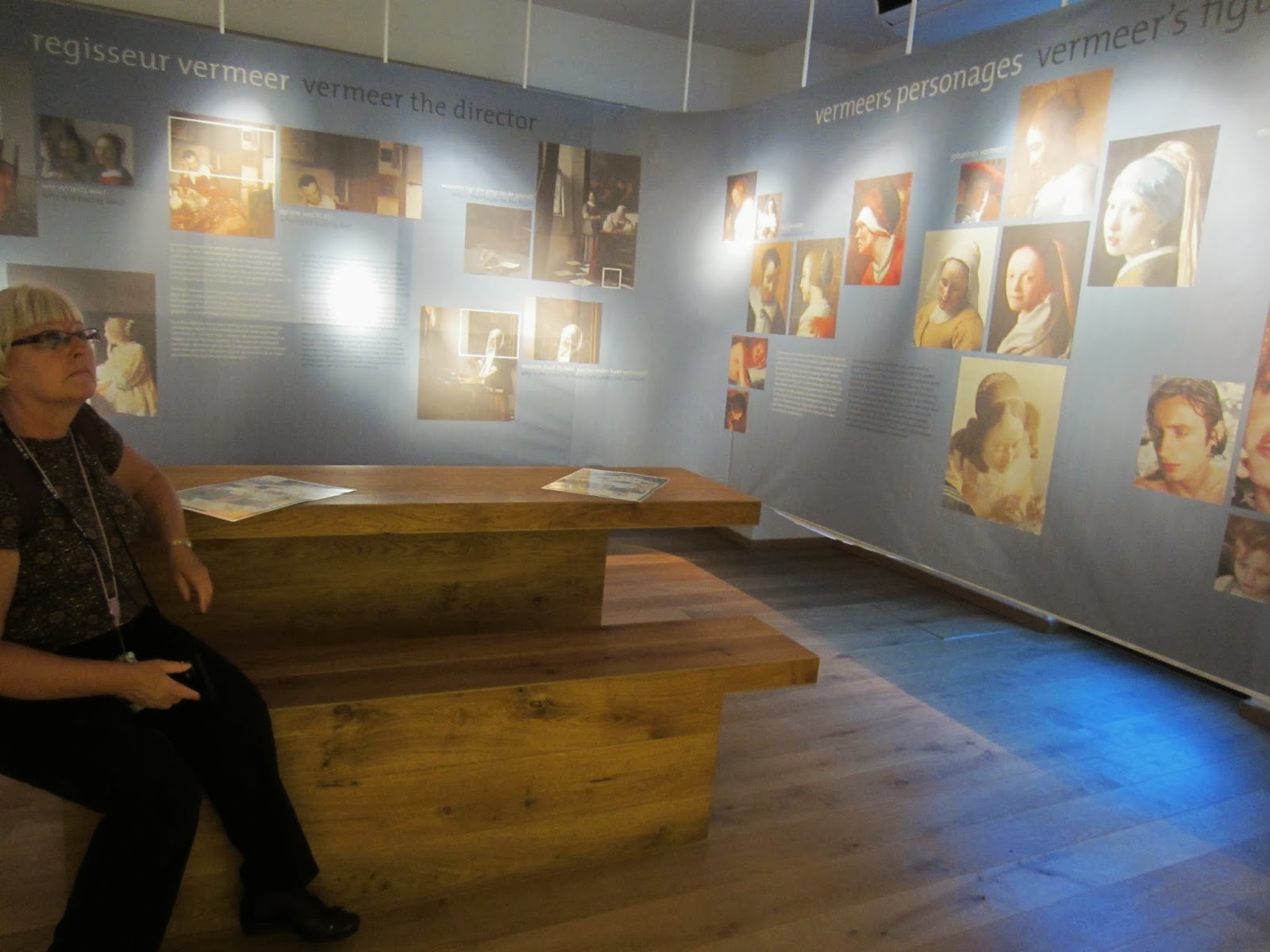
Sam and I were really impressed with the Vermeercentrum. The intelligent exhibit did a great job of tracking the career and unique creative mind of Delft's favorite resident. After watching a short movie in the lower level, we spent nearly two hours wandering through the three-story building.

Copies of all 37 known paintings by Vermeer are arranged chronologically and accompanied by brief and interesting commentary. There is not 100% agreement on how genuine three of the paintings are. It is thought that Vermeer produced between 40 and 60 paintings during his life--all in all, an unusually small body of work.


There's a mock-up of his studio, where his techniques are thoughtfully analyzed and explained, plus an exhibit detailing the hidden symbols of love found in many of his paintings and his use of light. Much of that was w-a-y more than I needed to know but very intricate and impressive.


History still knows very little about Vermeer; he left no diaries or letters. After centuries of relative obscurity, he and his paintings are now appreciated. They are a world full of light, peacefulness, and mysterious stories, a world that captivates our attention and respect today.

Delft owns none of his works, which I think is really tragic. The lady at the welcome desk told us they can't afford any of Vermeer's original works. However, this beautifully designed and displayed center pays proud tribute to their favorite son and his talent.


Painting #1 - The top painting in this post is Vermeer's "View of Delft" (1660-1661), a large-scale landscape of the Port of Delft at an unusually peaceful moment. It is a Sunday? The sun illuminates the New Church's tower and the shadow of the clouds changes colors. It currently hangs in the Hague.

Painting #2 - In the "Officer and Laughing Girl" (1655-1660), the face of the young girl--as seen over the broad shoulders of a soldier--is shining in the sunlight streaming into the room, reflecting off the leading between the window panes and the nails in the chair. The same sunlight is probably shining on the gentleman opposite her. The painting is part of the Frick Collection in NYC.

Painting #3 - The question of where this scene in "The Little Street" (1657-1661) was observed is still open for debate. A weekday afternoon in Delft, it is a convincing look at the beauty of ordinary life in the 17th century: women busy with their chores and children playing. This painting hangs in Amsterdam's Rijksmuseum, which we would see in a few days.

Delftware Porcelain


Sam began collecting Delftware, I believe, during our first trip to Delft in 2000. We found our way that day to the town's biggest tourist attraction, the Koninklijke Porceleyne Fles, the original Delft Blue earthenware factory famous worldwide. It was a confusing and time-consuming walk (about 15-20 minutes, if I remember correctly) from the train station through the Markt. Sam is allergic to public transportation so we walked very quickly! We didn't know where we were at the time, never having been here, plus we were subject to the train schedules to and from Haarlem.


The Dutch East India Company, partly headquartered in Delft, imported many exotic goods from the Far East, including Chinese porcelain. Those designs became trendy and were copied by many local potters. Three centuries later, their descendants are still going strong in that factory. But there are two other (of the original 32) authentic makers still existing in Delft.


On this morning, our group tour ended at one of the last three, De Candelaer (the candlestick). This shop is owned by Stephan (wearing a New York City t-shirt), a fourth generation artisan who began making the famous porcelain at age 15. Now, the next generation is already in training as per the photo of Stephan's son hanging in the studio! Annie, his only employee, does all the painting--she told Sam and me that she has been doing it for about 40 years and began her career at the famous main factory, the one we visited in 2000. (She was already working for Stephan by that time.)


Stephan has an interesting set-up in his back room, where he demonstrates the manufacturing process by showing porcelain samples at different stages in the steps. It is a time-consuming process because each piece takes eight days to complete.


The earthenware is made from a soupy mix of clay and water, which is either rotated on a spinning disk (for plates) or poured into hollow molds (vases, cups, etc.). The porous molds work like a sponge, sucking out the water to leave a layer of dry clay along the walls of the molds. After the clay object is removed from the mold, it is fired in a kiln for 24 hours.


Pottery removed from the kiln--referred to as a "biscuit" now--is handed to Annie, the painter, who traces traditional decorations with sable-hair pencils onto the piece. These are then painted with a black paint containing cobalt oxide, which is immediately soaked up by the biscuit. Then the objects are dipped into an opaque white glaze and fired a second time. The black paint is transformed into the famous Delft Blue by a chemical reaction; and the white glaze melts into a translucent glass-like outer layer.


Stephan also explained the difference between the mass-produced versus the unauthentic pieces. You need to look for one of three symbols--each specific to the three Delft makers--to confirm a piece's authenticity. It will also say "Delft." Decals identifying pieces from China--and not authentic--say "Delft Blue." And the word "hand-painted" signals that only one small thing on the piece is actually hand-painted--not the entire surface design. Also, a crown on the decal indicates a fake.


Sam was very happy--she found a tea set which she ordered. After Stephan showed her unfinished samples, she told him what pieces she want. He finally responded--he was frankly incredulous, in my opinion: "You didn't even ask me how much these cost?" Sam flipped her hand in the air and said, "It doesn't matter."


Remember now, this was the morning of Sam's fall, her dull headache, and the continual swelling and blackening of her eyes. I guess shopping was the best way to take her mind off her medical issues, as tour buddy Kristy and I concluded! What a trooper.

Delft's New Church


The New Church is the second parish church of Delft, also Dutch Reformed, proudly standing over the town from its prominent position in the Markt. The construction of Nieuwe Kerk began in 1383 and took 100 years to complete. With its Late Gothic lines, today the stone tower (dating from 1875) houses a carillon with chimes played on request by the town bell ringer, especially for brides marrying at the Town Hall. The statue in front is of Hugo Grotius (Hugo the Great), a legal scholar and writer of maritime law.


The church was devastated by the 1536 fire and then ransacked, of course, by iconoclasts in the 1560s. After a nearby gun-powder depot exploded and ruined its windows in 1654, the church was rebuilt giving it the look we see today. The chandeliers, produced in 1981 in traditional 17th century style, marked the church's 600th birthday.


Inside are buried the beloved Dutch ruler William I of Orange (1614-1622)--considered the father of the Netherlands--and Dutch royalty who succeeded him. William's ornate tomb--a canopied monument to his greatness--dominates the choir area. There are two representations of William: one of white marble, reclining peacefully; and a strong, armored king in bronze, sitting royally. A dog at his feet symbolizes loyalty and the angel of Fame above the dog blows a trumpet. The female statues at the corners of his monument represent Liberty, Justice, Religion, and Fortitude.


A few paces in front of William's monument is a large stone slab marking the entrance to a sprawling underground labyrinth which holds the tombs of most of William I's descendants--another 45 tombs at this time.


The royal family considers the burial vaults or mausoleum as their private domain. Delft's Lord-Mayor is the official keeper of the keys and administrator of the complex, which is not open to the public. Note the huge rings on the corners of the heavy slab, allowing access to the vault.


Over the years, the vault has been extended a few times--the most recent in 1922 when Queen Wilhelmina made the decision to built a wider entrance with staircases and a vestibule. The former entrance to the extended old vault then became the service entry. This large replica of the underground area sits inside the church and was a popular place for visitors when we were there. Unfortunately, Q was waiting outside for us to conclude our tour with her so I didn't get a chance to study this like I typically would.

The Markt and Some More Delft History


Q led us into the Markt between leaving the Old Church and before entering the Nieuwe Kerk (New Church). We stopped to learn about the square and some more history of the town. Looking toward the Town Hall, Q explained that the look of this market square was defined in 1536 when lightning struck the spire of the New Church. The fire it started destroyed two-thirds of the town. While all the buildings that ring the square have cellars dating from before the fire, the brick buildings we see above ground today were built after 1536.


In the 17th century, considered Delft's Golden Age, this was a thriving market town with an economy stoked by textiles and breweries. Two hundred breweries in the city, in fact, exported 80% of its beer. Then, in the 18th century, the economy collapsed. And without the infrastructure of a trading city--no river, local harbor, or major roads--the sleeping medieval town was left behind, just waiting to be reawakened.

The square has never really been renovated, perhaps because it must always be ready, on a day's notice, to host a royal funeral. As we had just learned, William I of Orange, leader of the Dutch revolt against Spain, was assassinated here in 1584. Under normal circumstances, he would have been buried in his family's hometown of Breda, but it was occupied by the Spanish. So William was laid to rest in Delft, and to this day, the House of Orange--the Dutch royal family--buries its nobility in the New Church (where we were headed next).

Part of Delft's economic heritage is in printing. The first Dutch Bible was printed here in 1477 in one of the buildings on the square; it is marked by a Bible on the building's corner. Five centuries later, in 1977, a reprint was published which is displayed in the Old Church (below).


Rebuilt in 1620 in the Renaissance style after the fire, the Town Hall is a law court, with Lady Justice and her scales prominently positioned on the façade. Of the 17 states in the Spanish Netherlands, seven seceded and created the Dutch Republic--the United Provinces of the Netherlands. Holland was one of these; and since it contained Amsterdam, it drove 85% of the country's economy. Her coat of arms is a red lion and is displayed on Delft's Town Hall.

Coffee Break at the Vermeer Center


Mid-way through our morning group tour with Q, we stopped at the Vermeercentrum for a coffee break. Some of us can always use a cup of coffee! (Funny how I alway "see" Scarlett Johansson in all the reproductions of Vermeer's famous painting, "Girl With a Pearl Earring.")


The center dedicated to Delft's favorite son is built on the spot where the Saint Lucas Guild was situated during Holland's Golden Age. A reconstruction of the building's façade was built in 2006.

Following his father (an art dealer), Johannes Vermeer joined this guild in 1653, the Delft guild for--amongst others--painters. He was chosen in 1662 and 1671 as one of the six deans. The guildhall was finally disbanded in 1833.


This, then, was the perfect location for the Vermeer Center. It is the only spot in the world where Vermeer's complete body of work is easily made accessible on a contemporary manner, with high-quality full-size reproductions and quotations from Vermeer's world. Next to these, there are interactive presentations for discovering the master and the use of his color palette.


Before we continued on our group tour to the New Church, we took a few moments to tease ourselves in the gift shop. Sam and I were certainly planning on returning here during our free time after lunch.

Delft's Old Church


The Oude Kerk is a Dutch Reformed house of worship and Delft's oldest parish church. It was officially founded in 1246, the same year in which Delft received city rights from Count William II, even though it is generally assumed that there had been a wooden church on this site as early as 1050. Names of its ministers, going back to 1572, fill an inside wall.


The Gothic tower reflected in the canal, with its brick spire and four turrets, was added between 1325 and 1350. The church is sober and clean because of iconoclastic riots in 1566 and 1572, which made a violent point of destroying all hints of Roman Catholicism and its imagery.


Within the church are the tombs of two local boys done good: the inventor of the microscope, Anton van Leeuwenhoek, and the painter Johannes Vermeer. Vermeer's actual tombstone is just a simple stone plaque in the floor. It is across from the pulpit (below), which dates from 1548, the only item inside the church surviving the riots in the mid-1500s.


When Vermeer died, he was broke; and the cost for a stone was determined by the size of the grave. To save money, Vermeer's family supposedly buried him standing up--the reason the stone is so small. The sign on the pedestal, however, says this marks the "spot where the grave used to be."


Although another, more grander Vermeer monument was installed in the church in 2007--a reflection of his greater popularity now than in previous generations--the exact location of his body in the church is unknown today.

Prinsenhof, the Convent of St. Agatha


During our morning walk, Q pointed out the former convent of St. Agatha, called Prinsenhof. William of Orange took refuge here after the king of Spain put a bounty on his head in 1580 for his role in the revolt of the Netherlands. Figuring the convent was a safe place in a safe city, William hid here for four years until an assassin finally killed him. (Q said the bullet holes are still visible on an inside wall).


There's a statue honoring William in the old herb garden; he was considered the founder of the Netherlands--like our George Washington. When the provinces broke away from Spain, they also broke from the Roman Catholic Church. The Dutch became "reformed" and dissolved the Catholic convents and monasteries. Although they had declared their freedom in 1579, a treaty ending the war for Dutch independence didn't come until 1648.


In the courtyard, there are three blue-and-white lampposts which were made in Delft's Chinese sister city and are reminders of the 400-year relationship between porcelain makers in China and Delft. The only color that could survive the extremely hot fire of the Chinese porcelain technique was blue, and that's the color of Delftware.