Showing posts with label Bus. Show all posts

Wednesday, March 5, 2014

Arrival in Amsterdam and Beware of the Fiets!


Driving into Amsterdam, Hilbren reminded us about the bicycles (or "fiets," the only Dutch word I know). We, of course, had seen them all around Holland--in the cities and in the country. There are even bike paths along major highways!

In the Netherlands, children must learn to bike (and swim--obviously--because of all the water). Since babies ride in bicycle baskets, it's in their blood and skills are learned early. In fact, some bikes are carrying one to three children (two in front and one on the back, for example). Bikes with dogs in baskets, dogs running beside bikes, bikes with friends on front, friends on the back, bikes with girls carrying cello's on their backs, teens riding side by side, young kids riding alone (without their parents), etc. Bikes, bikes, bikes everywhere and FAST!


Amsterdam seems to be the worst so far--compared to the other cities we've visited on this trip--for danger from the fiets. They know where they're going and they stop for nothing or no one! Despite the danger, surprisingly, riders don't even wear helmets.

Pedestrians are the minority, having to look every which way to survive. Because we also have to worry about the trams, the vehicles and buses, and other pedestrians (looking at their phones), there's not much space left on the sidewalks and roads. Sometimes you find yourself hugging the buildings but then also having to get around the bikes parked on the sidewalks! Madness! Amsterdam is a very fast-paced city; even Brussels wasn't such a sensory overload, I don't think.


On a busy Amsterdam street, we quickly unloaded our bags from the bus and waved goodbye to Dirk. We then walked a few blocks to the Hotel Alexander.

Tuesday, March 4, 2014

Zuiderzee Outdoor Museum


After the flower auction, we headed to the Enkhuizen Zuiderzee Outdoor Museum. And to get there, we drove over a lot of water and some interesting bridges to ride a boat to the museum's entrance. While waiting on the dock, Bud, one of our tour mates, wanted a photo of our "fall colors," he said--poor Sam and her bruised eyes.


The museum was founded in 1948 with the purpose of documenting the fishing culture around the Zuiderzee. When cut off from the North Sea in 1932, thus becoming an inland sea, people were concerned that the culture of the former region would disappear completely. These 15 acres on which the museum stands were built on the outside of the seawall separating Enkhuizen from the water on its east side. The little peninsula was created by spraying sand from the seabed.

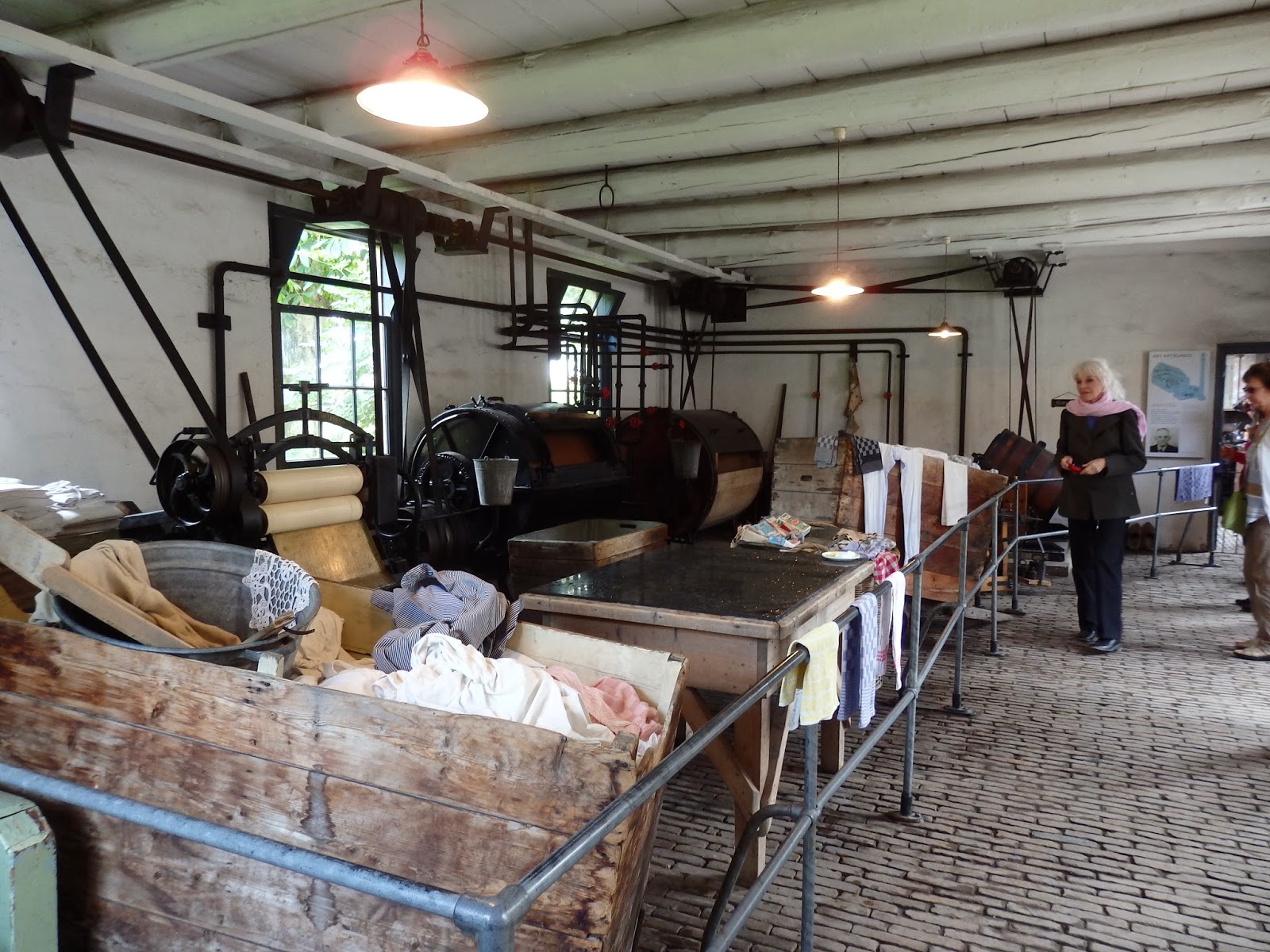
Hilbren explained that this open-air museum is similar to Williamsburg in the United States. And we did see a few people dressed in period costumes. They were working in some of the buildings and explaining their functions--i.e., the boiler/steam room, with the stoker who keeps the fire burning, which in turn drives the mechanism powering the laundry machines.


Doing laundry in the early 1900s was an amazingly detailed and time-consuming process, which a guy in that building explained. The soap-making, washing, rinsing, bleaching, stretching, pressing--overwhelming!

To find the most suitable houses for the museum village, staff members sent letters to all municipalities around the former Zuiderzee asking "if there were perhaps any buildings, large or small, earmarked for demolition, which could be regarded as characteristic of the former situation on the edges of the Zuiderzee." Many of the municipalities responded positively to this appeal; and only occasionally did the Museum actually have to buy a building. Most were donated.


Staff took into account the geographical origins, the function, and the social environment of each building, as well as the style, size, and façade within which the premises would be included. Streets, paths, ditches, and canals were assigned exactly the same dimensions as in their former situation. Historically-responsible paving, walls, and ground partitions completed the natural picture.


Various neighborhoods were created in this way: those around the church, the dike buildings, the town canal, and the fishing village, with a small polder between these last two. The Marken neighborhood (based on a copy of the Village of Marken), with the harbor, was the last neighborhood to be created.


Signs in front of each building explained what happened or who lived in the building. It was amazing what information has been culled from history and passed along to those who come after. These kilns burn shells from the North and Wadden Seas to create lime, which eventually is used in the manufacturing of cement.


We wandered and wandered through the little paths, over little foot bridges, and peeked into some shop windows. We entered the laundry, the church, the apothecary, and even flirted with some pigs who came running when I got close to the fence.


Last but not least, of course, the windmill is one of the mainstays of Holland's technological superiority in the Golden Age. They are used in paper-making, hemp-beating (a part of sail weaving), and pressing oil from linseed. In addition, they are indispensable in the impoldering of land or maintenance of the water balance. In all shapes and sizes, these old-fashioned wooden mills have nearly disappeared from the scene.

Hello to the Flower Market

 
On our way to Amsterdam and about an hour out of Delft, we stopped at the FloraHolland Aalsmeer Flower Auction, which is close to Holland's largest airport, Schiphol. This vast auction warehouse--an international trading platform for flowers and plants--ships merchandise literally all over the world on the day it's sold.
 

While we waited for Dirk to park the bus, Hilbren explained the details of the auction. Covering 243 acres (Wikipedia says it's the largest "building by footprint in the world"), it opens very early every day and employs over 4,000 people. Flowers from all over the world (Europe, Ecuador, Columbia, Ethiopia, Kenya, etc.) are traded and more than 20 million are sold daily with a 15% increase around Valentine's Day and Mother's Day--over 12 billion a year! That adds up to 4.4 billion euros annually.


I wonder how many football fields would fit in here. Each section on the floor is numbered, like a stadium.


Traffic is hectic on the floor where all the plants and flowers are moved around the warehouse on pallets. Much of the their movement is automated on tracks running this way and that. In other areas, workers stand on a fork-lift type machine, like a Segway, pulling pallets to and from the auction. Sometimes, they use a type of hand cart to pull the pallets in and out of line. It is organized chaos! And quite incredible to watch.


Buyers enter the refrigerators and look at the goods, take notes on what they want, and may call a customer about bidding on a particular item.


It works the opposite of an auction in the United States. In other words, the prices start high and work their way down. Entering an early bid gets a buyer what he/she wants at the highest price.


The buyers sit in a theatre-style room--30 to a row, 10 rows deep, with everyone on a computer and wearing headphones. Pallets wind their way in and out of the room on those automated tracks, like slow-moving train cars. Buyers view and bid continuously and electronically.
 

Automated clocks are mounted on the wall (a total of 38 auction clocks) plus a photo of the flower or plant currently open for bids and other automated information. The bidders only get a few seconds to take action before the product makes its way out of the room and is shipped off. Bidding activities continue until everything is sold.


This photo was taken from the bus after leaving the flower market on our way to Amsterdam (so it's not one of my best)--fields and greenhouses along the way, growing all of these beautiful flowers which eventually make their way through the market headed to Schipol. It was an interesting and fun stop.

Goodbye, Delft!


Breakfast was a 7:00 this morning because we were meeting in front of the hotel at 7:45 AM to hike to our bus. When we arrived the other day, Dirk had to park it many blocks away.


It's amazing he even got it in and then out of the parking lot this morning to head to Amsterdam. Fortunately, we had shorts-wearing Hilbren to help. It was a beautiful and sunny morning and Hilbren was expecting it to be warm.


But before we get to Amsterdam this afternoon, we still have a couple of stops to make: the famous Aalsmeer Flower Auction near Schiphol Airport and the Zuiederzee Outdoor Museum.

Thank You and Bon Voyage to Our Bus Driver


We have always had tour buses from the Belgium company, Heidebloem, and we have never been disappointed with the carriages nor their drivers. The buses are very spacious, very clean, and comfortable. And the drivers are polite, conscientious, and skillful. We have always felt safe in their care and always marvel at how they are able to navigate the narrow European streets.


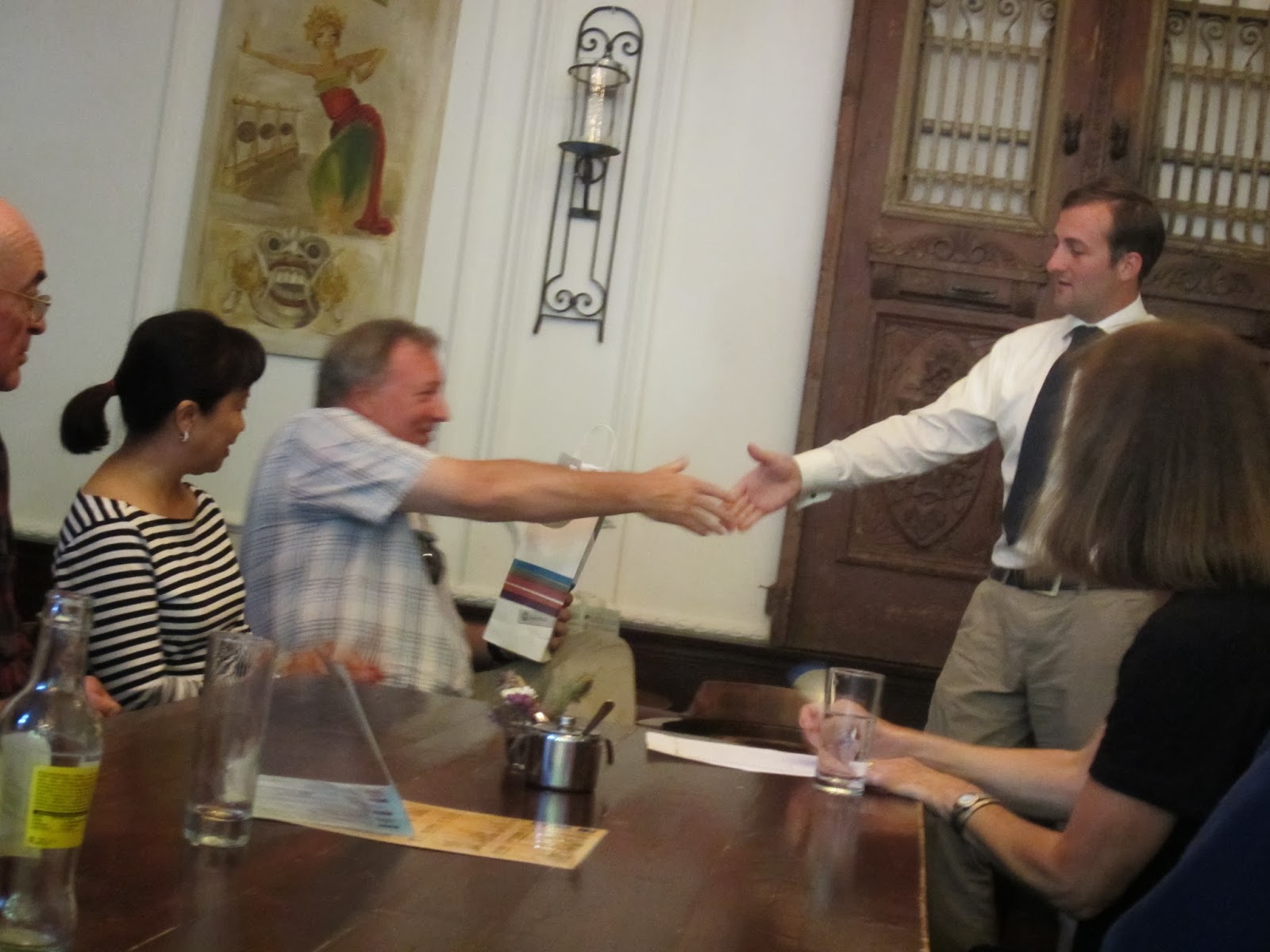
Dirk, our bus driver on this trip, will head home after dropping us off in Amsterdam tomorrow. So Hilbren arranged for some Dutch beer, liquors, and hors d'oeuvres--a say-goodbye-to-our-bus-driver happy hour. Plus, he presented Dirk with a bottle of spirits along with a thank you card signed by all of us.


It was enjoyable to visit and socialize with our tour buddies, which Sam and I hadn't done as much as we have on past trips. Plus, I finally took the time to interview Annika regarding what it's like to live in Chicago.


Sam decided that she didn't want to go out for dinner. WHAT? No hot meat?? She wanted to get into her jammies, put some ice on her eyes, and eat junk food. I'm sure it wasn't the most comfortable day for her and yet she persevered. She's tough!

So that's what we did this evening, while organizing and packing for the last stop on our trip. Ugh. We're now getting very tired of living out of a suitcase. Not to mention, we are happy to leave this hotel and the "scene of the accident!"

Monday, March 3, 2014

Maeslantkering Storm Surge Barrier and the Delta Project

Although this stop was a little mind-numbing for me--after all, we had been on and off the bus all day--I think the storm surge barrier was Sam's trip highlight. Hilbren had spent the day teaching us about the centuries-long struggle the Dutch have had with the seas. After the storm of 1953, they said "never again."
 

But the Netherlands exist in a low-lying Delta surrounded by water and the Port of Rotterdam must be accessible. So, how to solve the problem of and control storm surges? Six designs were submitted by companies within the Netherlands for the Delta Project--the barrier needed to be easy to maintain and not stop the flow of ships in and out of the port, even when there was fear of a surge. From those six companies, one was selected; and the barrier was installed in 1997.
 
Our group entered a grey metal industrial-looking building--the Keringhuis Museum labeled "Publiekscentrum Water--it looked more like a warehouse than a museum. But it held some interesting surprises. The huge photos, colorful layouts, and interactive displays were very impressive--in fact, critical for most of us to understand the concept. The very informed young man who was our guide explained in detail the history and workings of the barrier before we walked outside in the grey and windy weather.


If I understood correctly, this is how it works. As water rises--signaling a surge--the storm gates also rise, then shut, sinking to the riverbed and forming walls of steel. When storm season is over, the gates, which are open, sit on the docks to avoid corrosion--like they were today.

Every year on September 21st, they test the storm barrier by closing it (top photo), which is viewed by thousands who come out to watch. It stays closed for 12 hours so it can be examined and maintained. Since a major storm is expected only once every 10,000 years, I guess we'll never know if it will actually work! But what a lesson about how the Dutch survive living below sea-level.

The North Sea and the Port of Rotterdam


Well, Sam can't say she got to wade in the North Sea but at least we took our shoes off and walked across the softest and finest sand ever!


Hilbren surprised us by a short detour and stop at the North Sea. Hmmm, have I ever been on the shores of the North Sea before? Maybe when I was in the Netherlands during my first trip here in 1989.


It was very windy and many wind surfers were out. The span of sand from where we were standing to the sea was probably a football-field away.


Next, we drove by the Port of Rotterdam, one of the main ports and the largest logistic and industrial hub of Europe. It is the gateway of more than 350 million consumers to the European market. And with an annual throughput of 450 tons of cargo in 2012, it is by far the largest seaport of Europe.


It seemed to go forever and ever.--which makes sense because the port stretches over 40 kilometers (25 miles) and is about 12,500 hectares (nearly 31,000 acres). Unfortunately, the photos of the port are not very exciting.

Rebuilt Town of Zierikzee


Rebuilt after the catastrophic 1953 North Sea Flood, we stopped in Zierikzee to wander in the sun and find some lunch. What a beautiful day it was; we were lucky on this trip as far as weather went. After Hilbren gave us an introduction, we were free to take off, snap some photos, and find a place for lunch.


The town fronting the water was all rebuild since the flood, even though they kept the style of the original buildings.


We love these old drawbridges (this one, not so old) which are all over the Netherlands.


Fish and chips for lunch along the waterfront. What could be better? They were delicious and I ate too much (including an ice cream cone)!


And here's where we had our group photo taken, in front of the village's windmill.

Back on the bus and then a surprise stop at the North Sea.

The Netherland's Watersnood Museum


About 20 minutes from Bruges, we left Belgium and entered the Netherlands at Zeeland (translation," sea land"). Most of the land--a collection of islands--lies below sea level and was reclaimed over time from the sea, rivers, and lakes by the Dutch. In the process, the shape of the landscape has changed at the hands of both man and nature.

That's where the famous windmills enter into the picture. After diking off large tracts of land below sea level, the Dutch used those to harness wind energy, lifting the water up out of the enclosed area, diverting it into canals, and draining the land--called polders. They then cultivated hardy plants--like barley, followed by wheat--to remove salt from the soil, slowing turning marshy estuaries into fertile farmland. The windmills later served a second purpose for farmers by turning stone wheels to grind their grain.

 
Dutch reclamation projects are essentially finished. But in this era of global warning and rising sea levels, the Dutch are developing plans to upgrade their dikes and bulk up their beaches to hold back the sea. They also continue to innovate, building floatable homes and greenhouses (which rise with the tides) and relocating dikes farther from the rivers (to create wider floodplains). All this technological tinkering with nature over the centuries translated into a popular local saying: "God made the Earth, but the Dutch made Holland."
 

We finally--we drove for a couple hours, including a wrong turn because of construction--arrived at the town of Zierikzee and found the Watersnood (Flood) Museum in Ouwerkerk. This museum displays exhibits from the natural disaster which took place on the night of January 31, 1953 when the dykes gave way for a night of incredible flooding and mass destruction. Hilbren's uncle lived here at the time and swam all night to survive. Afterwards, he moved to Canada and never wanted to return because his memories were so traumatic.


Besides being dedicated to the North Sea Flood of 1953, the museum--which is located inside four massive breakwaters or caissons which were used to plug the last gap in the dike here--also shows how the Netherlands works with and against water, The caissons were from England and originally intended for one of the Allied landings at Ostend in Belgium, which was never realized.


For that reason, it was very cold in here--a very large exhibition "hall" full of exhibits, maps, books, records of the deceased, interactive displays, etc. We could've spent many hours educating ourselves but we only had about 45 minutes, much of which was taken up by watching a movie prior to wandering through the caissons.


Tens of thousands had to flee their homes that night; and 1,800 people lost their lives. The dreadful night obviously caused sheer devastation. But since that time, the Dutch government and people have worked to ensure this type of disaster never happens again. It was extremely sobering to see some of the remnants from the destruction to peoples' lives.


Next, we were headed to the rebuilt town of Zierikzee because the original one was damaged by the 1953 catastrophe.

Entering the Netherlands


This morning's bus ride was long today as we left Belgium and entered the Netherlands. I like the way this photo taken from the bus focused on the little barge heading along the canal next to the road leaving Bruges.
 
In Holland's 17th century Golden Age, the tiny country (Holland is just a nickname for the Netherlands) was a world power--politically, economically, and culturally--with more great artists per square mile than any other country at that time. Today, it is Europe's most densely populated and also one of its wealthiest and best organized.
 
"Netherlands" means "lowlands" and the country occupies the low-lying delta near the mouth of three of Europe's large rivers. In medieval times, inhabitants built a system of earthen dikes to protect their land from flooding caused by tides and storm surges. But in 1953, as we were to find out, severe floods breached the old dikes, killing 1,800 and requiring a major overhaul of the system.

Today's 350 miles of dikes and levees are high-tech with electronic systems to monitor water levels. Dutch experts traveled to Louisiana--and vice versa--after Hurricane Katrina to share their expertise with US officials after levee failure there caused massive flooding. And following Hurricane Sandy, American hydrology experts began looking to the Netherlands for models of how to protect vast areas from flooding. We would have a full day filled with learning about water management by the Dutch.

Saturday, March 1, 2014

On Our Way to Ghent

 
After a hearty breakfast this morning at our hotel (what did we do/eat last night?), which not only included assorted breads and jams as shown in this photo, but also sliced meats, fruits, vegetables, condiments (to make sandwiches, never my favorite in the mornings), we left Brussels at 8:30 on our favorite Heidebloem bus with driver, Dirk. (Our all-time favorite driver is Renee but we haven't seen him in a long time.)
 

On the way out of the city, we drove around the 1958 World's Fairgrounds in order to see the symbol of the event that year--a giant, silvery iron molecule, the Atomium. Escalators and stairs connect the various "atoms" so you're rewarded from the top sphere with views of the park complex and the Brussels' skyline, some of the best in the city. Or so we hear... We were only allowed off the bus to take some photos. We had a schedule, you know.


The drive to Ghent took about an hour; and when we arrived, Hilbren walked us around the town, weaving our way through a busy market (where we lost one of our couples), down quaint narrow streets, next to and along some little canals. He also swung us into the Cathedral of Saint-Bavo for a quick history lesson (separate post).


One of the biggest cities in Europe during the 14th century, Ghent had a population of around 65,000--massive in an age when most of Europe was rural farmland. North of the Alps, only Paris was larger. Two-thirds of the population was made up of textile workers, making medieval Ghent Europe's first industrial city and a powerhouse made very wealthy by the textile trade. But like its rival Bruges, Ghent's fortunes eventually fell, yet leaving it with a well-preserved historical nucleus. Instead of oozing with charm and cobbles like Bruges, it is now home to Belgium's largest university and is a living, thriving city. Today's population is around 240,000.


This Meat Hall (Groot Vleeshuis) sits in Vegetable Market Square. It has seen better days, but was built entirely without nails, employing ship-builders' expertise. For hygienic reasons, until the 19th century, this was the only place in town allowed to sell meat. Today, we still see locally-cured hams hanging from the rafters next to a restaurant and a shop selling specialty products. (It was also our bathroom stop in Ghent!)

Before meeting for a canal cruise, we were on our own for lunch. After retracing our steps, Sam and I ended up at the little stand recommended by Hilbren. He was already there when we arrived; and eventually, a few more of our group showed up.


For less than 5 euros, we enjoyed a sausage sprinkled with onions and stuffed with cheese; yummy well-made frites (fried the correct way, Hilbren explained--in two different vats of oil); and a soda. Again, following the tradition in this part of the world, Sam enjoyed hers with mayonnaise (versus catsup); I had tartar sauce this time--something different. We sat on a short concrete wall across from the stand, people-watched, and enjoyed our meal.


Now, it was off to a canal cruise, the first and only one on this trip.