Showing posts with label Eating. Show all posts

Friday, March 7, 2014

Final Group Dinner


The restaurant, called the Pantry, served typical and authentic Dutch comfort food. Hilbren explained that there are few Dutch restaurants in the Netherlands because Dutch food is uncomplicated and homey. So most people eat at home. The majority of restaurants in the city serve food from other places: Indonesian (especially popular), Asian, and Italian, to name a few.


As you can see, we were pretty packed in here. Plus, it was a Friday night so the place was crowded. For our group dinners, we had pre-ordered our meals a day or two in advance from choices posted by Hilbren (however, we could never remember our selections!). This, as I may have mentioned before, makes it much easier for the restaurant staff to prepare and serve our rowdy group. 


Tonight, the starter choices were goat cheese croquets, shrimp croquets, or Dutch pea soup. The main course choices were a salmon filet with mashed potatoes; ground beef with sautéed onions, mashed potatoes and beets; or a ground beef casserole with cauliflower and "Old Amsterdam Cheese."


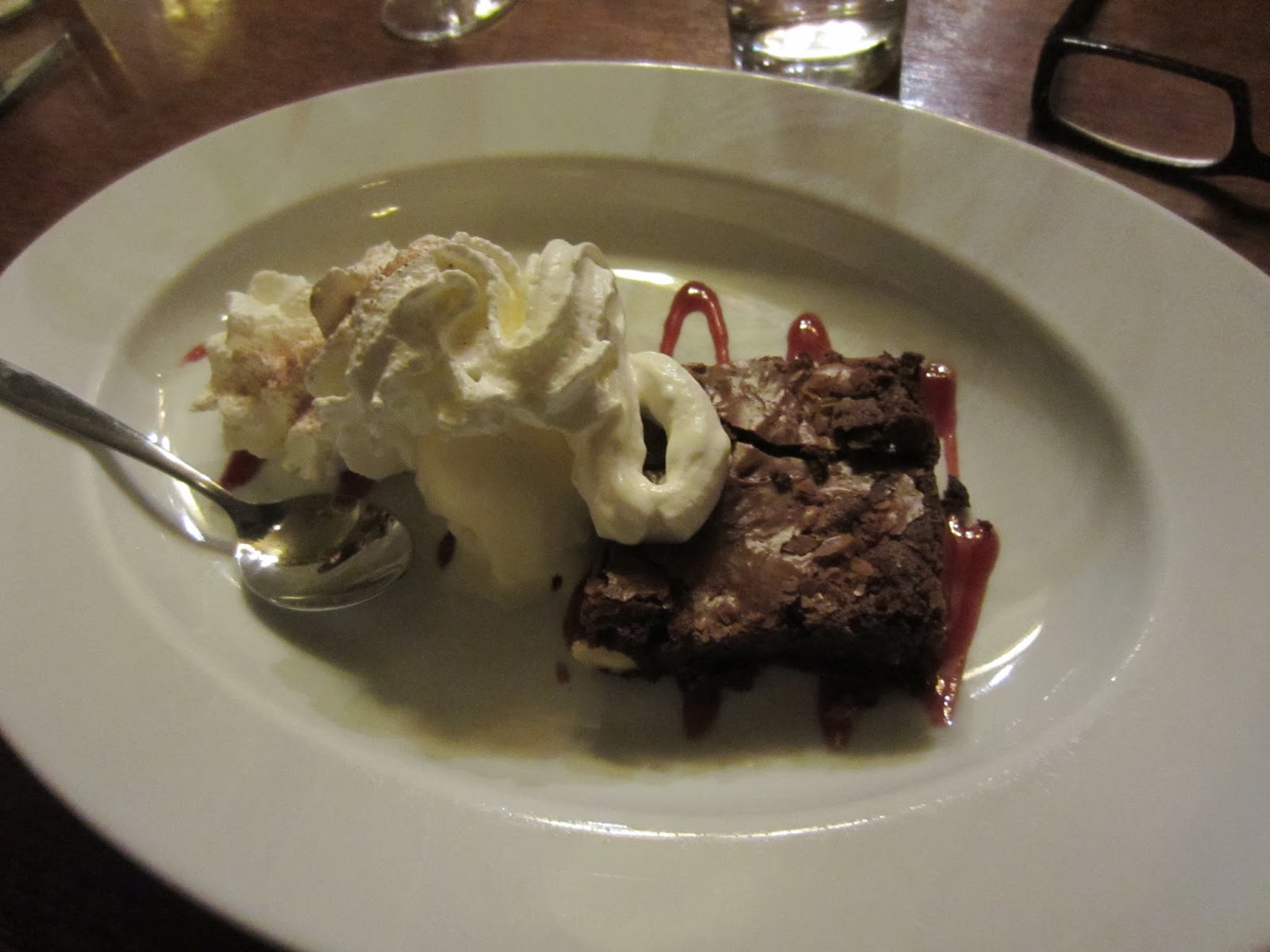
And, the dessert choices--the only ones I care about--were chocolate brownies; Vlaaflip (a mixture of yogurt, cottage cheese, and custard--seriously!?); or Poffertjes (little pancake fritters). By now, we had had enough Dutch pancakes and you can guess what most of us chose.

On the way back, we wandered through Vondelpark, a huge, lively city park popular with the Dutch. Families with little kids, romantic couples, strolling seniors, and even hippies sharing blankets and beers hang out here. It is also a popular and favored venue for free summer concerts and Friday night inline skating during the summer and early fall.


Although some of our buddies continued the party, Sam and I quietly slipped away to return to the hotel. We had an taxi reserved for 6:00 AM the next day so the alarm would ring early. We were headed back to Houston after another fun sisters' trip to Europe.

Our Traditional Old Friend, Plus Dam Square


Sam and I have a tradition of eating at McDonald's in all the European cities we visit. I mentioned to her when we arrived in Amsterdam (our last stop) that we hadn't done it yet on this trip... And yesterday, while walking with the group down the pedestrian street, Kalverstraat, guess what we spied?


So this afternoon, we found our way back to maintain our tradition. Some travelers consider it sacrilege to stop at a Burger King, a Starbucks, a McDonalds when out of the country. But we've stopped hiding from this; sometimes, you just need a "taste of home." (Yes, sir, we've seen a lot of museums in eleven days! I love this shirt!)

On the way back to the hotel, we walked again through Dam Square, which is the historic heart of the city. Amsterdam got its start here around 1250, when fishermen in this marshy delta settled along the built-up banks of the Amstel River. They built a "damme" to bloc the Amstel River and created a small village called "Amstel-damme." Get it?


My memories of Dam Square are from my very first trip to Europe in 1989. The square seemed bigger then (isn't that always the way?) and was busy, busy, busy with drunks, bums, and street entertainers, like this accordion player entering his "venue" today to join the mimes, jugglers, and human statues who still mingle with locals and tourists. I even remember from my first trip a person swinging on a trapeze which reached into the air! And all this was happening during the day--you can imagine what "events" were held in the evenings. But Amsterdam has been cleaned up over the decades and is not as seedy as my first impressions attest. And yet I have very fond memories of that trip.


The Bulldog Café Coffeeshop, towards where the accordion player is headed, is not the most famous or original Bulldog, which is in the Red Light District facing a canal. The chain claims to be the city's very first marijuana coffeeshop established here in 1975. It is a famous and well-known destination for all young American visitors--touristy like a Hard Rock Café. True connoisseurs (and Rick Steves' tour members), however, seek out smaller, neighborhood places with better-quality pot and those playing Donovan music for their older and mellower clientele.

Visiting the Rijksmuseum


The 17th century saw the Netherlands at the pinnacle of its power when they won their independence from Spain. Trade and shipping boomed; wealth poured in; the Dutch people were understandably proud; and the arts flourished. This became their Golden Age. And after so much sober religious art from the Middle Ages, artists discovered upper-middle-class businessmen in the Protestant republic who fueled Holland's capitalist economy and thus, commissioned big canvases to flaunt their prosperity. In the 17th century alone, five million paintings were hanging in those peoples' homes. Eventually, the best of these needed a place to be displayed.


This morning found our group marching to a guided tour of the Rijksmuseum (which means, the "State Museum"). Thanks to a ten-year, 374 million euros renovation, it once again matches the vision of its 19th century architect, Pierre Cuypers. Built in 1885 to house the Netherland's greatest art, a series of brutal 20th century renovations chopped up and painted over a great amount of the massive complex. But today, much of Cuypers' original Gothic-revival design is back: natural light floods large rooms with high ceilings and long viewing galleries surround two massive courtyards, walled up for half a century.


The Rijksmuseum has up to 8,000 works on display (from the 13th through the 20th centuries), including several thousand paintings. The incomparable collection of 17th century Dutch Masters includes those by Rembrandt, Vermeer, Hals, and Steen. Now, around the museum, many pieces are displayed together in their cultural context, making the exhibits a lively mix of Delftware, photographs, decorative objects, paintings, etc. The renovation has restored this great building to its original 1885 glory. And it's beautiful inside.


After an informative tour by a docent (we were divided into two groups), we were released to continue exploring on our own. It's a huge place and there were lots of things we wanted to see.


Of course, Sam and I were "forced" to try some fancy drinks and sweets in the fancy café before we continued our treasure hunt. It seems like we're now doing "morning cake and coffee!" Delicious!


Climbing up to the second floor on a staircase which hasn't been replaced since 1885, we entered the Great Hall. With its stained-glass windows, vaulted ceiling, and gilt moldings, this looks like the inside of many cathedrals we've seen on our travels. And it is--a cathedral to Dutch art and history. For more than 50 years, this space was painted over and used as a lobby and gift shop. For the recent restoration, it was returned back to Cuypers' design. The late-Victorian murals on the walls are original, restored after a long absence--the murals were deemed chauvinistic and taken down in the 1920s. They celebrate great moments in Dutch history--lots of explorers and warrior kings.
 
 
Who doesn't recognize Frans Hals' (1581-1666) the "Merry Drinker," which he painted in 1627? This jovial man in a black hat captures the earthy, exuberant spirit of the Dutch Golden Age. The militiaman merrily raises his glass of Berkemeyer to toast us. Hals' bravura painting style--the spontaneously applied brushstrokes enhancing the portrait's sense of liveliness and animation--ensured the continued success of the artist. We were now headed, along with many other museum visitors, to see the famous Vermeer section.
 
 
The master of tranquility and stillness, most of Vermeer's canvases show interiors of Dutch homes where women are engaged in everyday activities, lit by a side window. The Rijksmuseum has the best collection of Vermeers in the world--four of them. (There are only 34 in captivity, including "The Music Lesson" owned by Her Majesty Queen Elizabeth II.)
 
 
In one of my favorites, "The Milkmaid" (1658), a maidservant, entirely absorbed in her work, pours milk  into a bowl. Except for the stream of milk, which you can almost hear, everything else is still. The sign next to the painting explains, "Vermeer took this simple everyday activity and made it the subject of an impressive painting--the woman stands like a statue in the brightly lit room. Vermeer also had an eye for how light by means of hundreds of colorful dots play over the surface of objects."
 
We saw much, much more, like Rembrandt's "Isaac and Rebecca: (a.k.a. "The Jewish Bride", 1667), but our minds were saturated and it was time to move on.
 

Thursday, March 6, 2014

Do You Feel Anything Yet?

 
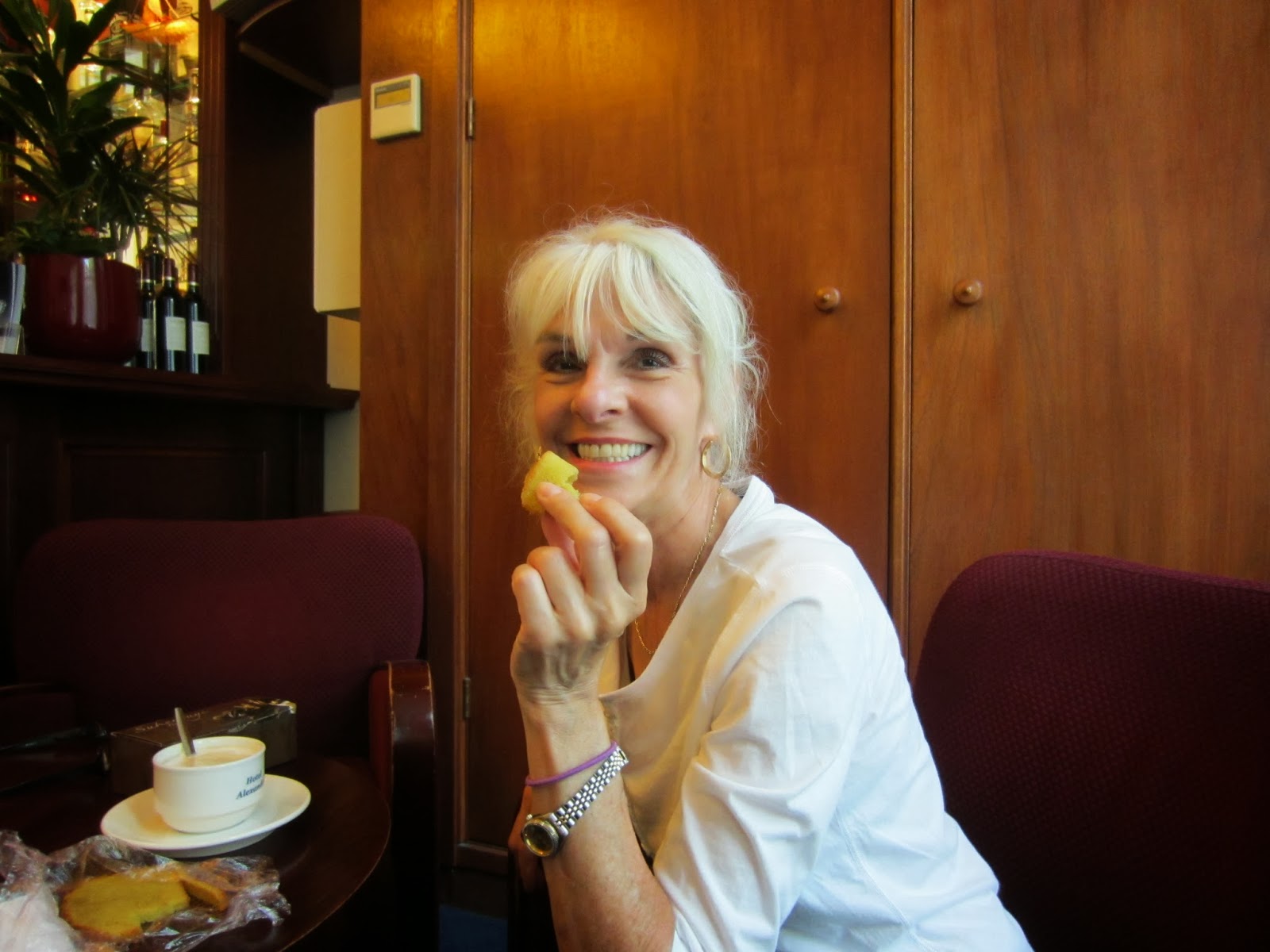
After touring the Van Gogh museum and returning to the hotel, Sam took a rest while I headed to the lobby for an espresso, some Bruges chocolates, and to test my "cake." I was a little hesitant because I have never indulged in marijuana and didn't want to make a fool of myself--who knew how I was going to react to this soft drug. I had an interesting conversation with the young hotel clerk (very hip and nice--probably the son of the owners) and he was very intrigued (or incredulous?) by my experiment.


I decided to only eat a small piece--not even a quarter slice, as listed on the package instructions. And every 15 minutes, the young man looked over at me and said, "Do you feel anything yet?" I didn't--and just continued reading and relaxing. Eventually, Sam came downstairs and our tour buddies began drifting into the lobby, returning from their afternoon adventures.


It was obvious that I wasn't the only one who had been eating "cake." Bud, the guy from Cape Cod, had already been snacking and looked a little bleary-eyed. And the big, burly retired Brooklyn cop came downstairs wearing an earring! Sam and I hadn't really mixed with any of the group outside of group events so we joined several couples and Bud for a nice dinner that evening. "Do you feel anything yet?"

 
We walked to a lovely restaurant, Bicken, and sat outside; it was a very nice evening and we had a lot of laughs. Closest to the camera are Mike and Peggy from Sonoma, CA; then Pam and Larry from Brooklyn; Bud (waving) from Cape Code; and Herman and Kay from Youngstown, OH.


As you can tell, this was a fairly fancy place (expensive)--small portions of food but displayed beautifully.

 
And by this time, I was feeling something--very, very giggly--more so than usual. And at one time, Sam leaned over and said I was pretty quiet (which is VERY unusual). Besides the intermittent giggling, I remember thinking (again) that I did not want to make a fool of myself. And I was having trouble following the conversations going on around me. By the time someone made it to the end of a sentence, I had lost track of the beginning of it! Very strange.
 
I tried to explain this to the lobby clerk when I returned--because he caught my eye right away and asked, "Do you feel anything yet?" I said that I was really giggly but that could've been because I was drinking wine. His eyes widened and he blurted out, "You were drinking wine, too!?!" "Was I not supposed to?" I asked...


I had complained that my sleep the previous night was like being in a Dali painting--I believed I never slept because objects were constantly flying around in my brain. This night--after eating some "cake"--I again believed that morning arrived without any sleep. But as I lay in a comatose state, the objects (or thoughts) were lazily floating around in my brain and I was entirely calm. The next day, I handed the rest of my "cake" to Bud. I knew it was in good hands...

A Begijnhof, the English Reformed Church, and Lunch at Blue


We have been introduced to Begijnhofs in other cities, a spot that's not only a tourist attraction but a place where people live. This quiet and peaceful courtyard, lined with houses around a church, has sheltered women since 1346 (and is quite a contrast from noisy Kalverstraat, along which we had walked after leaving the "hidden" church).

The Begijnhof was for centuries the home of a community of Beguines--pious and simple women who removed themselves from the world at large to dedicate their lives to God. When first established, it was literally a "woman's island"--a circle of houses facing the courtyard and surrounded by water.


This statue of one of the charitable sisters sits just beyond the courtyard's entrance near the church. The Beguines' ranks swelled during the Crusades when so many men took off--never to return--leaving society with an abundance of single women. Poor and rich alike--as well as those widowed by the hazards of overseas trade--turned their backs on materialism and marriage to live out their days as Beguines in Christian poverty and to serve others.

Very popular for their simple, unpretentious Christ-like dedication, they spent their days deep in prayer and busy with daily tasks--spinning wool, making lace, teaching, and caring for the sick. Though obedient to a mother superior, the members of the lay order were not nuns. In quiet seclusion, they provided a striking contrast to the more decadent and corrupt Roman Church, inspiring one another as well as their neighbors.


We then walked into the brick-faced English Reformed church, which was built in 1420 to serve the Beguine community. In 1578 when Catholicism was outlawed, the Dutch Reformed Church took over many of these Catholic monasteries. Still, the Begijnhof survived; and in 1607, this church became Anglican.


The church served as a refuge for English traders and religious refugees fleeing persecution in England. Strict Protestants such as the Pilgrims stopped in tolerant Amsterdam, praying in this church before sailing to religious freedom in America. In fact, the stained glass at the far end shows Pilgrims praying before boarding the Mayflower. And on the altar sits a Bible from 1763. Amazing history.

We were finally "dismissed" for lunch so Sam and I headed to the third floor of an American-like shopping center. Their "Blue" café, which Hilbren recommended, was modern, intimate, and comfortable with a beautiful view (also "blue" today).


And the food was great, too! We both had sandwiches but mine was an open-faced one with cheese, honey, and pecans. Ahhh, we needed the break and did I mention the view?


We were now fueled up for our next stop, the Van Gogh Museum.

Wednesday, March 5, 2014

Orientation, Metro Lesson, Indonesian Food

 
We met in front of the hotel at 6:00 PM and Hibren led us on an orientation walk through the streets on our way to tonight's restaurant. This involved a lesson--one that makes Sam's hair stand on end--in using the trams.
 
 
Although I am now very comfortable riding the Paris Metro and buses, I don't speak or read Dutch and it's always a challenge to learn the particular process--which doors to enter, which to exit, how to validate the tickets, etc. (Frankly, I did screw up when exiting one day! But I wasn't caught and think it was the last time we planned to use the two-day pass anyway; so no harm, no foul.)
 
 
Leidseplein, named after a particularly bustling square, was our nearest stop and I think we were always supposed to look for trams marked with #5. (Probably the reason I snapped this photo, journalist that I am...) And, we weren't the only ones trying to get oriented.


Five hundred years of history with the former Indonesian colony has made their food a favorite with the Dutch. You can experience a rijsttafel (literally, "rice table") at most of these restaurants--food served as we would describe "family-style." 


Our dinner was served with lots of rice and around twelve dishes to share: tofu satay with peanut sauce, tempeh satay, spicy tofu, mango and pineapple salad with peanut dressing, spicy green beans, garlic chips, and more. It was a feast for--especially--vegetarians and we liked many of the dishes. The table at which Sam and I sat left a lot of food at the end; however, the other tables really chowed down!

After leaving the Sampurna Indonesian restaurant, we walked through the Red Light District before going home for sleep!

Tuesday, March 4, 2014

Lunch at the Zuiderzee


Lunch was on our own so after walking around the museum, which was frankly massive, Sam and I decided we better find our meeting place before selecting a place to eat. On our way to the small town, we walked pass some silly goats making good use of an abandoned boat next to a canal.

It was a beautiful, sunny, and comfortable day for a nice walk. And we wanted to eat on the "sunny side of the street" so we were looking for a café with outdoor seating in the sun.


Lucky us because we found exactly what we wanted not too far from our meeting place. There was even a little draw bridge and Sam hoped to see it raised for a boat to sail through.


I had another "pancake" with apples and bacon and Sam chose a very colorful and hearty-looking salad.


Truth be told, I'm all about the syrup and the powdered sugar!


Our patience finally paid off. Before we finished eating, we noticed the bridge spans begin to separate and rise up. And although our photos didn't successfully show the boats (they were low in the water), we were treated with seeing one or two of their sails pass by.

 
And we weren't the only ones enjoying the view and snapping photos. But now, we better get to the bus!

Zuiderzee Outdoor Museum


After the flower auction, we headed to the Enkhuizen Zuiderzee Outdoor Museum. And to get there, we drove over a lot of water and some interesting bridges to ride a boat to the museum's entrance. While waiting on the dock, Bud, one of our tour mates, wanted a photo of our "fall colors," he said--poor Sam and her bruised eyes.


The museum was founded in 1948 with the purpose of documenting the fishing culture around the Zuiderzee. When cut off from the North Sea in 1932, thus becoming an inland sea, people were concerned that the culture of the former region would disappear completely. These 15 acres on which the museum stands were built on the outside of the seawall separating Enkhuizen from the water on its east side. The little peninsula was created by spraying sand from the seabed.

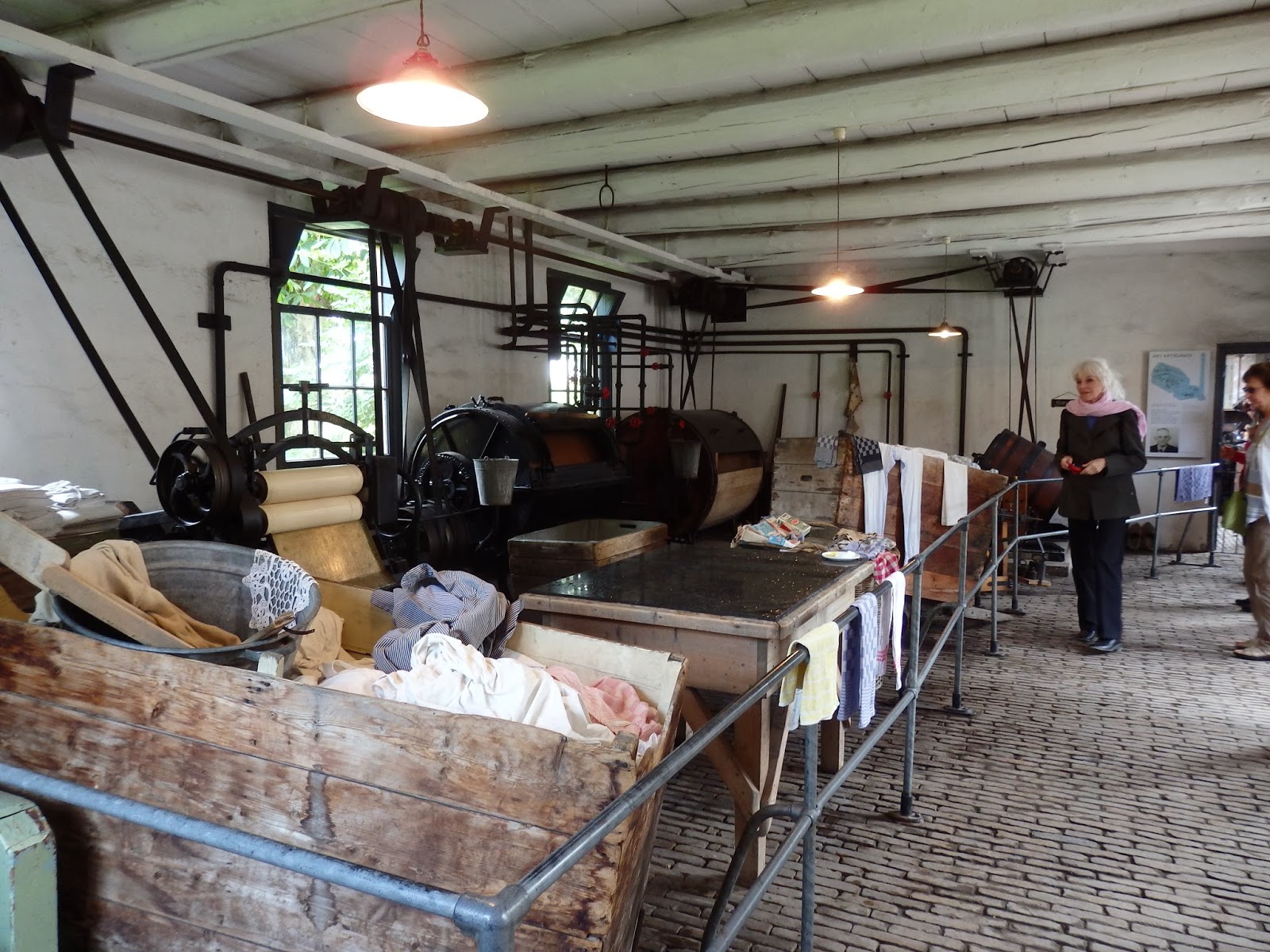
Hilbren explained that this open-air museum is similar to Williamsburg in the United States. And we did see a few people dressed in period costumes. They were working in some of the buildings and explaining their functions--i.e., the boiler/steam room, with the stoker who keeps the fire burning, which in turn drives the mechanism powering the laundry machines.


Doing laundry in the early 1900s was an amazingly detailed and time-consuming process, which a guy in that building explained. The soap-making, washing, rinsing, bleaching, stretching, pressing--overwhelming!

To find the most suitable houses for the museum village, staff members sent letters to all municipalities around the former Zuiderzee asking "if there were perhaps any buildings, large or small, earmarked for demolition, which could be regarded as characteristic of the former situation on the edges of the Zuiderzee." Many of the municipalities responded positively to this appeal; and only occasionally did the Museum actually have to buy a building. Most were donated.


Staff took into account the geographical origins, the function, and the social environment of each building, as well as the style, size, and façade within which the premises would be included. Streets, paths, ditches, and canals were assigned exactly the same dimensions as in their former situation. Historically-responsible paving, walls, and ground partitions completed the natural picture.


Various neighborhoods were created in this way: those around the church, the dike buildings, the town canal, and the fishing village, with a small polder between these last two. The Marken neighborhood (based on a copy of the Village of Marken), with the harbor, was the last neighborhood to be created.


Signs in front of each building explained what happened or who lived in the building. It was amazing what information has been culled from history and passed along to those who come after. These kilns burn shells from the North and Wadden Seas to create lime, which eventually is used in the manufacturing of cement.


We wandered and wandered through the little paths, over little foot bridges, and peeked into some shop windows. We entered the laundry, the church, the apothecary, and even flirted with some pigs who came running when I got close to the fence.


Last but not least, of course, the windmill is one of the mainstays of Holland's technological superiority in the Golden Age. They are used in paper-making, hemp-beating (a part of sail weaving), and pressing oil from linseed. In addition, they are indispensable in the impoldering of land or maintenance of the water balance. In all shapes and sizes, these old-fashioned wooden mills have nearly disappeared from the scene.

Thank You and Bon Voyage to Our Bus Driver


We have always had tour buses from the Belgium company, Heidebloem, and we have never been disappointed with the carriages nor their drivers. The buses are very spacious, very clean, and comfortable. And the drivers are polite, conscientious, and skillful. We have always felt safe in their care and always marvel at how they are able to navigate the narrow European streets.


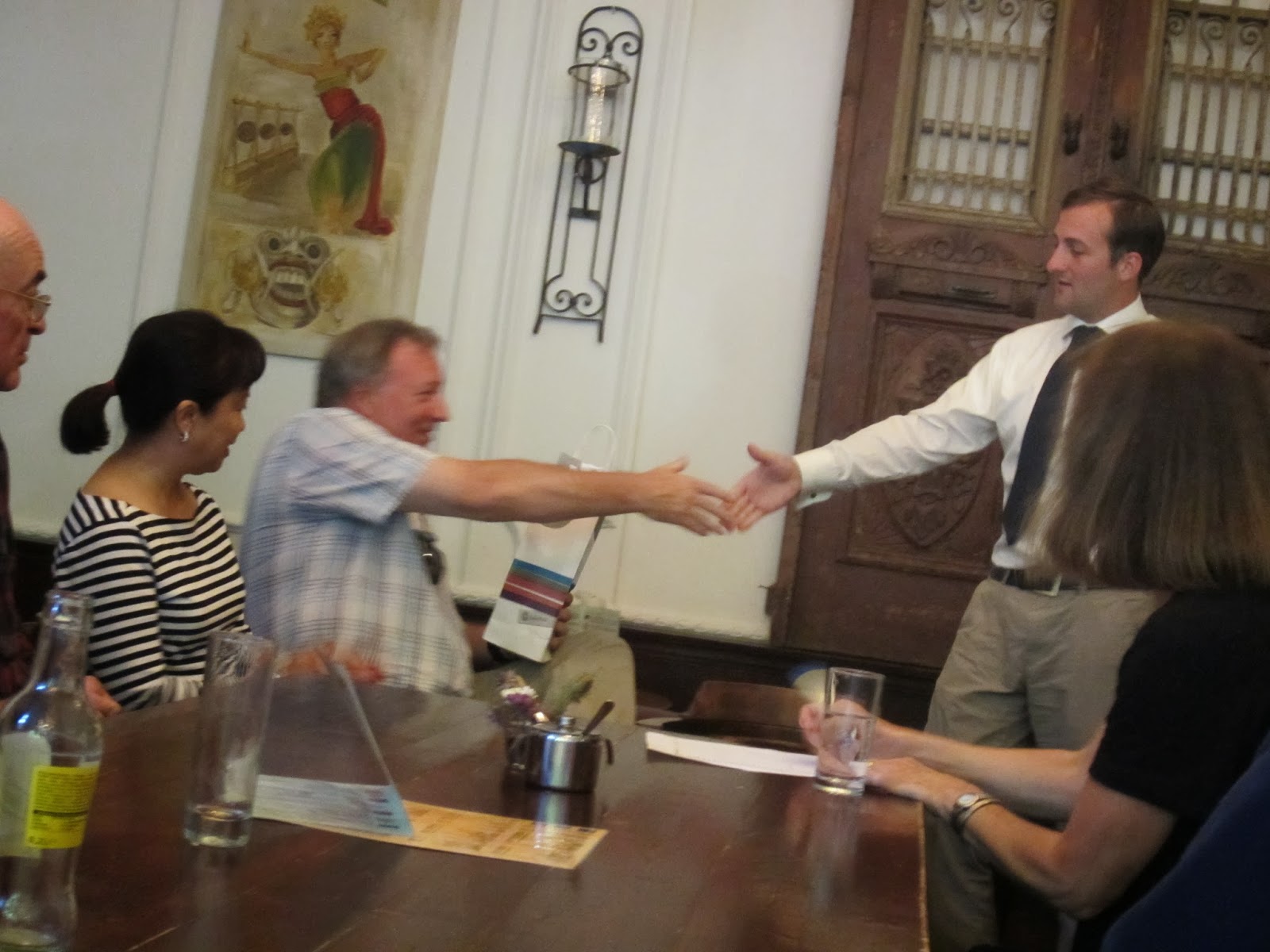
Dirk, our bus driver on this trip, will head home after dropping us off in Amsterdam tomorrow. So Hilbren arranged for some Dutch beer, liquors, and hors d'oeuvres--a say-goodbye-to-our-bus-driver happy hour. Plus, he presented Dirk with a bottle of spirits along with a thank you card signed by all of us.


It was enjoyable to visit and socialize with our tour buddies, which Sam and I hadn't done as much as we have on past trips. Plus, I finally took the time to interview Annika regarding what it's like to live in Chicago.


Sam decided that she didn't want to go out for dinner. WHAT? No hot meat?? She wanted to get into her jammies, put some ice on her eyes, and eat junk food. I'm sure it wasn't the most comfortable day for her and yet she persevered. She's tough!

So that's what we did this evening, while organizing and packing for the last stop on our trip. Ugh. We're now getting very tired of living out of a suitcase. Not to mention, we are happy to leave this hotel and the "scene of the accident!"