Showing posts with label Tour Group. Show all posts

Friday, March 7, 2014

Final Group Dinner


The restaurant, called the Pantry, served typical and authentic Dutch comfort food. Hilbren explained that there are few Dutch restaurants in the Netherlands because Dutch food is uncomplicated and homey. So most people eat at home. The majority of restaurants in the city serve food from other places: Indonesian (especially popular), Asian, and Italian, to name a few.


As you can see, we were pretty packed in here. Plus, it was a Friday night so the place was crowded. For our group dinners, we had pre-ordered our meals a day or two in advance from choices posted by Hilbren (however, we could never remember our selections!). This, as I may have mentioned before, makes it much easier for the restaurant staff to prepare and serve our rowdy group. 


Tonight, the starter choices were goat cheese croquets, shrimp croquets, or Dutch pea soup. The main course choices were a salmon filet with mashed potatoes; ground beef with sautéed onions, mashed potatoes and beets; or a ground beef casserole with cauliflower and "Old Amsterdam Cheese."


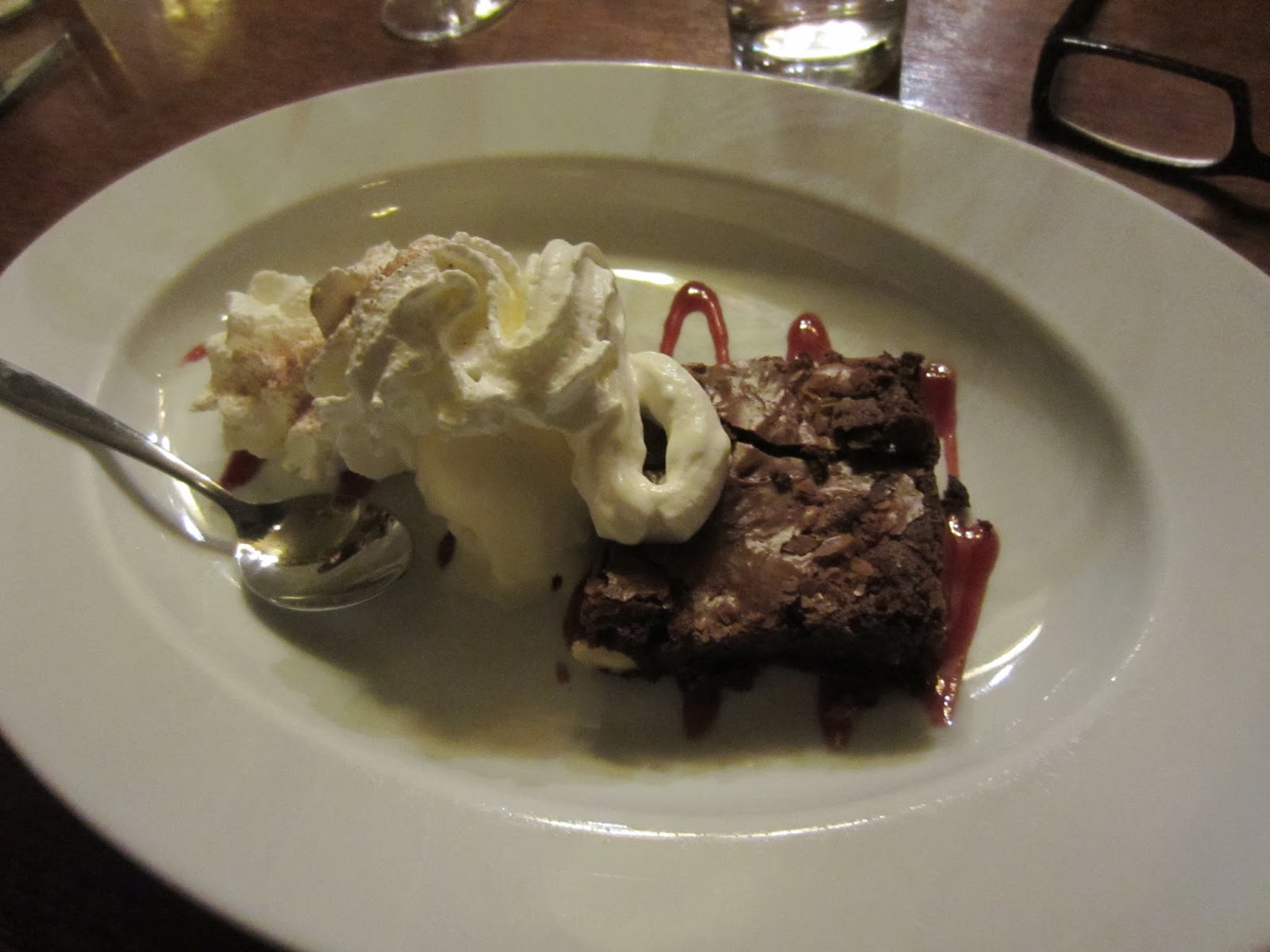
And, the dessert choices--the only ones I care about--were chocolate brownies; Vlaaflip (a mixture of yogurt, cottage cheese, and custard--seriously!?); or Poffertjes (little pancake fritters). By now, we had had enough Dutch pancakes and you can guess what most of us chose.

On the way back, we wandered through Vondelpark, a huge, lively city park popular with the Dutch. Families with little kids, romantic couples, strolling seniors, and even hippies sharing blankets and beers hang out here. It is also a popular and favored venue for free summer concerts and Friday night inline skating during the summer and early fall.


Although some of our buddies continued the party, Sam and I quietly slipped away to return to the hotel. We had an taxi reserved for 6:00 AM the next day so the alarm would ring early. We were headed back to Houston after another fun sisters' trip to Europe.

Max Euweplein and Tiny Souvenirs


Rick Steves' tours always end with a group dinner, our final gathering. And I think this was the first time on this trip where we had to walk in a little downpour on our way to the restaurant. We've been lucky with the weather; in fact, I know I was dressed too warmly on some days.


This scene caught our attention as we scurried by. In a pleasant interior courtyard surrounded by cafés and the ever-popular Hard Rock, this large chessboard with knee-high kings gets a lot of attention. The square is named after Max Euwe, a Dutch world chess champion. He is known for beating 14-year-old Bobby Fischer in 1957 with 20 moves.


We quickly took shelter under a row of tall, grey, Greek-style columns next to the square. Had we not had our heads tucked into our collars to avoid rain in our faces, we might've seen the Latin inscription above the colonnade--"Homo Sapiens non urinat in ventum." It supposedly translates to "People, don't pee into the wind." Good advice.


This is where we paused for Hilbren to give a little speech and hand out a little souvenir. I will add these tiny porcelain blue and white Dutch shoes to my miniature reminders of past Rick Steves' tours.

Rembrandt's "Night Watch "

This is one of the most famous and well-known paintings hanging in the Rijksmuseum and deserves a separate post. As usual, the more you learn about a painting, the more interesting it becomes. Rembrandt's masterpiece, the "Night Watch," his most famous--though not necessarily greatest--is a group portrait of a company of Amsterdam's militiamen, the city's civic guard. Rembrandt made the painting in 1642 at the age of 36 for their guild headquarters, the Kloveniersdoelen. It hung in the large assembly room, together with six other group portraits.
 

Standing in the foreground are Captain Frans Banninck Cocq (in black with a red sash) giving an order and Lieutenant Willem van Ruytenburch, focusing on the captain's every word. That Rembrandt depicted the militiamen in action is quite exceptional; until then, "sitters" in such group portraits were either standing or sitting stiffly next to one another.

The painting is full of action: flags waving, drums beating, the guardsmen (who, by the 1640s, were really only an honorary militia of rich bigwigs) spilling onto the street from under an arch in the back. It's "all for one and one for all" as the soldiers grab lances, load their muskets, and rush to Amsterdam's rescue.

Rembrandt used light to emphasize important details, such as the captain's hand gesture and the girl in the pale dress. She is probably the civic guard's mascot and is one of the figures Rembrandt added to animate the composition. The drummer at the far right and the boy running at the left were added for similar reasons.

The painting was a smashing success in its day. However, there are elements in it that show why Rembrandt soon fell out of favor as a portrait painter. He seemed to spend as much time painting the dwarf and the mysterious glowing girl with a chicken as he did the faces of his employers.

But Rembrandt caught the optimistic spirit of Holland in the 1600s. Its war of independence from Spain was heading to victory and the economy was booming. These guardsmen on the move epitomize the proud, independent, upwardly mobile Dutch. Compared with other, less famous group portraits, where every face is visible, well-lit, flat, and flashbulb-perfect, these people paid good money to have their faces preserved for posterity, and they wanted to be right up front. Other group portraits may be colorful, dignified works by a master...but not quite masterpieces. Rembrandt rousted the Civic Guards off their fat duffs. And by adding movement and depth to an otherwise static scene, he took posers and turned them into warriors--a simple portrait became great art.


Some other "Night Watch" scuttlebutt. First, "Night Watch" is a misnomer since it's a daytime scene. But over the years, as the preserving varnish darkened and layers of dirt built up, the sun set on this painting and it got its popular title. When the painting was moved in 1715 from the large hall of the Kloveniersdoelen to a smaller room in Amsterdam's town hall, three sides were lopped off so it would fit in between two doors in its new location! This resulted in putting the two main characters in the center and causing the work to become more static than intended. (Unfortunately, the pieces were lost.)


During WWII, when the Nazis where "shopping" for art throughout Europe, the painting was rolled up and hidden for five years. In 1975, a madman attacked it, slicing the captain's legs; and in 1990, it was sprayed with acid (skillfully restored after both incidents). Such a dramatic history.

Rembrandt's life darkened long before his "Night Watch" did. This work marked the peak of his popularity...and the beginning of his fall from grace. Free from the dictates of employers, he painted what he wanted and how he wanted. Rembrandt went beyond mere craftsmanship to probe into, and draw life from, the deepest wells of the human soul.


On our way out of the museum, a person is usually forced into the gift shop. This was a fun construction game for children based on the famous painting. But we didn't indulge in any retail therapy here today.

By the way, "Night Watch" is now back in its original position in this beautiful gallery at the center of the museum, exactly where architect Cuypers had originally placed it in 1885. And it is always surrounded by mobs of people.

Visiting the Rijksmuseum


The 17th century saw the Netherlands at the pinnacle of its power when they won their independence from Spain. Trade and shipping boomed; wealth poured in; the Dutch people were understandably proud; and the arts flourished. This became their Golden Age. And after so much sober religious art from the Middle Ages, artists discovered upper-middle-class businessmen in the Protestant republic who fueled Holland's capitalist economy and thus, commissioned big canvases to flaunt their prosperity. In the 17th century alone, five million paintings were hanging in those peoples' homes. Eventually, the best of these needed a place to be displayed.


This morning found our group marching to a guided tour of the Rijksmuseum (which means, the "State Museum"). Thanks to a ten-year, 374 million euros renovation, it once again matches the vision of its 19th century architect, Pierre Cuypers. Built in 1885 to house the Netherland's greatest art, a series of brutal 20th century renovations chopped up and painted over a great amount of the massive complex. But today, much of Cuypers' original Gothic-revival design is back: natural light floods large rooms with high ceilings and long viewing galleries surround two massive courtyards, walled up for half a century.


The Rijksmuseum has up to 8,000 works on display (from the 13th through the 20th centuries), including several thousand paintings. The incomparable collection of 17th century Dutch Masters includes those by Rembrandt, Vermeer, Hals, and Steen. Now, around the museum, many pieces are displayed together in their cultural context, making the exhibits a lively mix of Delftware, photographs, decorative objects, paintings, etc. The renovation has restored this great building to its original 1885 glory. And it's beautiful inside.


After an informative tour by a docent (we were divided into two groups), we were released to continue exploring on our own. It's a huge place and there were lots of things we wanted to see.


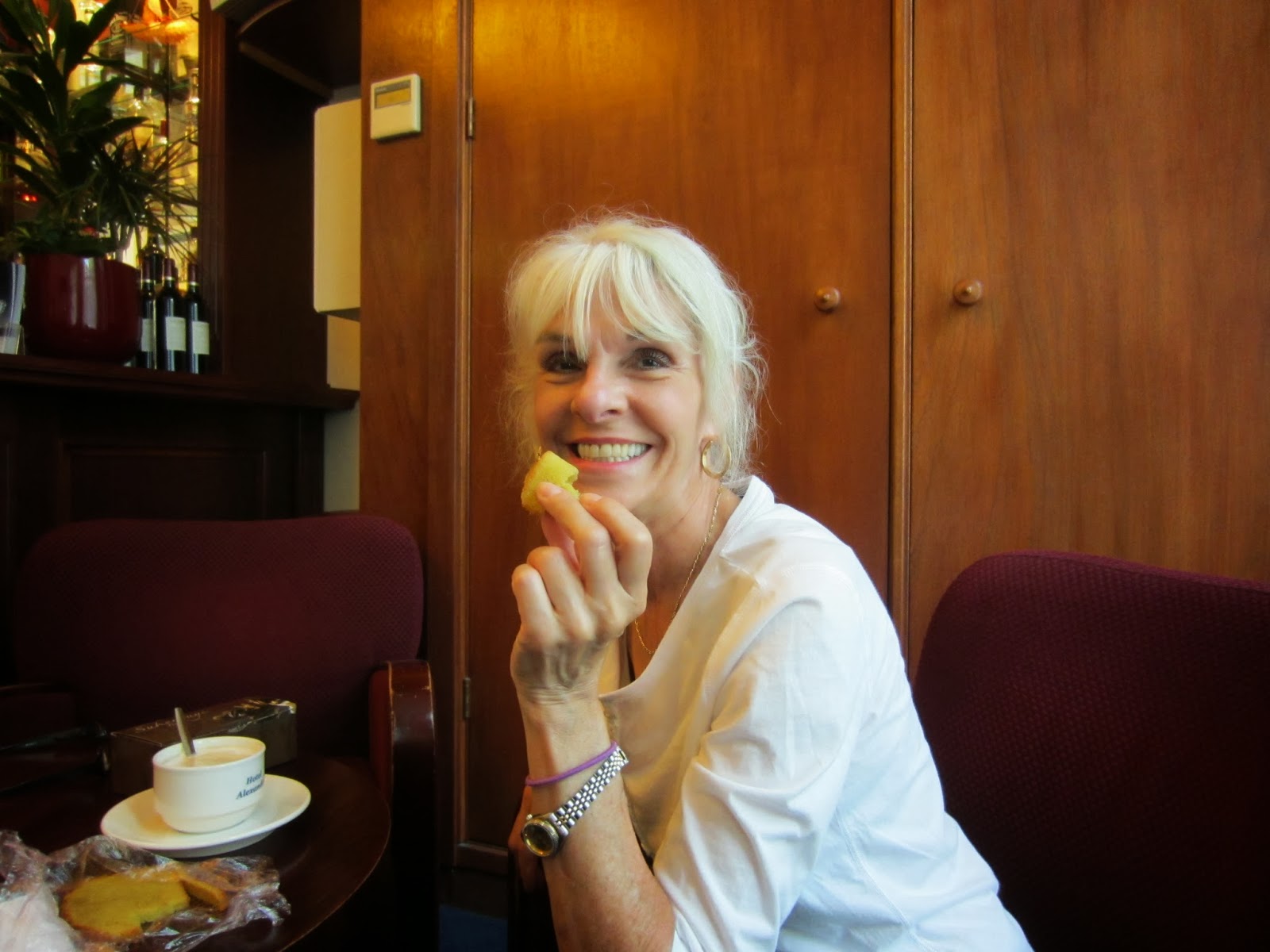
Of course, Sam and I were "forced" to try some fancy drinks and sweets in the fancy café before we continued our treasure hunt. It seems like we're now doing "morning cake and coffee!" Delicious!


Climbing up to the second floor on a staircase which hasn't been replaced since 1885, we entered the Great Hall. With its stained-glass windows, vaulted ceiling, and gilt moldings, this looks like the inside of many cathedrals we've seen on our travels. And it is--a cathedral to Dutch art and history. For more than 50 years, this space was painted over and used as a lobby and gift shop. For the recent restoration, it was returned back to Cuypers' design. The late-Victorian murals on the walls are original, restored after a long absence--the murals were deemed chauvinistic and taken down in the 1920s. They celebrate great moments in Dutch history--lots of explorers and warrior kings.
 
 
Who doesn't recognize Frans Hals' (1581-1666) the "Merry Drinker," which he painted in 1627? This jovial man in a black hat captures the earthy, exuberant spirit of the Dutch Golden Age. The militiaman merrily raises his glass of Berkemeyer to toast us. Hals' bravura painting style--the spontaneously applied brushstrokes enhancing the portrait's sense of liveliness and animation--ensured the continued success of the artist. We were now headed, along with many other museum visitors, to see the famous Vermeer section.
 
 
The master of tranquility and stillness, most of Vermeer's canvases show interiors of Dutch homes where women are engaged in everyday activities, lit by a side window. The Rijksmuseum has the best collection of Vermeers in the world--four of them. (There are only 34 in captivity, including "The Music Lesson" owned by Her Majesty Queen Elizabeth II.)
 
 
In one of my favorites, "The Milkmaid" (1658), a maidservant, entirely absorbed in her work, pours milk  into a bowl. Except for the stream of milk, which you can almost hear, everything else is still. The sign next to the painting explains, "Vermeer took this simple everyday activity and made it the subject of an impressive painting--the woman stands like a statue in the brightly lit room. Vermeer also had an eye for how light by means of hundreds of colorful dots play over the surface of objects."
 
We saw much, much more, like Rembrandt's "Isaac and Rebecca: (a.k.a. "The Jewish Bride", 1667), but our minds were saturated and it was time to move on.
 

Thursday, March 6, 2014

Do You Feel Anything Yet?

 
After touring the Van Gogh museum and returning to the hotel, Sam took a rest while I headed to the lobby for an espresso, some Bruges chocolates, and to test my "cake." I was a little hesitant because I have never indulged in marijuana and didn't want to make a fool of myself--who knew how I was going to react to this soft drug. I had an interesting conversation with the young hotel clerk (very hip and nice--probably the son of the owners) and he was very intrigued (or incredulous?) by my experiment.


I decided to only eat a small piece--not even a quarter slice, as listed on the package instructions. And every 15 minutes, the young man looked over at me and said, "Do you feel anything yet?" I didn't--and just continued reading and relaxing. Eventually, Sam came downstairs and our tour buddies began drifting into the lobby, returning from their afternoon adventures.


It was obvious that I wasn't the only one who had been eating "cake." Bud, the guy from Cape Cod, had already been snacking and looked a little bleary-eyed. And the big, burly retired Brooklyn cop came downstairs wearing an earring! Sam and I hadn't really mixed with any of the group outside of group events so we joined several couples and Bud for a nice dinner that evening. "Do you feel anything yet?"

 
We walked to a lovely restaurant, Bicken, and sat outside; it was a very nice evening and we had a lot of laughs. Closest to the camera are Mike and Peggy from Sonoma, CA; then Pam and Larry from Brooklyn; Bud (waving) from Cape Code; and Herman and Kay from Youngstown, OH.


As you can tell, this was a fairly fancy place (expensive)--small portions of food but displayed beautifully.

 
And by this time, I was feeling something--very, very giggly--more so than usual. And at one time, Sam leaned over and said I was pretty quiet (which is VERY unusual). Besides the intermittent giggling, I remember thinking (again) that I did not want to make a fool of myself. And I was having trouble following the conversations going on around me. By the time someone made it to the end of a sentence, I had lost track of the beginning of it! Very strange.
 
I tried to explain this to the lobby clerk when I returned--because he caught my eye right away and asked, "Do you feel anything yet?" I said that I was really giggly but that could've been because I was drinking wine. His eyes widened and he blurted out, "You were drinking wine, too!?!" "Was I not supposed to?" I asked...


I had complained that my sleep the previous night was like being in a Dali painting--I believed I never slept because objects were constantly flying around in my brain. This night--after eating some "cake"--I again believed that morning arrived without any sleep. But as I lay in a comatose state, the objects (or thoughts) were lazily floating around in my brain and I was entirely calm. The next day, I handed the rest of my "cake" to Bud. I knew it was in good hands...

A Begijnhof, the English Reformed Church, and Lunch at Blue


We have been introduced to Begijnhofs in other cities, a spot that's not only a tourist attraction but a place where people live. This quiet and peaceful courtyard, lined with houses around a church, has sheltered women since 1346 (and is quite a contrast from noisy Kalverstraat, along which we had walked after leaving the "hidden" church).

The Begijnhof was for centuries the home of a community of Beguines--pious and simple women who removed themselves from the world at large to dedicate their lives to God. When first established, it was literally a "woman's island"--a circle of houses facing the courtyard and surrounded by water.


This statue of one of the charitable sisters sits just beyond the courtyard's entrance near the church. The Beguines' ranks swelled during the Crusades when so many men took off--never to return--leaving society with an abundance of single women. Poor and rich alike--as well as those widowed by the hazards of overseas trade--turned their backs on materialism and marriage to live out their days as Beguines in Christian poverty and to serve others.

Very popular for their simple, unpretentious Christ-like dedication, they spent their days deep in prayer and busy with daily tasks--spinning wool, making lace, teaching, and caring for the sick. Though obedient to a mother superior, the members of the lay order were not nuns. In quiet seclusion, they provided a striking contrast to the more decadent and corrupt Roman Church, inspiring one another as well as their neighbors.


We then walked into the brick-faced English Reformed church, which was built in 1420 to serve the Beguine community. In 1578 when Catholicism was outlawed, the Dutch Reformed Church took over many of these Catholic monasteries. Still, the Begijnhof survived; and in 1607, this church became Anglican.


The church served as a refuge for English traders and religious refugees fleeing persecution in England. Strict Protestants such as the Pilgrims stopped in tolerant Amsterdam, praying in this church before sailing to religious freedom in America. In fact, the stained glass at the far end shows Pilgrims praying before boarding the Mayflower. And on the altar sits a Bible from 1763. Amazing history.

We were finally "dismissed" for lunch so Sam and I headed to the third floor of an American-like shopping center. Their "Blue" café, which Hilbren recommended, was modern, intimate, and comfortable with a beautiful view (also "blue" today).


And the food was great, too! We both had sandwiches but mine was an open-faced one with cheese, honey, and pecans. Ahhh, we needed the break and did I mention the view?


We were now fueled up for our next stop, the Van Gogh Museum.

De Papegaai Hidden Church


Continuing along our walk, Hilbren introduced us to some more sites where he thought we might want to explore during our free afternoon. Tucked amongst chain stores on the pedestrian-only Kalverstraat, he invited us into a "hidden church," not uncommon in some cities and countries around the world.
 
In the 1500s, Protestants were fighting Catholics all over Europe. Amsterdam had long made an effort to put business above ideological differences; but by 1578, Protestant extremists took political control of the city. They expelled Catholic leaders and bishops and outlawed the religion, stripping their churches of lavish decorations and converting them into Dutch Reformed churches. Simultaneously, the Dutch rose up against their (Catholic) Spanish overlords, and eventually threw them out.
 

For the next two centuries, Amsterdam's Catholics were driven underground. While technically illegal here, Catholicism was tolerated (kind of like marijuana is these days). Catholics could worship so long as they practiced in humble, unadvertised places, like this church.


It gets its name (De Papegaai) from a parrot carved over the entrance of the house that formerly stood on this site. I read that a stuffed parrot hangs in the nave as a nod to that original papegaai. But I didn't notice that. I know I was zoning out--we passed by and saw lots of stuff on this particular walk.


Today, the church asks visitors for a mere "15 minutes for God" (as the sign says: Kwartier voor God)--an indication of how religion has long been a marginal part of highly commercial and secular Amsterdam. I, of course, noticed the vertical French message along the wooden edge of the board: Un quart d'heure pour Dieu.

Walking the Streets - Westerkerk, the Royal Palace, and Multatuli

After leaving Ludo's coffeeshop (I was surprised how many of us bought a little treat), Hilbren walked us back through the city. I had no idea where we were or where we were going but he pointed out important buildings and continued to teach us some more history along the way. The Rick Steves' guides never stop teaching!

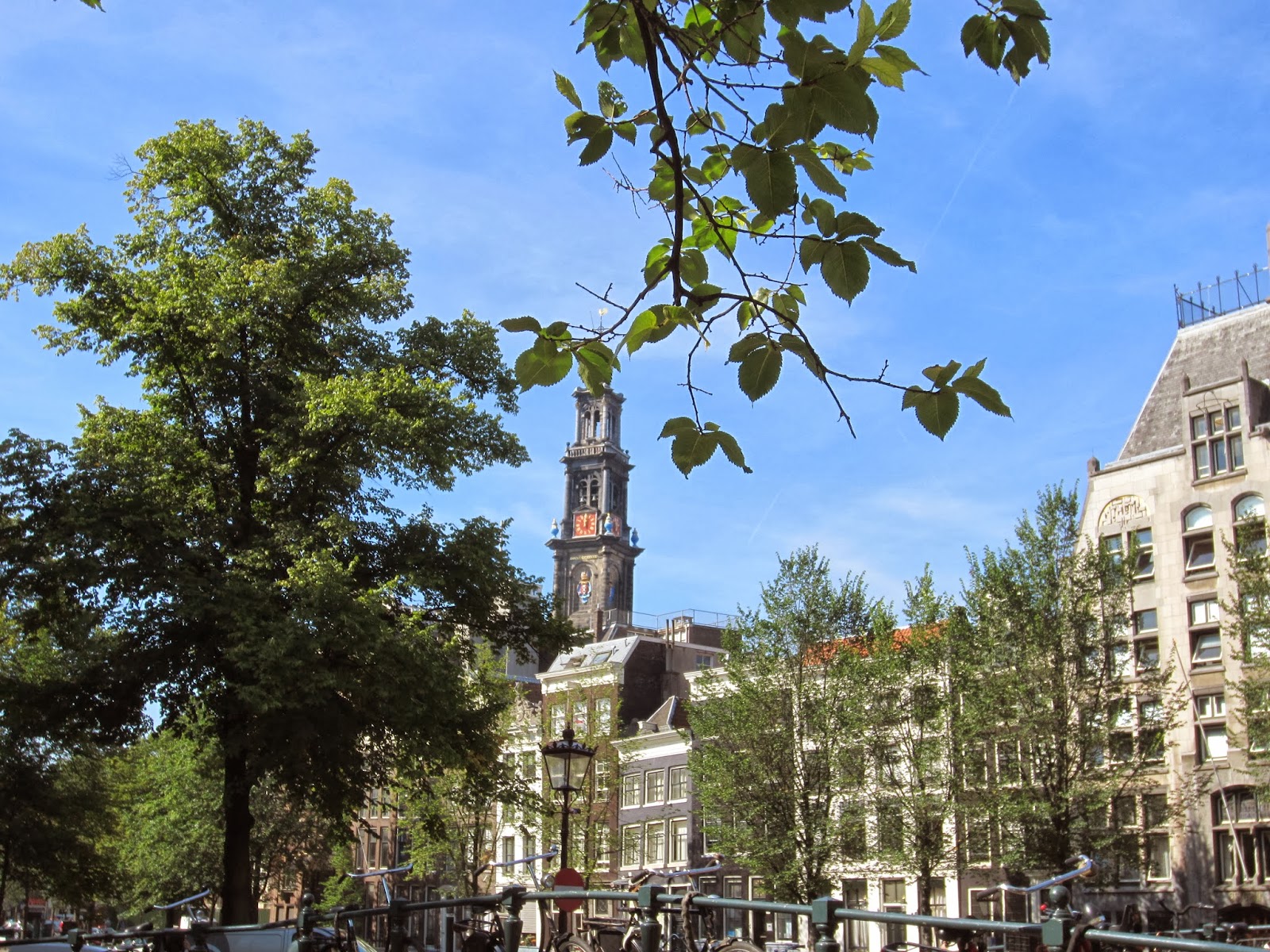
Amsterdam's tallest steeple belongs to the landmark church, Westerkerk (built in 1631), and has a crown at the top (not visible in this photo). It was a gift of the Habsburg emperor, Maximilian I, and as thanks for a big loan, the city got permission to use the Habsburg royal symbol. The tower also displays the symbol of Amsterdam, its three Xs.


Hilbren tells us that Rembrandt's body is buried somewhere under the pews in this church but no one knows exactly where. The church tower's carillon chimes every 15 minutes--although I don't remember noticing this--and play full songs at other times. Invented by Dutch bell makers in the 1400s, a live musician plays the keyboard inside the tower to make the bells of different sizes and pitches "sing." During WWII, the Westerkerk's carillon reminded Anne Frank every day that there was, indeed, a world outside her window.


Amsterdam is one of the cradles of modern democracy. And despite its name, the Royal Palace used to be the City Hall. In medieval times, self-governing Amsterdam prided itself on its independence--thumbing its nose at royalty--and this was where the city council and mayor met. Around 1650, the old medieval town hall was replaced with an classical-styled building, recalling the democratic Greeks. The triangular pediment features denizens of the sea cavorting with Neptune and his gilded copper trident--all appropriate imagery for sea-trading Amsterdam.


The building became known as the Royal Palace in 1806, when Napoleon invaded and installed his brother Louis as king. Even after Napoleon was defeated, the victorious powers dictated that the Netherlands remain a monarchy under a noble Dutch family called the House of Orange. Today, the palace remains one of the four official residences of King Willem-Alexander. (Though Amsterdam is the nominal capital of the Netherlands, all government activity--and the King's actual permanent home--takes place in The Hague, 30 miles away.) Hilbren pointed out that the palace needs to be cleaned. However, city officials, he said, are reluctant to construct the scaffolding to accomplish this because the palace must be presentable at all times in case there is a royal funeral.


At one point, we walked by this "big head" statue honoring a writer known by his pen name, Multatuli. Born in Amsterdam in 1820, Multatuli (aka, Eduard Douwes Dekker) sought his fortune in Indonesia, a Netherlands' colony at the time. His semi-autobiographical novel written in 1860, "Max Havelaar," follows a progressive civil servant fighting to reform colonial abuses, which Dekker witnessed while working as a bureaucrat. He was the first author to criticize Dutch colonial practices--a very bold position back then--and for his talent and subject matter, Multatuli has been dubbed "the Dutch Rudyard Kipling."

Meeting Ludo at Paradox


I was determined not to be a marijuana virgin by the end of this trip. Rick Steves is a big proponent of legalizing the drug in America; and I bet he had some effect on the recent Washington State law enacted in 2013. So, he has added this little side trip to his Amsterdam tours. Education is power, you know.

Most of Amsterdam's downtown coffeeshops--the common label for those selling marijuana (as well as coffee) which must be licensed--feel grungy and ominous to American travelers not part of the youth-hostel crowd. Paradox, owned by Ludo (an old hippie--my perception only--and friend of Rick's), is cozy and more inviting to those of us without piercings and numerous tattoos.


Ludo, the owner for the past 22+ years, was happy to spend 30+ minutes explaining the Dutch approach to marijuana, the history, its laws and the rules regarding its sale, etc. I noticed the menus on the table were for coffee and snacks only--you must ask if you want to see a tobacco menu because it's illegal to advertise.


The retail sale of marijuana is strictly regulated; and people are encouraged not to buy soft drugs on the street. Marijuana purchased in well-established shops is always good quality (much safer with good prices); the minimum age to purchase is 18. Proceeds are taxed and it is a competitive business. Coffeeshops can sell up to five grams per person per day--pre-rolled joints, in little baggies, and in cookies and cake. Owners, Ludo says, have an interest in keeping their trade safe and healthy and maintaining their shop's reputation. Because remember, they cannot advertise.

Authorities want shops to stay small and not become export bases. So each coffeeshop is allowed an inventory of about a pound of pot in stock at one time. This means that a popular shop must withstand the hassle of replenishing stock five or six times daily. Otherwise, it can lose its license. There are about 200 coffeeshops in the city now, and 800 have been closed for not following the rules.


Ludo was anxious to tell us that hemp has been around for centuries. Medieval bibles and even the Declaration of Independence are written on hemp; hemp paper, in fact, lasts longer than regular paper). Glaucoma, menstrual cramps, MS, cancer, seizures, side-effects from radiation--all are helped by smoking or ingesting weed. It improves your appetite and health quality without the side effects of other medical drugs.

When smoking weed, Ludo explained, the effects go straight to the brain. However, it may take 30-60 minutes to feel the effects after eating a cookie or brownie, for example, or less if you're eating it on an empty stomach. And those who overdo? The "fix" is to drink a Code, which is full of sugar. "No one dies from weed," says Ludo. "It would take about 2,000 kilos of marijuana to kill a person."


Ludo's partner, Wiljan, was also very informative, patient with descriptions, and happy to help us with our choices. During Ludo's presentation, it suddenly dawned on me--a non-smoker--that it made more sense to eat a cookie than attempt to smoke. So for six euros, I bought a slice of pound cake, which included one gram of pot. Wiljan explained that since I have never tried marijuana, I should only eat a quarter of it at first so I can determine how it effects me.


Soooo, when will I slip this into our schedule and what will happen??

Wednesday, March 5, 2014

The Anne Frank Museum


The Netherlands had been neutral during the Great War; and progressive and modern--but a bit naïve--Amsterdam was in for a rude awakening during WWII. In May 1940, Germany began bombing Schiphol Airport as they prepared to invade the Netherlands. When the Dutch army fought back, the Nazis responded by leveling Rotterdam. A week later, the Netherlands surrendered; Queen Wilhelmina fled to Britain; and the Nazis began a five-year occupation.

Our first stop today was this thoughtfully-designed exhibit, which offers thorough coverage of the Frank family story. This is my third visit to the museum--the first being in 1989 before they remodeled the entrance. The museum is a fascinating--and sobering--look at the hideaway of young Anne during the Nazi occupation. Anne, her parents, an older sister, and four others spent more than two years in a "Secret Annex" behind her father's business. While in hiding, as we all know, 13-year-old Anne kept a diary chronicling her extraordinary experience.


One day in August 1944, the Nazis--acting on a tip--arrested the group and sent them to concentration camps in Poland and Germany. It really hits you when you remember that this was after the Normandy landings which signaled the end of the war. Unfortunately, and even though Anne's family knew of the landings, it was not in time to save them. Anne and her sister died of typhus in March of 1945, only weeks before their camp was liberated. Of the eight inhabitants of the Secret Annex, only Anne's father, Otto Frank, survived.

We filed into a meeting room and listened to a really honest and moving presentation from a docent. As she explained, the front part of the building, facing the canal, remained the offices and warehouses in an operating business owned and run by Otto Frank, Anne's father. The back half, where the Franks and others lived, was the Secret Annex, its stairway entrance concealed by a bookcase. All the windows were blacked out so they could not be seen from the street or courtyard and they had to be silent all day--no talking, no flushing, no moving around--so the factory workers below would not hear them.


We were allowed to take photos in this meeting room but not within the annex. We followed many tourists up narrow stairways and through rooms where, for 25 months, the eight Amsterdam Jews hid from Nazi persecution. Really, it was genius--this house behind a house, within a house, tucked within the city in broad daylight. To this day, we still don't know the identity of the person who tipped off the police. And now knowing they were so close to liberation--such a shame.


Sam and I were the last ones out, I think, because I spent so much time taking photos in the meeting room before we headed up the steps. And I have always wanted to buy Anne's book at the museum so I got that crossed off my list. (This might be the last time I'm in Amsterdam.) It came with a commemorative bookmark and a sticker inside the book confirming its purchase at Anne's huis; so I was happy I bought it here.