Showing posts with label Artist. Show all posts

Friday, March 7, 2014

The Outdoor Gardens of the Rijksmuseum


As we left the museum, our paths took us through the relaxing Rijksmuseum garden, also restored with an eye to Cuypers' original vision. It features statues, fountains, ponds, and five centuries of Dutch architectural artifacts.


Sam hopped into the middle of this fountain--and escaped without a drop.

Sculptures by Henry Moore (1898-1986), one of the most influential artists of the 20th century, are featured in the gardens. His monumental figures seem abstract, yet are clearly inspired by natural forms. On Moore's walks across the rolling English countryside, he would often collect animal bones which he sometimes literally transformed into sculptures.

A key theme in Moore's oeuvre is the reclining figure, in which the human body acquires a landscape-like quality. He tried to express--in stone or bronze--the energy he felt in nature: "I would like to think my sculpture has a vitality from inside it."


For example, his "Reclining Woman: Elbow" (above) was placed at the main entrance of the Leeds (England) City Art Gallery in 1982. Detractors complained: "Puzzling, suggestive, ridiculous, and diabolical," the Yorkshire Post commented. But that changed. When the sculpture was removed to be shown at the Rijksmuseum, the newspaper wrote, "You'll miss her when she's gone."


The sensual curves of the "Two Piece Reclining Figure: Cut" are interrupted by the incision in the center. Yet this also creates space, like the eye at the top (not visible in this photo), through which the sky appears. These hollows are typical of Moore's exploration of the sculpture's connection with its environment.


Henry Moore isn't the only sculptor featured in these gardens. "Mercury and Psyche" is a copy of a famous work by Adriaen de Vries now in the Louvre. De Vries worked at Giambologna's studio in Italy and for Emperor Rudolf II in Prague. As a result, he enjoyed considerable fame abroad, while remaining relatively obscure in the Netherlands. This copy was commissioned in 1890 for the Rijksmuseum garden.


I was also fascinated with this beautiful "street art" displayed in a shallow pond stretching out in front of the museum. We wandered around the neighborhood after leaving the museum, looking for a pastry shop my friend asked me to locate. We gave up after about 30 minutes and ended up at a souvenir shop where we bought some t-shirts. Then it was time for some lunch.

Rembrandt's "Night Watch "

This is one of the most famous and well-known paintings hanging in the Rijksmuseum and deserves a separate post. As usual, the more you learn about a painting, the more interesting it becomes. Rembrandt's masterpiece, the "Night Watch," his most famous--though not necessarily greatest--is a group portrait of a company of Amsterdam's militiamen, the city's civic guard. Rembrandt made the painting in 1642 at the age of 36 for their guild headquarters, the Kloveniersdoelen. It hung in the large assembly room, together with six other group portraits.
 

Standing in the foreground are Captain Frans Banninck Cocq (in black with a red sash) giving an order and Lieutenant Willem van Ruytenburch, focusing on the captain's every word. That Rembrandt depicted the militiamen in action is quite exceptional; until then, "sitters" in such group portraits were either standing or sitting stiffly next to one another.

The painting is full of action: flags waving, drums beating, the guardsmen (who, by the 1640s, were really only an honorary militia of rich bigwigs) spilling onto the street from under an arch in the back. It's "all for one and one for all" as the soldiers grab lances, load their muskets, and rush to Amsterdam's rescue.

Rembrandt used light to emphasize important details, such as the captain's hand gesture and the girl in the pale dress. She is probably the civic guard's mascot and is one of the figures Rembrandt added to animate the composition. The drummer at the far right and the boy running at the left were added for similar reasons.

The painting was a smashing success in its day. However, there are elements in it that show why Rembrandt soon fell out of favor as a portrait painter. He seemed to spend as much time painting the dwarf and the mysterious glowing girl with a chicken as he did the faces of his employers.

But Rembrandt caught the optimistic spirit of Holland in the 1600s. Its war of independence from Spain was heading to victory and the economy was booming. These guardsmen on the move epitomize the proud, independent, upwardly mobile Dutch. Compared with other, less famous group portraits, where every face is visible, well-lit, flat, and flashbulb-perfect, these people paid good money to have their faces preserved for posterity, and they wanted to be right up front. Other group portraits may be colorful, dignified works by a master...but not quite masterpieces. Rembrandt rousted the Civic Guards off their fat duffs. And by adding movement and depth to an otherwise static scene, he took posers and turned them into warriors--a simple portrait became great art.


Some other "Night Watch" scuttlebutt. First, "Night Watch" is a misnomer since it's a daytime scene. But over the years, as the preserving varnish darkened and layers of dirt built up, the sun set on this painting and it got its popular title. When the painting was moved in 1715 from the large hall of the Kloveniersdoelen to a smaller room in Amsterdam's town hall, three sides were lopped off so it would fit in between two doors in its new location! This resulted in putting the two main characters in the center and causing the work to become more static than intended. (Unfortunately, the pieces were lost.)


During WWII, when the Nazis where "shopping" for art throughout Europe, the painting was rolled up and hidden for five years. In 1975, a madman attacked it, slicing the captain's legs; and in 1990, it was sprayed with acid (skillfully restored after both incidents). Such a dramatic history.

Rembrandt's life darkened long before his "Night Watch" did. This work marked the peak of his popularity...and the beginning of his fall from grace. Free from the dictates of employers, he painted what he wanted and how he wanted. Rembrandt went beyond mere craftsmanship to probe into, and draw life from, the deepest wells of the human soul.


On our way out of the museum, a person is usually forced into the gift shop. This was a fun construction game for children based on the famous painting. But we didn't indulge in any retail therapy here today.

By the way, "Night Watch" is now back in its original position in this beautiful gallery at the center of the museum, exactly where architect Cuypers had originally placed it in 1885. And it is always surrounded by mobs of people.

Thursday, March 6, 2014

Rembrandtplein and Other Street Art

The site of this leafy square was another city gate in the defensive walls constructed to protect the city in the Middle Ages. It was renamed Rembrandtplein when this cast iron statue by Louis Royer (1793-1868) was moved here in 1876. Cast in one piece, it is Amsterdam's oldest surviving statue in a public space and stands on a grey granite base bearing a replica of Rembrandt's signature. Coincidently, the square is near where the famous painter owned a house from 1639 to 1656.
 
 
As part of the artist's 400th birthday celebration in 2006, Russian artists Mikhail Dronov and Alexander Taratynov made bronze-cast representatives of a jaunty group of statues from his most famous painting and displayed them around Royer's work. We'll be seeing the "Night Watch" tomorrow at the Rijksmuseum.
 
Evidently, this is quite a lively area, especially with late-night dance groups who party here into the wee hours. Sam and I just wandered upon it while we were looking for a pharmacy on our way home from the Van Gogh Museum. She hoped to find some heat packs for her black eyes.
 
 
We also came across this rough clay statue reclining on a half roof outside a restaurant. As I snapped the photo, some guy sitting in a courtyard said something about sharing in the profits from my photograph. Huh? And because he wasn't smiling, I pretended I didn't speak English (again) and kept walking.


Which way do we go? Actually, we knew where we were when we got back to the museums. Circular route, anyone? And after stepping into a hotel along the way to ask about the nearest pharmacy (which was just around the corner), Sam discovered that any heat pads they had for sale were w-a-y too big for her face.

Vincent van Gogh, the Man


"I am a man of passions," said Vincent van Gogh (1853-1890).

When I read Van Gogh's letters to his brother Theo, I was surprised to learn they were sons of a pastor and, in fact, Vincent toyed with becoming a minister. Although his first job at age 16 was clerking for an art dealership, his two interests--art and religion--distracted him from his dreary work and he was eventually fired.

The next ten years were a collage of dead ends as Vincent bounced around northern Europe (England, France, Belgium, and the Netherlands), pursuing one path after another. In his letters to Theo and their parents, he writes of launching into each project with incredible energy, then becoming disillusioned and moving on to something else: teacher at a boarding school, assistant preacher, bookstore apprentice, preacher again, theology student, English student, literature student, art student. He fell in love but was rejected; he quarreled with his family and was estranged; he lived with a prostitute and her daughter, offending the few friends he had. Finally, in his late 20s, worn out, flat broke, and in poor health, Vincent returned to his family and made peace. That's when he started to paint.


The self-portrait by the artist (top) was painted in 1888 while he was living in Paris with Theo (March 1886 - February 1888). The budding young artist proudly displayed his new palette full of bright new colors. He was trying his hand at Impressionism techniques--building a scene using dabs of different-colored paint. A whole new world of art--and life--had opened up to him in Paris.


While there, along other Impressionist painters, Vincent learned the shimmering effect which comes from placing dabs of different colors side by side on the canvas. At a distance, the two colors blend in the eye of the viewer to become a third color. In the "Self-Portrait with Straw Hat" above (1887), Vincent used separate strokes of blue, yellow, green, and red to create a brown beard--a beard which seems to throb with excitement.

"You wouldn't recognize Vincent, he has changed so much... The doctor says that he is now perfectly fit again. He is making tremendous strides with his work... He is also far livelier than he used to be and is popular with people." - Theo van Gogh to their mother


Van Gogh's use of color is world-famous. Many of his theories can be traced back to that of complimentary colors. In "Irises," yellow and purple--colors that reinforce each other, according to the theory--thus maximize their effect. The purple (a mixture of red and blue) is now mainly blue, since the red pigment has faded.

Despite his new sociability, as referenced by Theo, Vincent never quite fit in with his Impressionist friends. As he developed into a good painter, he became anxious to strike out on his own. Also, he thought the social life of the big city was distracting him from serious work. Wanting peace and quiet, a place where he could throw himself completely into his work, he headed for the sunny south of France.


"The worse I get along with people, the more I learn to have faith in Nature and concentrate on her."

He saw sunflowers as his signature subject and he painted a half-dozen versions of them, each a study of intense yellow. Even a simple work like the one above, painted in 1889, bursts with life. But during his time in Provence, he swung from flurries of ecstatic activity to bouts of great loneliness. And after his friend, fellow artist Paul Gauguin, arrived, things went sour very fast. This began his spiral into "acute mania with hallucinations," as diagnosed by an Arles' doctor. (By the way, in January 2014, the painting above was displayed at London's National Gallery next to the sunflowers he painted in 1888--the first time in six decades they have been hung side by side.)


Vincent spent some time--productive time, actually--in a St. Remy mental hospital, still painting as his health seemed to improve: pictures of his hospital room, the gardens of the asylum, and landscapes (when he was allowed outside) like "The Garden of Saint Paul's Hospital" painted in 1889 (or, as it's also known, "The fall of the leaves"). The stark brown trees are blown by the wind, and a solitary figure (Vincent?) makes his way along a narrow winding path as the wind rains leaves down on him. The colors are surreal--blue, green, and red tree trunks with heavy black outlines. A road runs away from us, heading nowhere.

How much of these paintings reflect Vincent's spiral into total depression and finally putting a bullet through his chest? Although his life was sad and tragic, the record he left us is one of beauty. And I'm beginning to appreciate that beauty more and more.

Believe it or not, Vincent sold only one of his canvases during his lifetime--to a woman in Brussels. In 1987, one of his "Sunflowers" sold for $40 million and three years later, a portrait of his doctor for more than $80 million. Sadly, this "famous after the fact" was not uncommon for some of Europe's most renown artists.

The Van Gogh Museum


In 2000, on Sam's first trip to Amsterdam, neither one of us had any interest in Vincent van Gogh. Not only that, we only had about 45 minutes to visit the museum that day and chose, instead, to enjoy the sunshine and vast green space between the Rijksmuseum and Van Gogh's.

But tastes change--or mature. We are now more interested in Vincent--I've been studying and reading about him for the past several years--and we were both looking forward to discovering and exploring the place. So we used our free Thursday afternoon to visit his remarkable museum, which features works by the troubled Dutch artist--works of art which seem to mirror his life.


Vincent, who killed himself in 1890 at age 37, is best known for sunny, Impressionist canvases that vibrate and pulse with vitality. The museum's 200 paintings--which offer a virtual stroll through his work and life--were owned by Theo, Vincent's younger, art-dealer brother. Paintings were divided into five periods of his life--the Netherlands, Paris, Arles, St. Remy, and Auvers-sur-Oise.

The mix of his creative genius and his tumultuous life makes the museum as much a walk with Vincent as with his art. In fact, the paintings, arranged chronologically, leave a series of suicide notes and begin with some dark, gray canvases showing the hard, plain existence of the Dutch people--simple buildings, barren trees, and overcast skies--a world where it seems spring will never arrive.


"The Potato Eaters," painted in 1885, reflects a dark, cramped room lit only by a dim light and poor workers helping themselves to a steaming plate of potatoes. Van Gogh gave their heads "something like the color of a really dusty potato, unpeeled, of course." In line with the theory he was studying at the time, he obtained all his colors by mixing the primary colors red, yellow, and blue. The artist produced a large number of preparatory studies in the cottage of the peasant family that we see eating their meal here, but he made the final painting in his studio.


We really liked the displays and the very interactive audioguide. In fact, it was a SmartPhone-like device and while standing in front of a painting, we'd sometimes receive an email from Vincent. And if I could figure out how to open it....it was intriguing to read the information he provided about a painting or technique. Like the email about the "Courtesan" he painted in 1887.


In Van Gogh's day, many artists were keen collectors of Japanese prints, which presented them with a fresh way of looking at composition, the use of color, and perspective. In fact, Vincent and Theo built up a collection of their own Japanese prints. The "Courtesan" painting was based on a cover illustration for a magazine on Japanese art, using other models for the surrounding landscape which also displayed water plants, a frog, and a crane.


"The Bedroom" was painted in 1888--his actual bedroom in his "yellow house" in Arles--and this was the first version. The second version is in Chicago's Art Institute and the third, in Paris's Musee d'Orsay.

I really liked the openness of the museum, the bright wall colors--the same colors Vincent used--how the paintings were displayed, the general feel of the museum. I think Sam enjoyed it, as well.

Tuesday, March 4, 2014

The Vermeer Center


The great Dutch Golden age painter, Johannes Vermeer, was born in Delft in 1632, grew up near the Markt, and staged a number of his paintings here. His father, an art dealer who had an inn where many local artists met, gave Johannes a passion for painting and allowed him to meet other masters who had a formative influence on his life. From 1645 to 1660, Delft was a breeding ground for painting talent, where artists experimented with light, perspective, and space. Vermeer also met with his contemporaries in the Saint Luke's Guild (today's home to the Vermeer Center) and the city's taverns.

All over Europe in the 17th century, artists lived on commissions they received from the church and royal houses. However, in Holland at that time, these were both missing. There, ordinary citizens bought paintings on the open market, and every household had seven or eight hanging on their walls.


Late in the artist's career, with Holland fighting wars against England, the demand for art and luxuries went sour for the Dutch, forcing Vermeer to downsize. He sold his big home, packed up his wife and 15 children (!), and moved in with his wealthy mother-in-law, Maria Thins. He suddenly died two years later at age 43 in 1675, leaving his wife with eleven remaining children and a mountain of debt.


Vermeer painted landscapes and scenes from mythology and the Bible but he specialized in depicting the everyday actions of regular people. And though his scenes are usually still and peaceful, he artfully conveys deep tension and suggests a complicated story with subtle body language--for example, the subject glances at something out of view--or the inclusion of a small item, like a letter which seems significant. Vermeer also was a master of light, capturing it with an artistry that would make the Impressionist painters jealous over two centuries later.


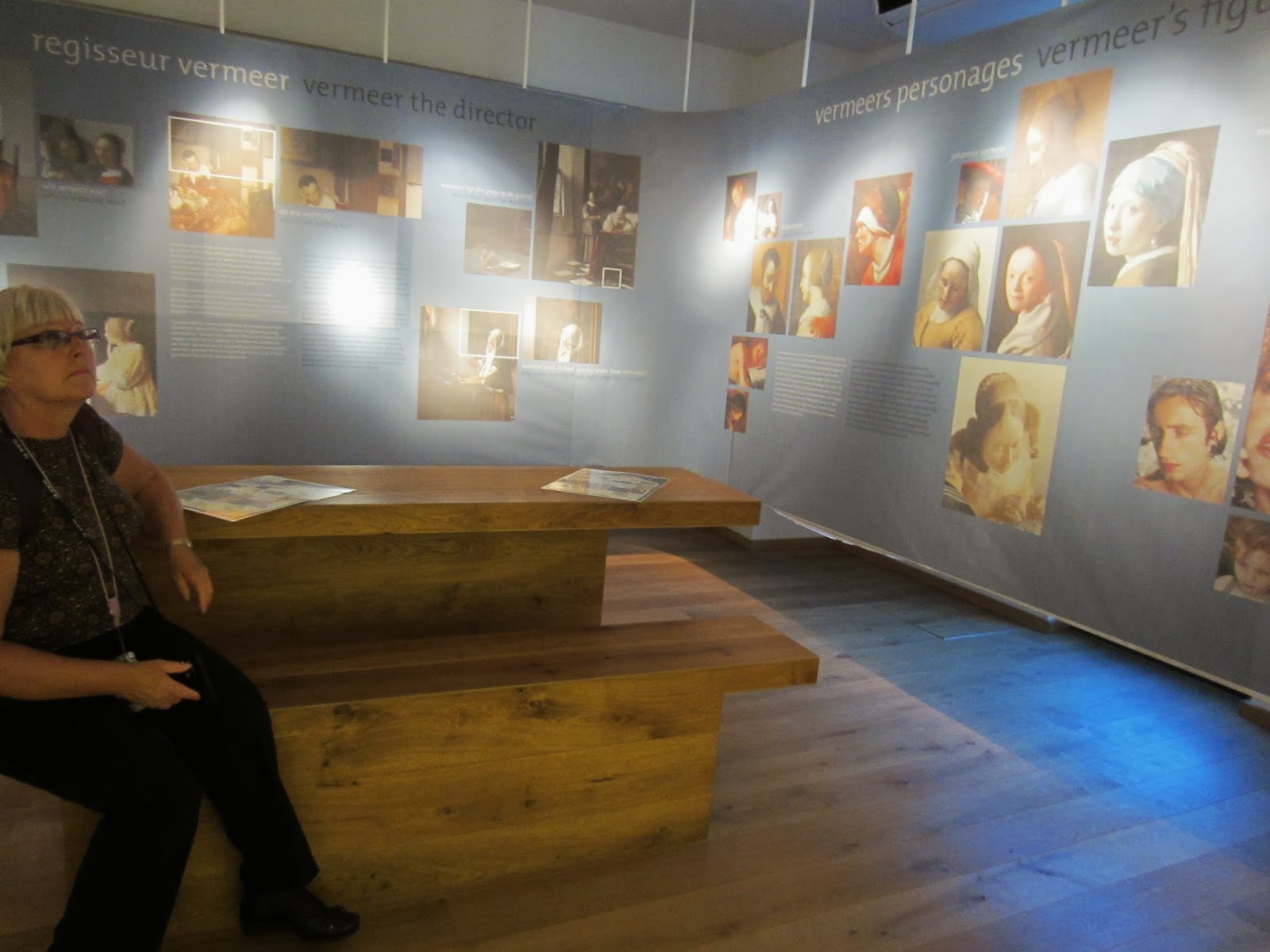
Sam and I were really impressed with the Vermeercentrum. The intelligent exhibit did a great job of tracking the career and unique creative mind of Delft's favorite resident. After watching a short movie in the lower level, we spent nearly two hours wandering through the three-story building.

Copies of all 37 known paintings by Vermeer are arranged chronologically and accompanied by brief and interesting commentary. There is not 100% agreement on how genuine three of the paintings are. It is thought that Vermeer produced between 40 and 60 paintings during his life--all in all, an unusually small body of work.


There's a mock-up of his studio, where his techniques are thoughtfully analyzed and explained, plus an exhibit detailing the hidden symbols of love found in many of his paintings and his use of light. Much of that was w-a-y more than I needed to know but very intricate and impressive.


History still knows very little about Vermeer; he left no diaries or letters. After centuries of relative obscurity, he and his paintings are now appreciated. They are a world full of light, peacefulness, and mysterious stories, a world that captivates our attention and respect today.

Delft owns none of his works, which I think is really tragic. The lady at the welcome desk told us they can't afford any of Vermeer's original works. However, this beautifully designed and displayed center pays proud tribute to their favorite son and his talent.


Painting #1 - The top painting in this post is Vermeer's "View of Delft" (1660-1661), a large-scale landscape of the Port of Delft at an unusually peaceful moment. It is a Sunday? The sun illuminates the New Church's tower and the shadow of the clouds changes colors. It currently hangs in the Hague.

Painting #2 - In the "Officer and Laughing Girl" (1655-1660), the face of the young girl--as seen over the broad shoulders of a soldier--is shining in the sunlight streaming into the room, reflecting off the leading between the window panes and the nails in the chair. The same sunlight is probably shining on the gentleman opposite her. The painting is part of the Frick Collection in NYC.

Painting #3 - The question of where this scene in "The Little Street" (1657-1661) was observed is still open for debate. A weekday afternoon in Delft, it is a convincing look at the beauty of ordinary life in the 17th century: women busy with their chores and children playing. This painting hangs in Amsterdam's Rijksmuseum, which we would see in a few days.

Delftware Porcelain


Sam began collecting Delftware, I believe, during our first trip to Delft in 2000. We found our way that day to the town's biggest tourist attraction, the Koninklijke Porceleyne Fles, the original Delft Blue earthenware factory famous worldwide. It was a confusing and time-consuming walk (about 15-20 minutes, if I remember correctly) from the train station through the Markt. Sam is allergic to public transportation so we walked very quickly! We didn't know where we were at the time, never having been here, plus we were subject to the train schedules to and from Haarlem.


The Dutch East India Company, partly headquartered in Delft, imported many exotic goods from the Far East, including Chinese porcelain. Those designs became trendy and were copied by many local potters. Three centuries later, their descendants are still going strong in that factory. But there are two other (of the original 32) authentic makers still existing in Delft.


On this morning, our group tour ended at one of the last three, De Candelaer (the candlestick). This shop is owned by Stephan (wearing a New York City t-shirt), a fourth generation artisan who began making the famous porcelain at age 15. Now, the next generation is already in training as per the photo of Stephan's son hanging in the studio! Annie, his only employee, does all the painting--she told Sam and me that she has been doing it for about 40 years and began her career at the famous main factory, the one we visited in 2000. (She was already working for Stephan by that time.)


Stephan has an interesting set-up in his back room, where he demonstrates the manufacturing process by showing porcelain samples at different stages in the steps. It is a time-consuming process because each piece takes eight days to complete.


The earthenware is made from a soupy mix of clay and water, which is either rotated on a spinning disk (for plates) or poured into hollow molds (vases, cups, etc.). The porous molds work like a sponge, sucking out the water to leave a layer of dry clay along the walls of the molds. After the clay object is removed from the mold, it is fired in a kiln for 24 hours.


Pottery removed from the kiln--referred to as a "biscuit" now--is handed to Annie, the painter, who traces traditional decorations with sable-hair pencils onto the piece. These are then painted with a black paint containing cobalt oxide, which is immediately soaked up by the biscuit. Then the objects are dipped into an opaque white glaze and fired a second time. The black paint is transformed into the famous Delft Blue by a chemical reaction; and the white glaze melts into a translucent glass-like outer layer.


Stephan also explained the difference between the mass-produced versus the unauthentic pieces. You need to look for one of three symbols--each specific to the three Delft makers--to confirm a piece's authenticity. It will also say "Delft." Decals identifying pieces from China--and not authentic--say "Delft Blue." And the word "hand-painted" signals that only one small thing on the piece is actually hand-painted--not the entire surface design. Also, a crown on the decal indicates a fake.


Sam was very happy--she found a tea set which she ordered. After Stephan showed her unfinished samples, she told him what pieces she want. He finally responded--he was frankly incredulous, in my opinion: "You didn't even ask me how much these cost?" Sam flipped her hand in the air and said, "It doesn't matter."


Remember now, this was the morning of Sam's fall, her dull headache, and the continual swelling and blackening of her eyes. I guess shopping was the best way to take her mind off her medical issues, as tour buddy Kristy and I concluded! What a trooper.

Delft's Old Church


The Oude Kerk is a Dutch Reformed house of worship and Delft's oldest parish church. It was officially founded in 1246, the same year in which Delft received city rights from Count William II, even though it is generally assumed that there had been a wooden church on this site as early as 1050. Names of its ministers, going back to 1572, fill an inside wall.


The Gothic tower reflected in the canal, with its brick spire and four turrets, was added between 1325 and 1350. The church is sober and clean because of iconoclastic riots in 1566 and 1572, which made a violent point of destroying all hints of Roman Catholicism and its imagery.


Within the church are the tombs of two local boys done good: the inventor of the microscope, Anton van Leeuwenhoek, and the painter Johannes Vermeer. Vermeer's actual tombstone is just a simple stone plaque in the floor. It is across from the pulpit (below), which dates from 1548, the only item inside the church surviving the riots in the mid-1500s.


When Vermeer died, he was broke; and the cost for a stone was determined by the size of the grave. To save money, Vermeer's family supposedly buried him standing up--the reason the stone is so small. The sign on the pedestal, however, says this marks the "spot where the grave used to be."


Although another, more grander Vermeer monument was installed in the church in 2007--a reflection of his greater popularity now than in previous generations--the exact location of his body in the church is unknown today.

Sunday, March 2, 2014

More about the Jan Van Eyck Plein


This is the square I've mentioned before, the one where Sam and I enjoyed our afternoon "coffee and cake"--more than once! During our morning tour on the first day with local guide, Daniella, she stopped here to explain the surrounding buildings.


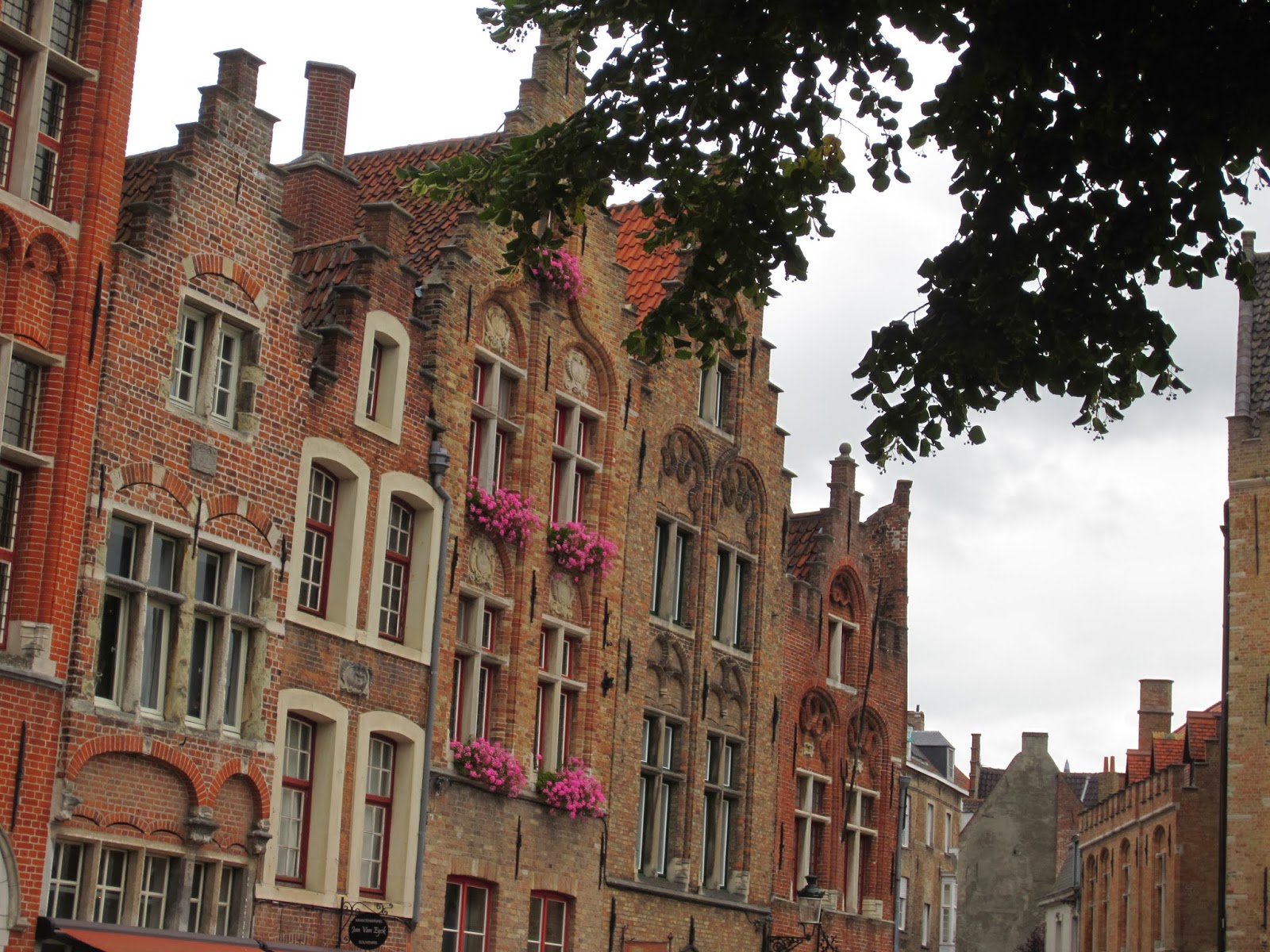
This part of Bruges began to develop from the year 1200, when the area near the canals became a thriving port. The current square was built centuries later, in the 18th century, when some of the canals were vaulted. Even today, the water still flows beneath our feet here. Several buildings were restored in the 19th century, including the Toll House, which is one of the oldest existing brick buildings in the city. In the Middle Ages, tolls on imported goods were paid in this building; today, it houses the Provincial Information Center and Library.


The 19th century statue of the artist is prominent in the square. In the above photo, Van Eyck is on the right, with his back to the canal and looking over his plein. Close by, down another little street, is one of the two authentic wooden façades in the city. From the 17th century onwards, it was prohibited to build wooden façades and existing ones were torn down because of the fire hazard.

And, of course, our favorite Bruges' café is here. It is the one with the red umbrellas.